Rajasthan to Host Fifth Edition of Lokmanthan: CM Office
Synopsis
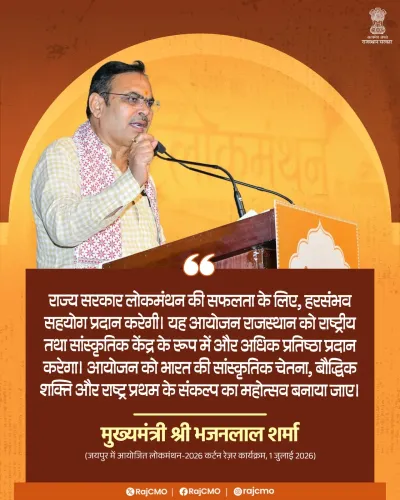
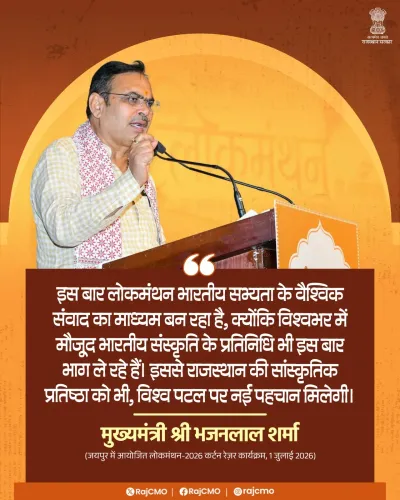
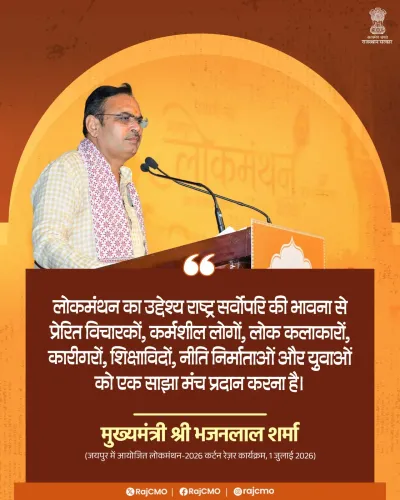
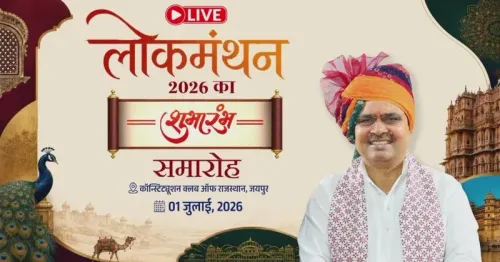
The Chief Minister's Office of Rajasthan announced on 2 July 2026 that Rajasthan will host the fifth edition of Lokmanthan, a national cultural-intellectual conclave founded in 2016 on the theme of liberation from colonialism. CM Bhajan Lal Sharma's office called the hosting a matter of pride for the state.
Key Takeaways
The Chief Minister's Office of Rajasthan announced on 2 July 2026 that the state will host the fifth edition of Lokmanthan .
Lokmanthan was launched in 2016 with the theme of liberation from colonialism and focuses on indigenous knowledge traditions.
Chief Minister Bhajan Lal Sharma of the BJP government in Rajasthan is associated with the hosting announcement.
The event brings together cultural intellectuals, scholars, and state cultural departments from across India.
Specific dates, venue, and participating scholars for the Rajasthan edition have not yet been announced.
The hosting aligns Rajasthan with a broader BJP-governed-state pattern of foregrounding decolonisation and civilisational discourse.
The Chief Minister's Office of Rajasthan announced on Thursday, 2 July 2026 that the fifth edition of Lokmanthan will be held in Rajasthan, calling it a matter of pride for the state. The post, attributed to the office of Chief Minister Bhajan Lal Sharma, highlighted the conclave's founding theme of liberation from colonialism, which has anchored the event since its inception in 2016.
Context
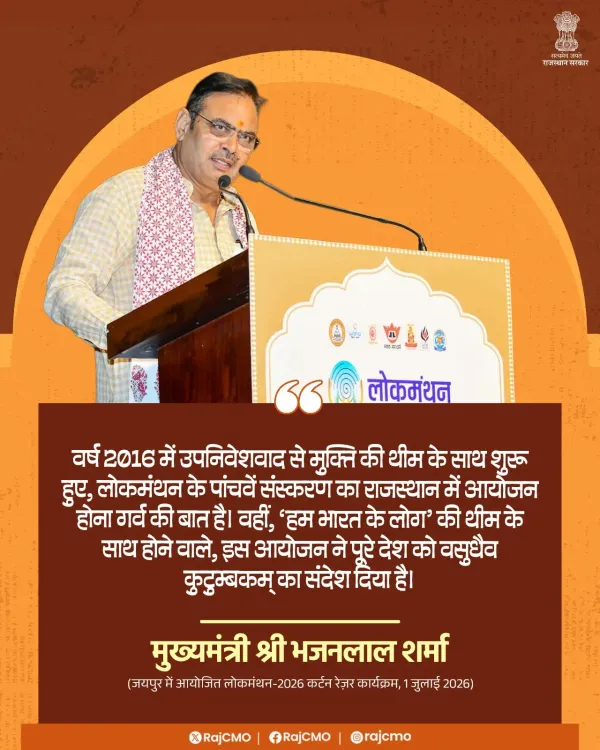
The CMO's post read: 'Varsh 2016 mein upaniveshvaad se mukti ki theme ke saath shuru hue Lokmanthan ke paanchve sanskaran ka Rajasthan mein aayojan hona garv ki baat hai' — translated as: 'It is a matter of pride that the fifth edition of Lokmanthan, which began in 2016 with the theme of liberation from colonialism, is being organised in Rajasthan.' The statement was accompanied by the hashtag #AapnoAgraniRajasthan ('Our Pioneering Rajasthan'), a branding phrase associated with the Sharma government's public outreach.
Lokmanthan is a national cultural-intellectual conclave that was launched in 2016 with an explicit focus on decolonisation and the revival of indigenous knowledge traditions. The platform brings together scholars, thinkers, and cultural practitioners to deliberate on civilisational themes rooted in Indian heritage.
Policy Backdrop
Since its founding, Lokmanthan has been held across different states, each edition deepening its engagement with what organisers describe as India's pre-colonial intellectual legacy. The selection of Rajasthan for the fifth edition places the state at the centre of a nationally significant cultural conversation.
Chief Minister Bhajan Lal Sharma, who leads a BJP government in Rajasthan, has aligned state cultural programming with broader central government emphasis on Indian knowledge systems, national pride, and what is often termed 'decolonisation of the mind.' Hosting Lokmanthan fits squarely within that policy orientation.
Stakeholders and Impact
The conclave typically draws participation from cultural intellectuals, academics, policy thinkers, and representatives of state cultural departments. For Rajasthan, hosting the fifth edition signals an elevated role in national cultural discourse and is expected to generate significant intellectual and civic engagement within the state.
The event also carries symbolic weight: Rajasthan's rich history as a centre of art, literature, and civilisational continuity makes it a fitting venue for a conclave centred on reclaiming indigenous narratives. State cultural bodies and civil society organisations are likely to be closely involved in the event's organisation and programming.
What's Next
Specific details — including the dates, venue, and list of participating scholars for the Rajasthan edition — are yet to be officially announced. Observers will watch for any follow-up declarations from the state government on cultural policy that may accompany or emerge from the conclave.
If past editions are any guide, Lokmanthan Rajasthan 2026 could serve as a platform for the state to articulate a broader vision for indigenous knowledge, education, and cultural heritage — potentially influencing state-level policy in these domains in the months ahead.
Point of View
A state with deep historical and civilisational roots, lends the fifth edition both symbolic and strategic weight. How the state translates the conclave's intellectual outputs into concrete cultural or educational policy will be the real test of its commitment to this agenda.
NationPress
30 Sept 2026
Frequently Asked Questions
What is Lokmanthan and when was it started?
Lokmanthan is a national cultural-intellectual conclave launched in 2016 with the theme of liberation from colonialism. It focuses on indigenous knowledge traditions and civilisational discourse, and has been held across different Indian states since its inception.
Which state is hosting the fifth edition of Lokmanthan?
Rajasthan has been announced as the host for the fifth edition of Lokmanthan, as confirmed by the Chief Minister's Office on 2 July 2026 .
Who is the Chief Minister of Rajasthan in 2026?
Bhajan Lal Sharma of the BJP is the Chief Minister of Rajasthan. His office made the announcement about Rajasthan hosting the fifth edition of Lokmanthan.
What is the theme of Lokmanthan?
Lokmanthan was founded in 2016 with an explicit theme of liberation from colonialism ( upaniveshvaad se mukti ), and each edition has continued to focus on decolonisation and the revival of Indian knowledge systems.
When will Lokmanthan fifth edition be held in Rajasthan?
Specific dates and venue for the fifth edition of Lokmanthan in Rajasthan have not yet been officially announced. The CMO's post on 2 July 2026 confirmed the hosting but did not disclose logistical details.