Rajasthan CM Office: VB Ji Ram Ji Yojana to Use AI, Satellite Tech
Synopsis
The Chief Minister's Office of Rajasthan says the VB Ji Ram Ji Yojana will use geo-tagging, satellite imagery, mobile apps and AI to ensure transparency, continuing the Bhajan Lal Sharma government's push for data-driven welfare delivery.
Key Takeaways
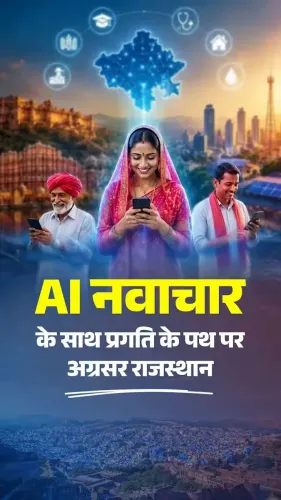
The Chief Minister's Office of Rajasthan announced on 3 July 2026 that the VB Ji Ram Ji Yojana will use geo-tagging, satellite imagery, mobile apps and AI for transparency.
Chief Minister Bhajan Lal Sharma was tagged in the official post, signalling direct political ownership of the initiative.
The announcement was made under the hashtag #आपणो_अग्रणी_राजस्थान , part of the state government's broader brand for Rajasthan's development agenda.
Rajasthan's earlier Bhamashah Scheme (2008) established a precedent for technology-enabled welfare delivery in the state.
The approach mirrors national models such as geo-tagging under PMAY-G and MGNREGA , extended now with AI-based monitoring.
Key milestones ahead include the mobile app launch, first satellite progress reports, and independent performance audits.
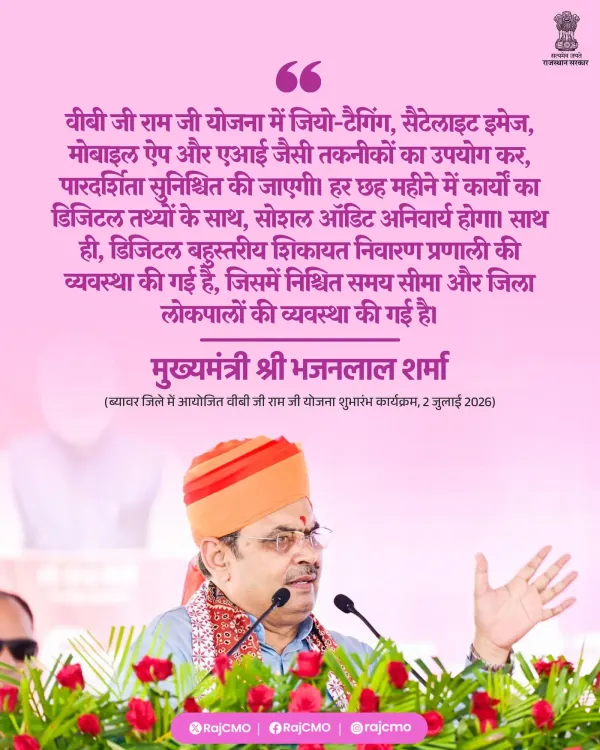
The Chief Minister's Office of Rajasthan announced on Friday, 3 July 2026 that the VB Ji Ram Ji Yojana will deploy geo-tagging, satellite imagery, mobile applications and artificial intelligence to ensure transparency in the welfare scheme's implementation, tagging Chief Minister Bhajan Lal Sharma in the post.
Context
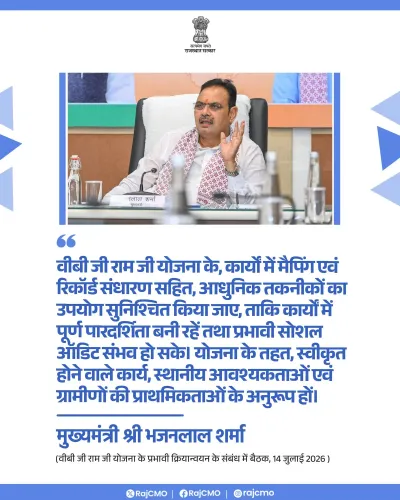
The CMO's post, shared under the hashtag #आपणो_अग्रणी_राजस्थान ('Our Leading Rajasthan'), states that technologies including geo-tagging, satellite images, mobile apps and AI will be used to 'ensure transparency' in the VB Ji Ram Ji Yojana. The announcement signals an intent to embed real-time digital oversight into the scheme's delivery mechanism from the outset.
The post does not specify the scheme's launch date, beneficiary categories or total outlay. What is clear is that the state government is positioning technology as a central pillar of the programme rather than an add-on audit tool.
Policy Backdrop
Rajasthan has a prior record of technology-led welfare delivery. The Bhamashah Scheme, launched in 2008, introduced direct benefit transfers and biometric-linked financial inclusion to reduce leakages in social spending. The current government, led by Chief Minister Bhajan Lal Sharma since December 2023, has consistently emphasised data-driven governance and administrative transparency as signature priorities.
Nationally, geo-tagging of assets and satellite-based progress monitoring were institutionalised under schemes such as PMAY-G (Pradhan Mantri Awaas Yojana – Gramin) and MGNREGA during the 2010s, establishing a template that state governments have since adapted. Rajasthan's approach with the VB Ji Ram Ji Yojana appears to extend this national model by layering AI-based analysis alongside conventional satellite and mobile-app monitoring.
Stakeholders and Impact
Welfare beneficiaries across Rajasthan stand to be the primary stakeholders. If implemented as described, geo-tagging and satellite imagery would allow officials and auditors to verify on-ground progress against disbursements, reducing scope for diversion or duplication of benefits.
Civil society groups and opposition parties are likely to scrutinise whether the technology infrastructure is actually procured and operationalised, and whether beneficiary data is protected under adequate privacy safeguards. The Government of Rajasthan will need to demonstrate that the digital tools translate into measurable reductions in grievances and leakages.
What's Next
Key milestones to watch include the formal launch of the dedicated mobile application, the release of the first satellite-based progress reports, and any performance audits by state or central agencies. The government's ability to publish transparent, publicly accessible dashboards will be a practical test of the transparency commitment outlined in today's announcement.
Broader adoption of AI-enabled monitoring in Rajasthan's welfare architecture could set a precedent for other state governments evaluating similar upgrades to their scheme-delivery infrastructure.
Point of View
A posture designed to pre-empt opposition criticism of fund leakages. By invoking AI and satellite imagery in a single social-media post, the CMO is also signalling to the central government and potential investors that Rajasthan is aligned with the national push for digital public infrastructure. However, the credibility of this commitment will hinge entirely on whether operational systems are deployed and made publicly auditable — a gap that has tripped up similar announcements in other states. The broader pattern suggests that geo-tech-enabled welfare monitoring is fast becoming a political baseline expectation, not a differentiator, in Indian state governance.
NationPress
1 Oct 2026
Frequently Asked Questions
What is the VB Ji Ram Ji Yojana in Rajasthan?
The VB Ji Ram Ji Yojana is a welfare scheme of the Government of Rajasthan. The Chief Minister's Office announced on 3 July 2026 that it will use geo-tagging, satellite imagery, mobile apps and AI to ensure transparency, though the scheme's full objectives and beneficiary categories have not been officially detailed in public records.
How will AI and satellite technology be used in Rajasthan's welfare scheme?
According to the Rajasthan CMO, the VB Ji Ram Ji Yojana will use geo-tagging to map assets, satellite images to monitor on-ground progress, mobile apps for real-time data collection, and AI for analysis — all aimed at ensuring transparency and reducing leakages in benefit delivery.
What is Bhajan Lal Sharma's role in the VB Ji Ram Ji Yojana?
Bhajan Lal Sharma is the Chief Minister of Rajasthan and was tagged in the CMO's official announcement about the scheme, indicating direct political ownership of the transparency initiative.
What is the hashtag Aapno Agrani Rajasthan about?
'Aapno Agrani Rajasthan' (meaning 'Our Leading Rajasthan') is a branding hashtag used by the Rajasthan government under Chief Minister Bhajan Lal Sharma to promote the state's development and governance initiatives.
Has Rajasthan used technology in welfare schemes before?
Yes. Rajasthan launched the Bhamashah Scheme in 2008, which used direct benefit transfers and biometric-linked accounts to reduce leakages in welfare payments, establishing an early precedent for technology-enabled social delivery in the state.