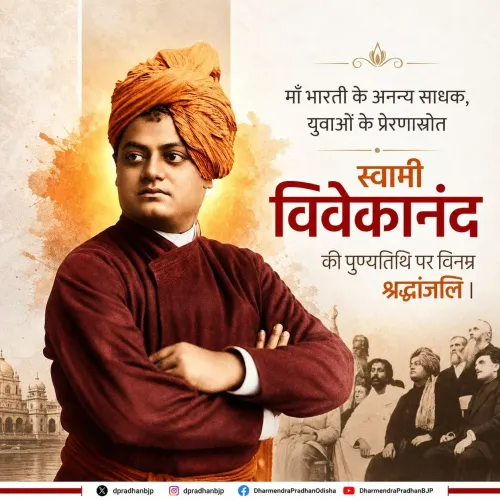
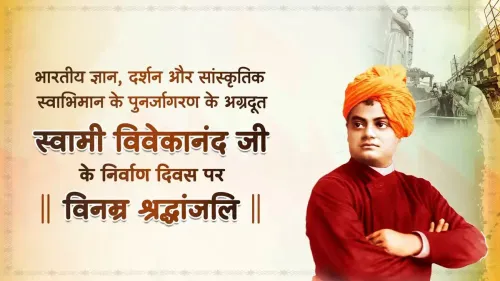
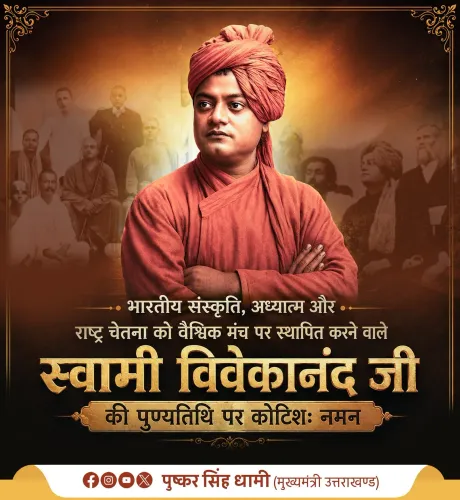
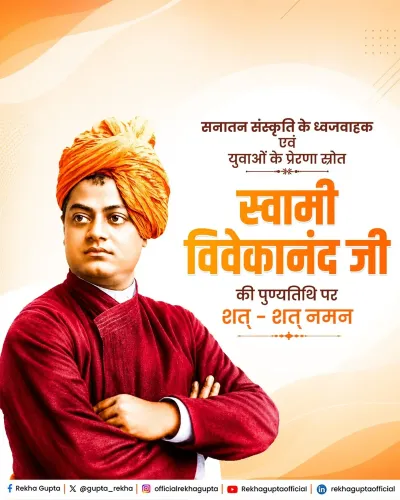
Rajnath Singh pays tribute on Swami Vivekananda's death anniversary
Synopsis
Union Defence Minister Rajnath Singh paid homage to Swami Vivekananda on his death anniversary on 4 July 2026, citing the philosopher-monk's ideals of spiritual nationalism, character-building, and self-reliance as enduring inspiration for a prosperous and self-reliant India.
Key Takeaways
Union Defence Minister Rajnath Singh posted a tribute to Swami Vivekananda on his Nirvan Diwas , 4 July 2026 .
Singh credited Vivekananda with bringing Indian culture, spirituality, and Sanatan thought to the global stage, notably at the 1893 Parliament of the World's Religions in Chicago .
The tribute invoked Vivekananda's belief that empowered, cultured, and self-confident citizens are a nation's greatest strength.
Singh linked Vivekananda's legacy directly to the Atmanirbhar Bharat vision of a self-reliant and developed India.
Since 1984 , the Government of India observes 12 January as National Youth Day in honour of Vivekananda's birth anniversary.
Senior BJP leaders regularly cite Vivekananda to connect spiritual heritage with contemporary governance themes including the National Education Policy .
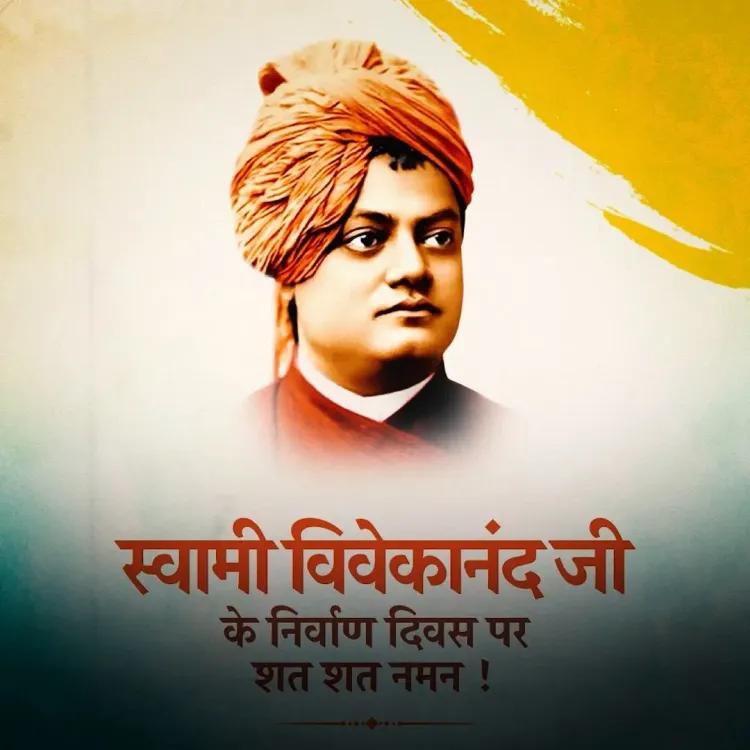
Union Defence Minister Rajnath Singh on Saturday, 4 July 2026, paid homage to Swami Vivekananda on the occasion of the philosopher-monk's Nirvan Diwas (death anniversary), invoking his legacy of spiritual nationalism and character-building as a guide for building a self-reliant India.
In a post on X, Singh offered what he called 'vinram shraddhaanjali evam koti-koti naman' — 'humble tribute and salutations beyond count' — to Vivekananda, crediting him with bringing 'the glorious tradition of Indian culture, spirituality and Sanatan thought' to the world stage.
Context
Swami Vivekananda (1863–1902) was a Hindu monk and philosopher whose address at the Parliament of the World's Religions in Chicago in 1893 introduced Vedanta and Yoga to Western audiences. He consistently stressed that patriotism, social service, moral development, and character-building were inseparable from genuine spiritual progress. His death anniversary falls on 4 July each year and is observed by government institutions and cultural organisations across India.
Singh's post quoted Vivekananda's central conviction: that 'empowered, cultured, and self-confident citizens are the greatest strength of a nation.' The tribute closed by linking Vivekananda's thought directly to the goal of a 'prosperous, self-reliant, and developed India.'
Policy Backdrop
Since 1984, the Government of India has observed 12 January — Vivekananda's birth anniversary — as National Youth Day, institutionalising his ideals of youth empowerment in the official calendar. His Nirvan Diwas in July forms the other bookend of this annual commemorative cycle.
Senior BJP leaders have long drawn on Vivekananda's framework to anchor contemporary policy rhetoric. The language of Atmanirbhar Bharat (Self-Reliant India), a flagship economic and strategic doctrine, maps closely onto Vivekananda's vision of a self-sufficient, disciplined citizenry — a connection Singh's post makes explicit by invoking 'aatmanirbhar evam viksit Bharat' (self-reliant and developed India).
Stakeholders and Impact
The tribute is directed broadly at Indian youth and citizens, the primary audience Vivekananda himself addressed. Cultural and educational institutions aligned with the government's National Education Policy framework regularly incorporate Vivekananda's emphasis on character formation and holistic development into curriculum discussions.
For the BJP as a political formation, invoking Vivekananda serves a dual purpose: it connects the party's governance agenda to a widely respected non-partisan spiritual figure, and it reinforces the idea that national strength flows from individual moral and intellectual cultivation rather than from state largesse alone.
What's Next
Vivekananda references by senior ministers are expected to intensify as the government approaches reviews of National Education Policy implementation and youth-focused schemes. The annual commemorative cycle — from National Youth Day in January through the Nirvan Diwas tribute in July — is likely to remain a recurring platform for connecting 19th-century reformist thought to 21st-century policy priorities such as skill development, moral education, and strategic self-reliance. How concretely these invocations translate into programmatic action will be the measure policymakers and civil society will watch most closely.
Point of View
Whose cross-ideological appeal makes him a politically safe but rhetorically powerful reference point. By explicitly pairing Vivekananda's ideas with 'Atmanirbhar Bharat,' the Defence Minister signals that self-reliance is framed not merely as economic policy but as a civilisational disposition. The timing on the death anniversary — rather than the more prominent birth anniversary in January — suggests a deliberate effort to sustain year-round cultural messaging. The real test will be whether such invocations gain traction in concrete policy decisions around youth development and education reform.
NationPress
2 Oct 2026
Frequently Asked Questions
Why is 4 July significant for Swami Vivekananda?
4 July marks Swami Vivekananda's Nirvan Diwas , the anniversary of his death in 1902 at Belur Math near Kolkata. It is observed annually by cultural, spiritual, and government institutions across India.
What is the connection between Swami Vivekananda and National Youth Day in India?
The Government of India has observed 12 January — Vivekananda's birth anniversary — as National Youth Day since 1984 , to promote his ideals of youth empowerment, character-building, and national service among young Indians.
What did Rajnath Singh say about Swami Vivekananda?
Rajnath Singh credited Vivekananda with bringing Indian culture, spirituality, and Sanatan thought to the world stage, and said his ideas on patriotism, social service, moral development, and character-building continue to inspire the building of a self-reliant and developed India.
Why do BJP leaders frequently cite Swami Vivekananda?
Senior BJP leaders invoke Vivekananda because his philosophy of spiritual nationalism, self-reliance, and disciplined citizenship aligns closely with the party's governance rhetoric, including schemes like Atmanirbhar Bharat , while his cross-ideological appeal lends broad legitimacy to such references.
What was Swami Vivekananda's most famous international contribution?
Vivekananda's address at the Parliament of the World's Religions in Chicago in 1893 is his most celebrated international moment, introducing Vedanta and Yoga to Western audiences and establishing India's spiritual heritage on the global stage.