Laos cracks down on illegal firearms and explosives amid regional concerns
Synopsis
Laos is stepping up its fight against illegal weapons with a new two-year enforcement plan, even as it simultaneously rolls out a nationwide digital identity system. Both moves signal a government pushing hard on security and modernisation — but the real test will be whether cross-border arms trafficking, a persistent regional problem, actually recedes.
Key Takeaways
Minister Vanthong Kongmany chaired a national security meeting in Vientiane on 18 August 2025 focused on firearms and explosives crimes.
The meeting reviewed the 2024–2026 national weapons collection campaign and set priorities for 2026–2028 .
Illegal firearms trade was described as a 'highly profitable transnational criminal activity' posing regional challenges.
The LAeID digital identity application was officially launched nationwide, replacing old white and green identity cards.
Old-style identity cards will no longer be accepted for official transactions under the new system.
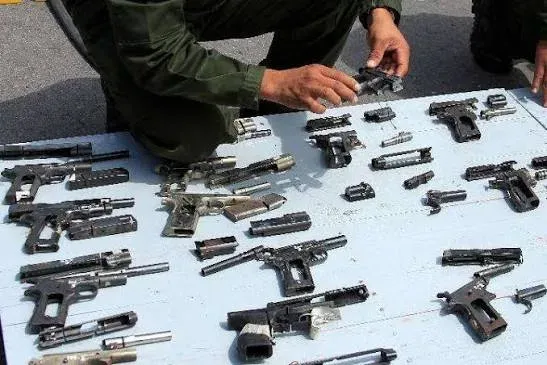
Laos' Ministry of Public Security convened a high-level meeting in the capital Vientiane on Monday, 18 August 2025, to strengthen the country's response to firearms- and explosives-related crimes. The session was chaired by Minister of Public Security Vanthong Kongmany and reviewed progress under the national weapons collection campaign for 2024–2026, while laying out priorities for the next phase covering 2026–2028.
Key Concerns Raised
Addressing the meeting, Minister Vanthong Kongmany stated that the illegal possession, trade, and use of firearms and explosives remain serious crimes that threaten lives, property, public security, social order, and national development. He further noted that the illegal firearms trade is a 'highly profitable transnational criminal activity,' and that the widespread availability and misuse of weapons continue to pose challenges to countries across the region.
This comes amid growing concern in Southeast Asia over cross-border arms trafficking, which regional security bodies have repeatedly flagged as a destabilising force. Laos, sharing borders with China, Vietnam, Cambodia, Thailand, and Myanmar, occupies a strategically sensitive position in the region's illicit-weapons landscape.
2026–2028 Priorities Outlined
The meeting outlined the roadmap for the next two-year cycle of the firearms and explosives collection campaign. While specific targets were not publicly disclosed, the ministry signalled that enforcement would be intensified and inter-agency coordination strengthened. Analysts note that such campaigns in the region have historically produced mixed results, with confiscation drives sometimes displacing rather than dismantling trafficking networks.
Digital Identity Push Runs Parallel
In a separate but related development, the Ministry of Public Security officially launched the LAeID application nationwide, replacing the traditional census registration system with a modern electronic identity platform. The ministry announced that old-style identity cards — including the white and green cards — will no longer be accepted for official transactions.
The LAeID system is designed to streamline the management, verification, and use of information held in the national citizen database. Government ministries, local authorities, civil servants, businesses, and citizens have all been urged to register and keep personal information updated through the application. Electronic records stored on the platform may serve as official references for employment and various transactions, reducing reliance on paper-based census registration books.
Broader Digital Transformation Drive
The dual announcements reflect the Lao government's stated commitment to digital transformation as a driver of national development. Authorities have emphasised expanding e-government services, building a digitally skilled workforce, and promoting overall digital growth. The LAeID rollout is among the most visible steps in this agenda, signalling a shift from legacy administrative systems to an integrated electronic framework.
As the 2026–2028 firearms campaign gets underway and the LAeID system scales up, the effectiveness of both initiatives will depend heavily on public compliance and institutional coordination across Laos' diverse provinces.
Point of View
In theory, make it harder for unregistered individuals to acquire or trade weapons through official channels. But the harder problem is transnational: Laos sits at the heart of a region where arms flow across porous borders with relative ease. Domestic collection campaigns have limited reach against trafficking networks that operate internationally. The 2026–2028 plan's credibility will rest on whether it includes cross-border enforcement mechanisms, not just internal confiscation drives.
NationPress
2 Oct 2026
Frequently Asked Questions
Why did Laos hold a firearms and explosives security meeting?
The Lao Ministry of Public Security convened the meeting on 18 August 2025 to strengthen prevention and enforcement against illegal firearms and explosives crimes. Minister Vanthong Kongmany noted these crimes threaten lives, property, public order, and national development.
What is the Laos firearms collection campaign?
It is a nationwide initiative to collect and remove illegal firearms and explosives from circulation. The current campaign runs from 2024 to 2026, with a follow-on plan covering 2026 to 2028 now outlined.
What is the LAeID application launched in Laos?
LAeID is a nationwide digital identity application launched by the Lao Ministry of Public Security to replace the traditional paper-based census registration system. It manages, verifies, and stores citizen identity information electronically, and old white and green identity cards will no longer be accepted for official use.
Who is affected by the new LAeID system in Laos?
All Lao citizens, civil servants, businesses, government agencies, and local authorities are required to register on the LAeID platform and keep their personal information updated. Electronic records on the system will serve as official references for employment and other transactions.
How does illegal arms trafficking affect Laos and the region?
According to Minister Vanthong Kongmany, the illegal firearms trade is a highly profitable transnational criminal activity. Laos borders five countries, making it a transit-sensitive zone, and the widespread availability of illicit weapons continues to challenge security across Southeast Asia.