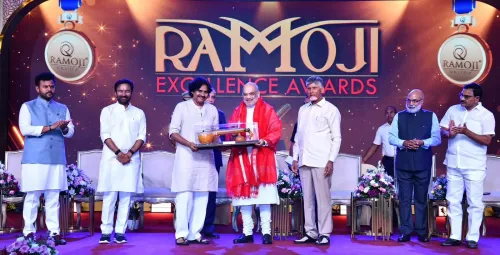
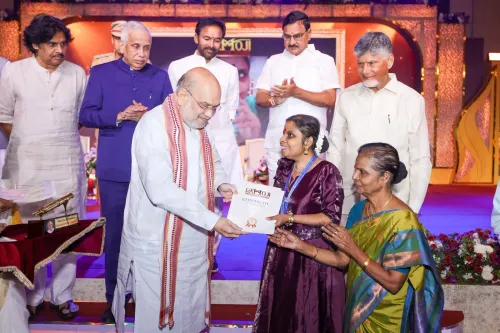
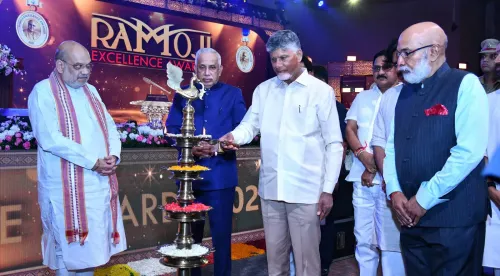
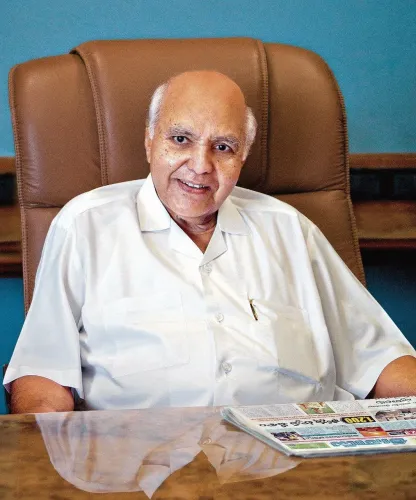
Amit Shah Pays Tribute to Ramoji Rao, ETV Founder

Synopsis
Union Home Minister Amit Shah honoured media entrepreneur Ramoji Rao on November 16, 2026, praising his adoption of new technology to build ETV across Telugu and other Indian languages, spotlighting the legacy of post-liberalisation regional broadcasting.
Key Takeaways
Amit Shah posted a tribute to Ramoji Rao on November 16, 2026 , praising his technological vision.
Rao founded the Eenadu newspaper group and later launched the ETV television network.
ETV began in Telugu and expanded to multiple Indian languages, reaching audiences underserved by national broadcasters.
Rao's early investment in satellite and production technology made vernacular TV a viable commercial force.
Shah's tribute reflects a wider tradition of political acknowledgment for pioneers of post- 1990s private broadcasting in India.
A quiet but pointed salute from the highest levels of government: Union Home Minister Amit Shah on Monday, November 16, 2026, paid tribute to Ramoji Rao, the media entrepreneur who built one of India's most consequential private broadcasting empires, crediting him with embracing new technology to bring regional-language television to millions of Indian homes.
Shah wrote that 'Ramoji Rao Ji imbibed every new technology and established the ETV in Telugu and other Indian languages' — a compact summation of a career that redrew the map of Indian media. The tribute underscores how deeply Rao's legacy is woven into the story of post-liberalisation broadcasting.
The Man Who Bet on Regional Voices
Ramoji Rao was the founder of the Eenadu newspaper group, which became one of the most widely read Telugu-language dailies in Andhra Pradesh and later Telangana. He extended that regional footprint into television when he launched ETV (Eenadu Television), initially in Telugu and subsequently across a range of Indian languages, building a network that reached audiences who had long been underserved by national broadcasters.
What set Rao apart was his instinct for technology adoption. At a time when satellite broadcasting was still new and infrastructure fragile, ETV invested in production quality and distribution reach that matched — and in regional markets often exceeded — that of better-funded rivals. The result was a network that made vernacular television a viable commercial and cultural force.
Why Political Leaders Mark Media Milestones
Shah's tribute fits a wider pattern: since the 1990s liberalisation opened India's airwaves to private players, political figures across the spectrum have periodically acknowledged the pioneers who built regional broadcasting. The acknowledgment carries weight because vernacular media — Telugu, Kannada, Marathi, Bengali and beyond — has shaped how hundreds of millions of Indians receive news and entertainment, often more intimately than national English-language outlets ever could.
Recognising founders like Rao is also a form of public validation for the broader project of regional-language media, whose growth remains one of the more consequential and underreported stories of modern India.
Ramoji Rao's work proved that a regional-language broadcaster could be both technologically ambitious and deeply local — a combination India's media landscape is still learning from.
Point of View
Shah implicitly frames early vernacular broadcasters as nation-builders — a framing the BJP has consistently used to validate regional cultural identity alongside national integration. The tribute also quietly elevates the story of private media liberalisation as a success story of the post-1991 era, one the current government is happy to associate itself with. For media historians, acknowledgment from a serving Home Minister keeps Rao's model — regional, technologically agile, language-first — in the public conversation at a moment when those very qualities define the next wave of Indian digital media.
NationPress
17 Nov 2026
Frequently Asked Questions
Who is Ramoji Rao and why is he significant in Indian media?
Ramoji Rao was the founder of the Eenadu newspaper group and the ETV television network, making him one of the most influential figures in Indian regional-language media after the 1990s liberalisation.
What is ETV and which languages does it broadcast in?
ETV, or Eenadu Television, is a private broadcast network that launched in Telugu and later expanded to cover multiple other Indian languages, bringing regional-language programming to a mass audience.
Why did Amit Shah pay tribute to Ramoji Rao?
Shah credited Rao with embracing new technology to establish ETV across Telugu and other Indian languages, honouring his contribution to expanding private regional broadcasting in India.
What was Ramoji Rao's contribution to Telugu media?
Rao built the Eenadu newspaper into one of the most-read Telugu dailies and then extended that reach into television via ETV, investing in satellite technology and production quality that set new standards for vernacular broadcasting.
How has Indian regional-language television grown since the 1990s?
Following liberalisation in the early 1990s, private regional-language broadcasters expanded rapidly, with networks like ETV demonstrating that vernacular television could be commercially viable and culturally influential on a national scale.