Amit Shah: Andhra Pradesh will be India's most developed state in 10 years

Synopsis
Union Home Minister Amit Shah declared on November 16, 2026 that Andhra Pradesh will become India's most developed state within ten years, posting the pledge in both English and Telugu and backing it with a video — setting a public, time-stamped benchmark for the post-bifurcation state.
Key Takeaways
Amit Shah declared on November 16, 2026 that Andhra Pradesh will be India's most developed state within 10 years .
The post was written in both English and Telugu , signalling a direct message to Andhra Pradesh's population and leadership.
Andhra Pradesh was created by the Andhra Pradesh Reorganisation Act, 2014 , which bifurcated the former state and left the residual AP without its historic capital Hyderabad .
Shah's claim sets a specific, verifiable benchmark — the most developed state, within a decade — rather than a generic aspirational statement.
The post was accompanied by a video , suggesting delivery at or alongside a public event or address.
Central infrastructure, industrial corridor, and connectivity schemes are among the key levers the Union government controls that would need to accelerate significantly for the target to be met.
A bold ten-year promise for Andhra Pradesh — that is what Union Home Minister Amit Shah put on record on Monday, November 16, 2026, declaring in a post on X that the southern state would emerge as the most developed in the country within a decade.
Shah wrote in both English and Telugu: 'రాబోయే 10 ఏళ్లలో ఆంధ్రప్రదేశ్ దేశంలోనే అత్యంత అభివృద్ధి చెందిన రాష్ట్రంగా అవతరిస్తుంది!' ('In the coming 10 years, Andhra Pradesh will emerge as the most developed state in the country!'). The bilingual framing — English headline, Telugu affirmation — signals a message aimed squarely at the state's electorate and leadership alike.
A state still finding its footing after bifurcation
Andhra Pradesh was carved out of the former, undivided state under the Andhra Pradesh Reorganisation Act of 2014, which created Telangana as a separate entity. The bifurcation left the residual Andhra Pradesh without its historic capital Hyderabad — a city that remained with Telangana — forcing the state to rebuild its administrative and economic identity from near scratch. That backstory gives Shah's ten-year horizon a pointed weight: the clock, in many ways, has been running since 2014.
Central ministers periodically issue forward-looking statements on state development, typically framed within the government's cooperative federalism agenda. What distinguishes this post is the specificity of the claim — not 'one of the most developed' but the most developed — and the precise ten-year window attached to it. That is a verifiable benchmark, and it will be measured.
What 'most developed' would actually require
Reaching the top of India's development ladder in a decade would demand sustained momentum across infrastructure, per-capita income, human development indices, and ease of doing business — metrics on which larger, more established states currently hold commanding leads. Central schemes in infrastructure, ports, industrial corridors, and connectivity are among the levers that the Union government controls and that would need to flow disproportionately toward the state to close the gap at speed.
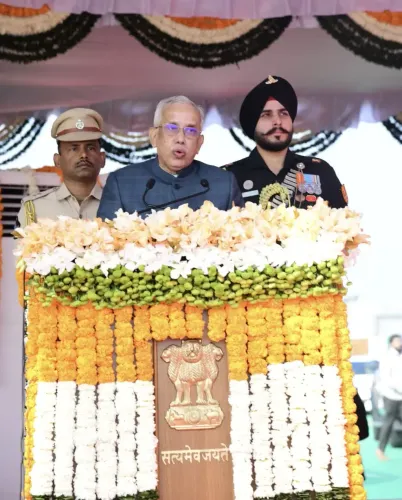
The post, accompanied by a video, suggests this was part of a broader address or event — the visual context likely filling in the specific policy or political occasion that the words alone do not name. What is unambiguous is the ambition: Shah has set a public, time-stamped target that both the Centre and the state government will now be held against.
Point of View
Not just a slogan. It lands against the still-raw backdrop of the 2014 bifurcation, which left AP economically disadvantaged and politically restive, making the Centre's development commitments to the state a recurring and sensitive pressure point. For the BJP, cementing a credible development narrative in AP is both a governance imperative and an electoral strategy in a state where coalition arithmetic matters. The real test will be whether the central resource allocations and scheme rollouts in the coming years actually track this ambition — or whether the benchmark becomes a liability.
NationPress
17 Nov 2026
Frequently Asked Questions
What did Amit Shah say about Andhra Pradesh's development?
Union Home Minister Amit Shah declared on November 16, 2026 that Andhra Pradesh will become the most developed state in India within the next ten years, posting the pledge in both English and Telugu on X.
Why is Andhra Pradesh considered underdeveloped compared to other states?
Andhra Pradesh lost its historic capital Hyderabad — along with its economic infrastructure — when the state was bifurcated in 2014 under the Andhra Pradesh Reorganisation Act, forcing the residual state to rebuild its administrative and economic base from scratch.
When was Andhra Pradesh bifurcated and why?
Andhra Pradesh was bifurcated in 2014 under the Andhra Pradesh Reorganisation Act, which created Telangana as a separate state. Hyderabad became the capital of Telangana, leaving the residual Andhra Pradesh without a developed capital city.
What would Andhra Pradesh need to become India's most developed state?
Reaching the top of India's development rankings would require sustained growth in infrastructure, per-capita income, human development indices, and ease of doing business — areas where larger, more established states currently hold significant leads.
Is Amit Shah's development claim for Andhra Pradesh a government policy commitment?
The statement is a public, time-stamped pledge by the Union Home Minister, which carries political weight, but specific policy instruments or central allocations tied to the claim have not been detailed in the post itself.