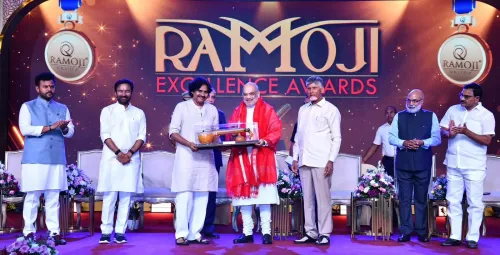
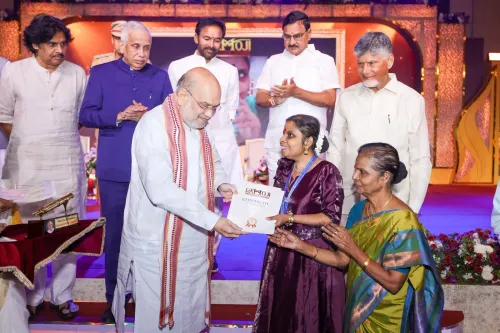
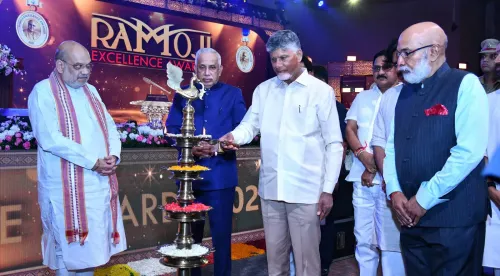
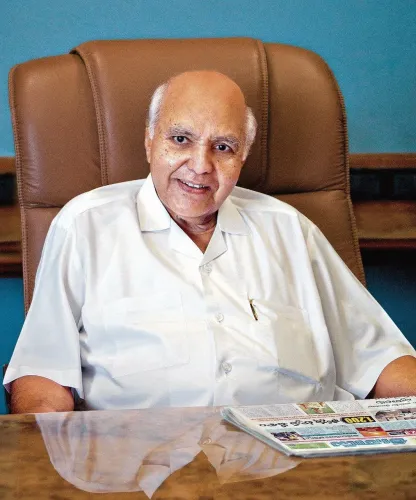
Amit Shah pays tribute to Ramoji Rao, calls Padma Vibhushan an honour to Telugu pride

Synopsis
Union Home Minister Amit Shah paid a bilingual tribute to media mogul Ramoji Rao on the conferment of the Padma Vibhushan, calling it an honour to journalism, literature, and the self-respect of the Telugu community.
Key Takeaways
Amit Shah posted a bilingual tribute in English and Telugu on 16 November 2026 marking Ramoji Rao's Padma Vibhushan conferment.
The Padma Vibhushan is India's second-highest civilian award, instituted in 1954 and conferred annually on the eve of Republic Day.
Ramoji Rao founded the Eenadu newspaper group and built Ramoji Film City , one of the world's largest integrated film production facilities.
Shah described the honour as a recognition of journalism, literature, and ' Telugu aatmagaurava ' — the self-respect of the Telugu soul.
The tribute underscores the government's framing of regional media contributions as matters of national significance.
When India confers its second-highest civilian honour on a journalist, it says something about the weight of that life's work. Union Home Minister Amit Shah marked the conferment of the Padma Vibhushan upon media legend Ramoji Rao with a bilingual tribute on Monday, 16 November 2026, calling it not merely a personal recognition but a salute to journalism, literature, and Telugu pride itself.
Posting in both English and Telugu, Shah wrote: 'Conferring the Padma Vibhushan upon Ramoji Rao Ji was an honour to journalism, literature and Telugu pride.' In Telugu, he added — రామోజీరావు గారికి పద్మవిభూషణ్ ప్రదానం చేయడం పాత్రికేయ రంగానికి, సాహిత్యానికి, తెలుగు ఆత్మగౌరవానికి దక్కిన గౌరవం — 'the conferment of the Padma Vibhushan upon Ramoji Rao is an honour that has been bestowed upon the field of journalism, literature, and the self-respect of the Telugu soul.'Who is Ramoji Rao and why the award resonates so deeply
Ramoji Rao is one of the most consequential figures in Indian regional media. He founded the Eenadu newspaper group, which grew into one of Telugu's most widely read and influential publications, and built Ramoji Film City near Hyderabad — recognised as one of the world's largest integrated film production facilities. His career spans decades of shaping how Telugu-speaking audiences in Andhra Pradesh and Telangana consume news and culture. For a linguistic community that runs into tens of millions across two states and a global diaspora, the honouring of a figure who dedicated his life to Telugu-language journalism carries unmistakable cultural weight. Shah's choice to post the tribute in Telugu — not just in English — underscores exactly that dimension.The Padma Vibhushan and the tradition behind it
The Padma Vibhushan is India's second-highest civilian award, instituted in 1954, awarded for 'exceptional and distinguished service' to the nation. Conferred annually on the eve of Republic Day, the honour has historically recognised contributions across the full spectrum of Indian public life — science, the arts, public affairs, and journalism among them. Recognising regional media stalwarts through the Padma series reflects a consistent policy thread across successive governments: that contributions to Indian languages and regional public discourse are national contributions. Shah's tribute arrives as a reminder that the architecture of Indian democracy rests, in part, on the vernacular press — the newspapers, broadcasters, and editors who informed and shaped opinion far beyond the English-language mainstream. For the Telugu community, the Padma Vibhushan going to one of their own is not a bureaucratic event. It is a moment of cultural validation — and Amit Shah framed it precisely that way.Point of View
States that remain politically consequential for the BJP's southern expansion. By framing the Padma Vibhushan as an honour to 'Telugu aatmagaurava,' he elevates a ceremonial award into a cultural statement. The move fits a broader BJP pattern of using Padma recognitions to build cultural capital with regional communities, positioning the central government as a custodian of linguistic and regional identity. It is soft power deployed with precision.
NationPress
17 Nov 2026
Frequently Asked Questions
Who is Ramoji Rao and what did he do?
Ramoji Rao is a Telugu media entrepreneur who founded the Eenadu newspaper group, one of the most widely read Telugu publications, and built Ramoji Film City near Hyderabad, recognised as one of the world's largest integrated film production facilities.
What is the Padma Vibhushan award?
The Padma Vibhushan is India's second-highest civilian award, instituted in 1954 . It is conferred annually on the eve of Republic Day for exceptional and distinguished service to the nation across fields including journalism, arts, and public life.
Why did Amit Shah post in Telugu?
Amit Shah posted his tribute in both English and Telugu to directly honour the Telugu community, underscoring that the award recognises not just an individual but the broader contribution to Telugu language, literature, and culture.
What did Amit Shah say about Ramoji Rao's Padma Vibhushan?
Shah said that conferring the Padma Vibhushan upon Ramoji Rao was 'an honour to journalism, literature and Telugu pride,' adding in Telugu that it was a recognition of the 'self-respect of the Telugu soul.'
How significant is the Padma Vibhushan for regional journalists in India?
The Padma Vibhushan for a regional media figure like Ramoji Rao reflects a consistent policy of successive Indian governments to treat contributions to vernacular journalism and regional languages as national contributions worthy of the country's highest civilian honours.