Rajnath Singh hails Tejaswin Shankar's Asian Games bronze
Synopsis
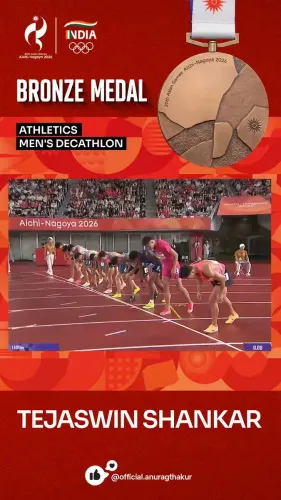
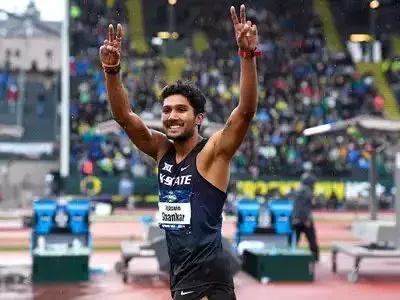
Defence Minister Rajnath Singh praised Tejaswin Shankar for winning the bronze medal in the Men's Decathlon at the Asian Games 2026 in Japan, calling it a commendable display of grit, versatility, and determination, and urging the athlete to continue bringing glory to India.
Key Takeaways
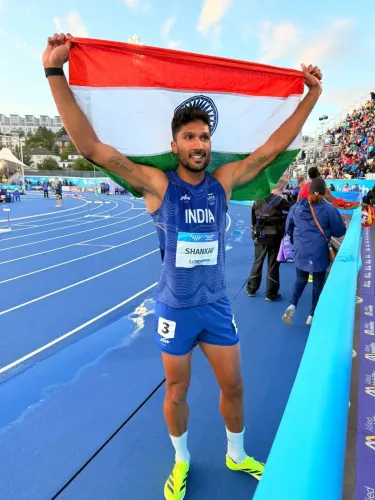
Tejaswin Shankar won the bronze medal in the Men's Decathlon at the Asian Games 2026 hosted by Japan .
Union Defence Minister Rajnath Singh congratulated Shankar on September 27, 2026 via X.
Singh described the performance as a 'commendable display of grit, versatility and determination.' Shankar is a multi-event athlete who competes in both decathlon and high jump at the national and international level.
India has a track record of fielding decathletes at successive Asian Games editions, with this bronze adding to that continental campaign.
A bronze medal in one of sport's most gruelling disciplines — ten events across two punishing days — and Tejaswin Shankar has delivered another chapter in India's expanding track-and-field story. Union Defence Minister Rajnath Singh took to X on Sunday, September 27, 2026 to congratulate the athlete on securing the bronze medal in the Men's Decathlon at the Asian Games 2026, praising what he called a 'commendable display of grit, versatility and determination.'
Ten events, one statement
The decathlon is not for the faint-hearted. Sprints, hurdles, jumps, throws, and a brutal 1,500 metres finale — an athlete must be competent at everything and dominant at nothing, or dominant at several things and resilient through the rest. For Shankar to climb onto the podium at the Asian Games level signals a depth of all-round athleticism that India's track-and-field programme is only beginning to harness.
Shankar is already known on the Indian athletics circuit for his versatility, having competed in both decathlon and high jump at national and international stages. The Asian Games bronze adds continental silverware to a career that has steadily built across successive major cycles.
Ministers, medals, and the ritual of recognition
Senior cabinet ministers publicly acknowledging sporting victories on social media has become a fixture of Indian political culture — and for good reason. Such moments land with genuine weight when the minister is among the country's most prominent political figures, as Rajnath Singh — former Chief Minister of Uttar Pradesh and former Union Home Minister — undoubtedly is. His message closed with a forward-looking note: 'May he continue to excel and bring greater glory to India in the years ahead.'
That framing matters. It positions the bronze not as a ceiling but as a launchpad — the language of a programme still mid-climb.
India's decathlon arc at the Asian Games
India has fielded decathletes at successive editions of the Asian Games, a quiet continuity that rarely makes front-page news but reflects a long-term investment in multi-event athletics. A podium finish at the 2026 edition hosted by Japan is precisely the kind of result that keeps that pipeline worth funding — and gives the next generation of Indian multi-eventers a concrete target to chase.
Shankar's bronze is a data point in that longer arc. The question now is whether Indian athletics builds the infrastructure — coaching depth, competition exposure, recovery science — to turn these individual podiums into a pattern.
Point of View
Versatility and determination') signals more than a routine shout-out. The decathlon is an event demanding a full-spectrum athlete, and India securing a podium finish at the Asian Games level reflects a maturing track-and-field programme that has expanded beyond the sprint-and-jump headlines. If the government's stated ambition is an Olympic podium in multi-events before the decade closes, recognitions like this one serve a dual function: rewarding current performers and signalling investment intent to the next cohort. The forward-looking close of Singh's message — 'greater glory in the years ahead' — hints at exactly that institutional framing.
NationPress
28 Sept 2026
Frequently Asked Questions
What medal did Tejaswin Shankar win at the Asian Games 2026?
Tejaswin Shankar won the bronze medal in the Men's Decathlon at the Asian Games 2026, which were hosted by Japan.
Who is Tejaswin Shankar?
Tejaswin Shankar is an Indian track and field athlete who competes in the decathlon and high jump at national and international levels.
Where are the Asian Games 2026 being held?
The Asian Games 2026 are hosted by Japan.
Why did Rajnath Singh congratulate Tejaswin Shankar?
Union Defence Minister Rajnath Singh posted on X to congratulate Shankar on winning the bronze medal in the Men's Decathlon, praising his grit, versatility, and determination.
What is the decathlon in athletics?
The decathlon is a combined track and field event comprising ten disciplines contested over two days — including sprints, hurdles, jumps, and throws — with athletes scored on their cumulative performance across all events.