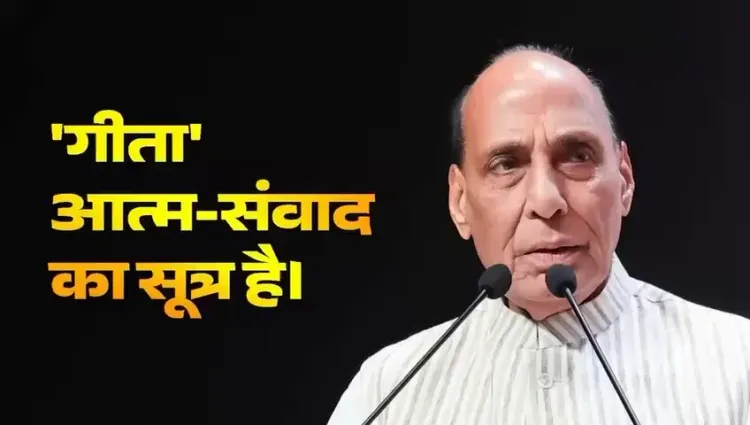
Rajnath Singh invokes Bhagavad Gita on youth and comparison
Synopsis
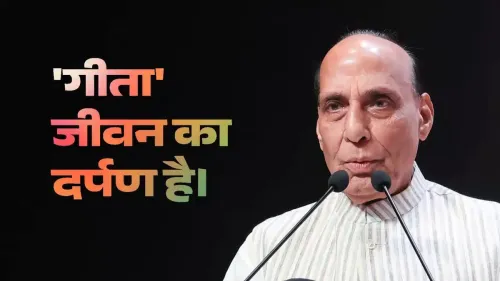
Union Defence Minister Rajnath Singh drew on the Bhagavad Gita on 27 September 2026 to address the compulsive comparison culture gripping today's youth, arguing life is a personal journey, not a contest, and that Gita offers wisdom for doubt, fear, hardship, and success.
Key Takeaways
Union Defence Minister Rajnath Singh posted on 27 September 2026 addressing India's youth and the culture of comparison.
He described the Bhagavad Gita as a guide for the inner journey, offering 'wisdom in doubt, courage in fear, patience in hardship, and humility in success.' Singh framed life not as a competition but as each person's own swadharma — individual path and duty.
The post included a video, suggesting the remarks may originate from a longer address or cultural programme.
Singh is one of BJP's most senior leaders, having served as UP Chief Minister, Union Home Minister, and now Union Defence Minister.
In an age of social media scorecards and curated lives, Union Defence Minister Rajnath Singh turned to one of India's oldest texts to deliver a message that cuts right through the noise: life is not a competition.
Posting on Sunday, 27 September 2026, Singh wrote in Hindi — 'जीवन कोई प्रतियोगिता नहीं, बल्कि प्रत्येक व्यक्ति की अपनी यात्रा और अपना स्वधर्म है' — 'Life is not a competition; every individual has their own journey and their own dharma.' The full post diagnosed a specific affliction of the current generation: the compulsive habit of comparison, what he called 'तुलना की वृत्ति' (the instinct of comparison). His prescription? The Bhagavad Gita.
From comparison to inner journey: Singh's Gita framework
The minister described the Gita as a text that takes a person from the external world inward — 'बाहर से भीतर की यात्रा'. He mapped out four specific qualities the scripture illuminates: 'wisdom in doubt, courage in fear, patience in hardship, and humility in success.' That four-part structure is deliberate. It tracks the full arc of a young person's life — the anxiety before a decision, the dread of failure, the grind in the middle, and the ego that can arrive with achievement. Singh is not simply quoting scripture; he is applying it as a practical emotional toolkit.A senior leader's long-running cultural register
Singh is among the BJP's most senior figures, having served as Chief Minister of Uttar Pradesh, Union Home Minister, and now as Union Minister of Defence. That political biography spans decades of public life, and his public communication has consistently woven together national-security themes with cultural and philosophical reflection. Senior Indian political figures invoking the Bhagavad Gita is not new — but the framing here is notably specific. Rather than citing the Gita for patriotism or duty in a martial sense, Singh anchors it to youth mental well-being and the psychological burden of social comparison. That is a contemporary framing of a classical text. The accompanying video in the post suggests this may be drawn from a longer address or programme on youth and culture, though specifics were not available. For a generation navigating academic pressure, job markets, and the relentless feed of others' apparent success, the counsel — stop measuring your journey against someone else's milestone — lands with practical weight. The Gita, Singh implies, is not a relic of ritual. It is a compass for the anxious present.Point of View
Singh signals a cultural-outreach lane that is distinct from legislative action. The emphasis on 'swadharma' — individual dharma, one's own path — is philosophically sophisticated and politically safe: it affirms individuality without endorsing Western self-help frameworks. As the BJP approaches its cultural communication strategy for a young, digitally connected electorate, such posts represent a soft but deliberate form of ideological outreach.
NationPress
28 Sept 2026
Frequently Asked Questions
What did Rajnath Singh say about the Bhagavad Gita and youth?
On 27 September 2026, Rajnath Singh said today's youth struggle with the habit of comparison, and urged them to see life as a personal journey rather than a competition, citing the Bhagavad Gita as a guide for inner strength, wisdom, courage, patience, and humility.
What is 'swadharma' as mentioned by Rajnath Singh?
Swadharma refers to one's own individual path, duty, or calling — the idea that each person has a unique journey that cannot and should not be measured against another's. Singh used the term to argue that comparison distorts this personal sense of purpose.
Why did Rajnath Singh quote the Bhagavad Gita?
Singh invoked the Gita to address what he called the 'comparison instinct' afflicting today's generation, framing the ancient text as a practical compass for navigating doubt, fear, hardship, and success — concerns directly relevant to contemporary youth.
What positions has Rajnath Singh held in Indian politics?
Rajnath Singh has served as Chief Minister of Uttar Pradesh, Union Home Minister, and currently holds the position of Union Minister of Defence. He is a senior leader of the Bharatiya Janata Party.
Is this the first time Rajnath Singh has spoken about the Bhagavad Gita publicly?
Senior Indian leaders, including Rajnath Singh, have periodically referenced the Bhagavad Gita in public discourse on resilience and ethics. This post is notable for specifically linking Gita teachings to the mental health and comparison culture challenges faced by today's youth.