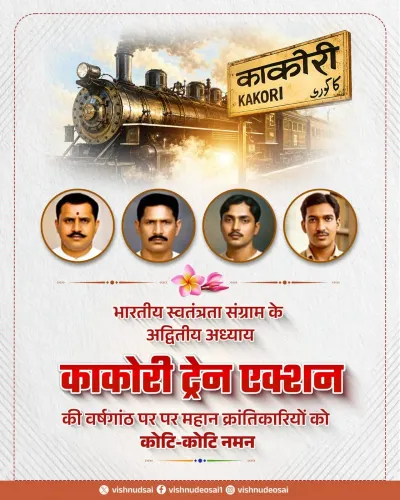
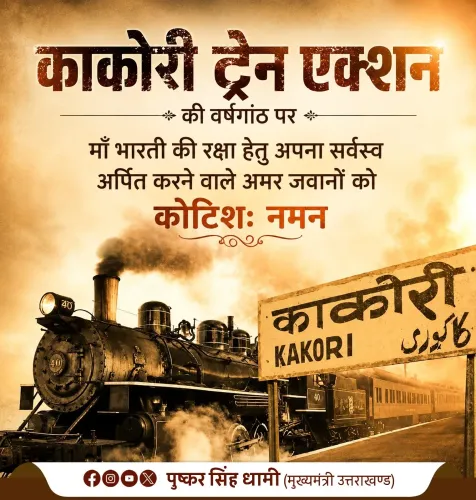
Rajnath Singh pays tribute on Kakori Train Action anniversary
Synopsis
Union Defence Minister Rajnath Singh marked the anniversary of the 1925 Kakori Train Action on 9 August 2026, honouring revolutionaries Chandrashekhar Azad, Ram Prasad Bismil, and Ashfaqulla Khan, and linking their sacrifice to the goal of a self-reliant, developed India.
Key Takeaways
Rajnath Singh posted a Hindi tribute on 9 August 2026 marking the Kakori Train Action anniversary .
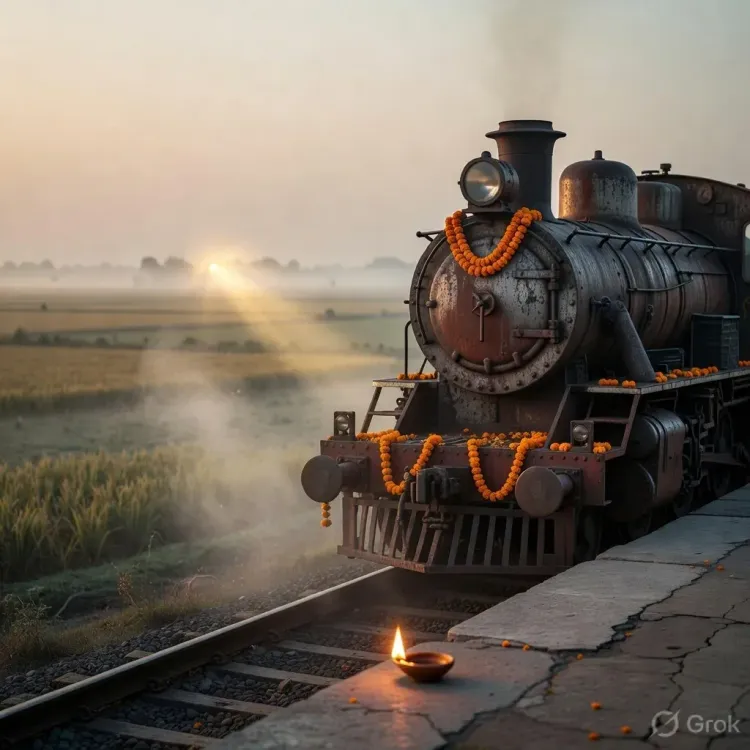
The Kakori Train Action took place on 9 August 1925 , when revolutionaries seized British treasury funds from a train near Kakori, Uttar Pradesh.
Singh specifically named Ram Prasad Bismil , Ashfaqulla Khan , and Chandrashekhar Azad — all of whom paid with their lives for their role in the independence movement.
Bismil and Ashfaqulla Khan were hanged in 1927 ; Azad died in a police encounter in Allahabad in 1931 .
Singh linked the revolutionaries' sacrifice to present-day goals of an Aatmanirbhar (self-reliant) and Viksit Bharat (developed India).
9 August is also the anniversary of the Quit India Movement (1942) , making it one of the most significant dates on India's nationalist calendar.
A century after a handful of young revolutionaries stopped a British train near a small town in Uttar Pradesh and changed the course of India's freedom struggle, Union Defence Minister Rajnath Singh paused on Sunday, 9 August 2026 to honour their memory — and to remind the nation what that courage demands of the present.
Posting in Hindi on the anniversary of the Kakori Train Action, Singh wrote: 'On the anniversary of the Kakori Train Action, I bow respectfully to those immortal revolutionaries who gave new direction and energy to the freedom struggle through their courage, sacrifice, and indomitable patriotism.' He described the Kakori incident not merely as a daring act against colonial rule, but as a symbol of the unbreakable resolve of the youth of that era and their total dedication to a free India.
What happened at Kakori — and why it still echoes
On 9 August 1925, a group of revolutionaries affiliated with the Hindustan Republican Association stopped Train No. 8 Down — the Shahjahanpur-Lucknow passenger — near the town of Kakori in present-day Uttar Pradesh and seized British government treasury funds being transported in it. The action was audacious by design: the revolutionaries needed money to fund the armed struggle, but they also wanted to demonstrate, publicly and dramatically, that colonial authority was not invincible. The British response was swift and severe. Mass arrests followed, and the episode became known as the Kakori Conspiracy Case. Ram Prasad Bismil, the poet-revolutionary who helped plan the action, was hanged on 19 December 1927. Ashfaqulla Khan, his close comrade, was executed the same year. Chandrashekhar Azad, who evaded capture at Kakori, continued the fight until he died in a police encounter at Alfred Park, Allahabad, on 27 February 1931 — famously shooting himself rather than surrender. Singh named all three in his post, writing that 'the sacrifice of Chandrashekhar Azad, Ram Prasad Bismil, Ashfaqulla Khan and their comrades reminds us that India's freedom was earned through the sacrifice and struggle of countless brave souls.'From 1925 to 'Viksit Bharat' — the through-line Singh draws
The tribute did not stop at remembrance. Singh closed with a call to action, urging that while honouring their memory, 'we must strengthen our resolve to preserve this priceless legacy of freedom and build a strong, prosperous, self-reliant and developed India' — invoking the government's signature Aatmanirbhar Bharat (self-reliant India) and Viksit Bharat (developed India) frameworks. It is a rhetorical bridge Indian political figures — and BJP leaders in particular — regularly build between revolutionary-era sacrifice and present-day national ambition. The date itself carries additional weight: 9 August is also the anniversary of the Quit India Movement of 1942, making it one of the most charged dates on India's nationalist calendar. State-level commemorations in Uttar Pradesh and national events tied to the Independence Day season typically cluster around this window.Point of View
Sacrifice-driven patriotism. The explicit linkage of 1925's sacrifice to 'Aatmanirbhar Bharat' and 'Viksit Bharat' is deliberate political messaging, tying historical legitimacy to the government's current economic and strategic agenda. Notably, the tribute to Ashfaqulla Khan — a Muslim revolutionary executed alongside Bismil — allows the BJP to project a composite nationalist identity at a time when communal optics are closely watched. As Independence Day approaches, such commemorations also serve to set the emotional tone for the government's annual messaging around sovereignty and national pride.
NationPress
9 Aug 2026
Frequently Asked Questions
What was the Kakori Train Action?
The Kakori Train Action took place on 9 August 1925 , when members of the Hindustan Republican Association stopped a British government train near Kakori in Uttar Pradesh and seized treasury funds to finance the armed independence movement. The British arrested dozens in the aftermath, in what became known as the Kakori Conspiracy Case.
Who were Ram Prasad Bismil and Ashfaqulla Khan?
Ram Prasad Bismil was a poet and revolutionary who helped plan the Kakori Train Action; he was hanged by British authorities in December 1927 . Ashfaqulla Khan was his close associate and fellow revolutionary, also executed in 1927 for his role in the Kakori incident.
What happened to Chandrashekhar Azad after Kakori?
Chandrashekhar Azad evaded arrest after the Kakori action and continued his revolutionary activities. He died on 27 February 1931 in a police encounter at Alfred Park in Allahabad , choosing to shoot himself rather than be captured.
Why does Rajnath Singh pay tribute to Kakori revolutionaries?
Union Defence Minister Rajnath Singh paid tribute on the anniversary of the Kakori Train Action (9 August) to honour the sacrifice of the revolutionaries and to link their legacy to the present-day goals of a self-reliant and developed India.
Why is 9 August significant in Indian history?
9 August marks two major events: the Kakori Train Action of 1925 and the launch of the Quit India Movement in 1942 , making it one of the most important dates on India's nationalist calendar.