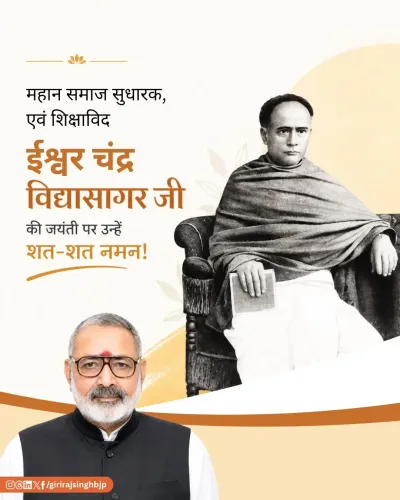
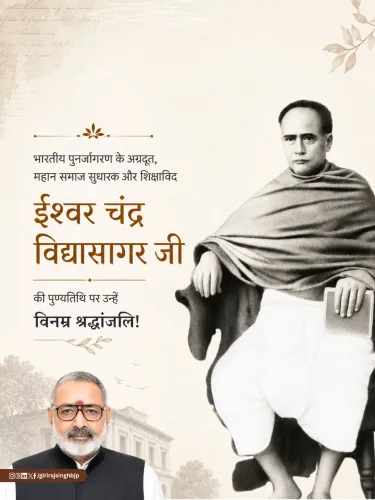
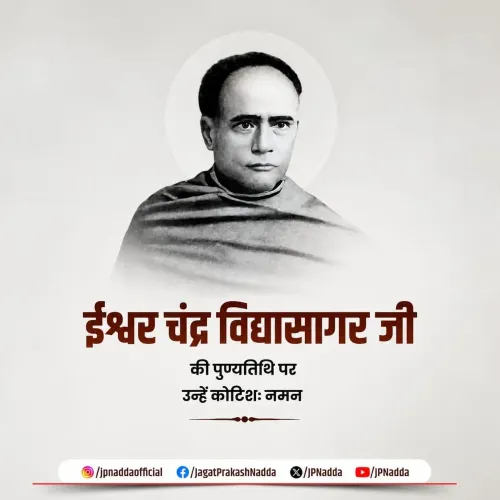
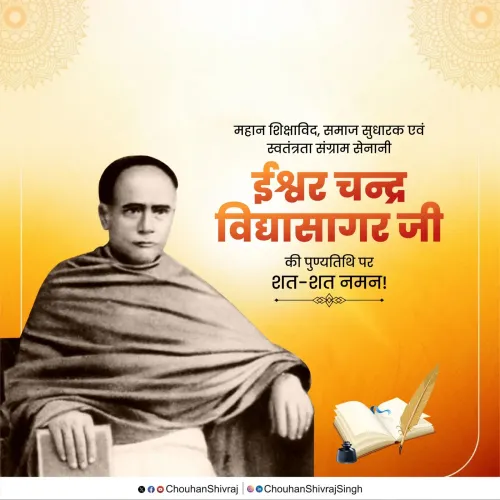
Rajnath Singh pays tribute to Ishwar Chandra Vidyasagar
Synopsis
Union Defence Minister Rajnath Singh marked Ishwar Chandra Vidyasagar's birth anniversary with a tribute honouring the 19th-century reformer's campaigns for widow remarriage, girls' education, opposition to child marriage, and lasting contributions to the Bengali language.
Key Takeaways
Rajnath Singh paid tribute to Ishwar Chandra Vidyasagar on his birth anniversary on Saturday, 26 September 2026 .
Vidyasagar ( 1820–1891 ) championed widow remarriage , opposed child marriage and polygamy , and established schools for girls across Bengal.
He made lasting contributions to the Bengali language and script , standardising its alphabet and producing foundational literacy primers.
Vidyasagar served as principal of Sanskrit College, Kolkata , using the role to push curricular reform blending Western and Indian scholarship.
The tribute carried no linked government scheme or policy announcement; it stands as a commemorative statement in a long tradition of reformer anniversary observances by Indian leaders.
On the birth anniversary of Ishwar Chandra Vidyasagar, Union Defence Minister Rajnath Singh remembered the 19th-century Bengali luminary as a 'towering social reformer, educator, and humanitarian' — a man whose campaigns reshaped the lives of women across colonial India and whose imprint on the Bengali language endures to this day.
The reformer who took on three battles at once
Ishwar Chandra Vidyasagar (1820–1891) did not pick one cause and champion it safely. He fought simultaneously for widow remarriage, against child marriage and polygamy, and for the radical — at the time — idea that girls deserved formal schooling. He established schools for girls across Bengal and worked tirelessly to expand access to learning for communities that had been shut out of it entirely. Rajnath Singh's tribute specifically highlighted each of these three fronts, calling them a reflection of Vidyasagar's 'unwavering commitment to a more just and compassionate society.'
Bengali script, Sanskrit scholarship, and a life in letters
Beyond social reform, Vidyasagar made enduring contributions to the Bengali language and script — standardising its alphabet and producing primers that generations of Bengali children would learn to read with. His command of Sanskrit earned him the title 'Vidyasagar' (ocean of knowledge) from Sanskrit College in Kolkata, where he later served as principal and used that institutional perch to push through curricular reforms that blended Western learning with Indian scholarship. Singh's post acknowledged these literary and linguistic contributions alongside the social ones — a fuller portrait than many commemorative statements manage.
A pattern of anniversary tributes, and why Vidyasagar still fits it
Indian political leaders across party lines mark the birth anniversaries of 19th-century reformers with public statements, a tradition that keeps the reformist lineage visible in the national conversation. Vidyasagar draws particular resonance because his battles — access to education, protection of women, rejection of regressive social customs — remain live policy conversations in 21st-century India. No new government scheme or event was announced alongside Saturday's tribute; the statement stands as a commemorative acknowledgement rather than a policy signal.
A man who believed knowledge was the sharpest instrument of social change — Vidyasagar's legacy dares every generation to measure its progress against his standard.
Point of View
Child marriage, and polygamy alongside girls' education, Singh frames Vidyasagar's legacy in terms directly relevant to ongoing debates about women's rights and social legislation. The acknowledgement of Vidyasagar's Bengali linguistic heritage also carries a subtle federalist warmth toward West Bengal, a state the BJP has actively contested. As commemorative statements go, this one is unusually specific in its content — a fuller engagement with the reformer's actual record than the genre typically demands.
NationPress
26 Sept 2026
Frequently Asked Questions
Who was Ishwar Chandra Vidyasagar?
Ishwar Chandra Vidyasagar (1820–1891) was a Bengali scholar, social reformer, and educator who campaigned for widow remarriage, opposed child marriage and polygamy, established schools for girls, and made enduring contributions to the Bengali language and script.
Why did Rajnath Singh pay tribute to Vidyasagar?
Rajnath Singh paid tribute on Vidyasagar's birth anniversary, honouring his legacy as a social reformer who fought for women's rights, expanded girls' education, and enriched the Bengali language.
What is Ishwar Chandra Vidyasagar's contribution to widow remarriage?
Vidyasagar was a leading advocate for legalising widow remarriage in colonial India, campaigning against the social stigma and religious sanction that kept widows from remarrying. His efforts contributed to the Widow Remarriage Act of 1856.
What did Vidyasagar do for girls' education in India?
Vidyasagar established multiple schools for girls across Bengal in the 19th century and worked to expand access to formal education for women and marginalised communities at a time when such education was rare.
What is Vidyasagar's contribution to the Bengali language?
Vidyasagar standardised the Bengali alphabet, reformed the script for greater clarity, and produced foundational literacy primers that shaped how generations of Bengalis learned to read and write.