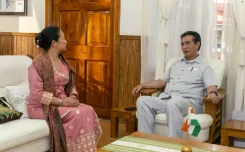
CM Revanth Reddy meets economist Arvind Subramanian on Telangana reforms

Synopsis
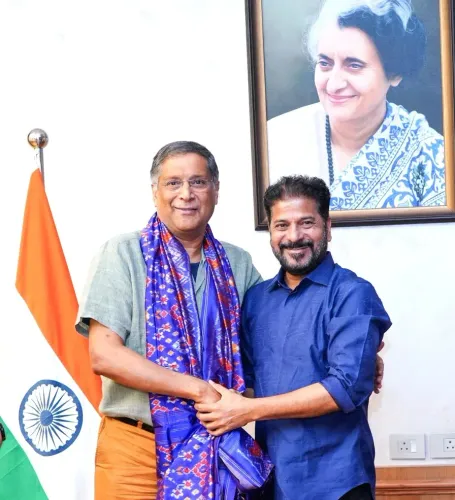
Telangana Chief Minister A. Revanth Reddy met former Chief Economic Adviser Arvind Subramanian on 7 August 2026 to discuss strengthening the state economy, boosting revenues, and advancing excise and GST reforms to improve the investment and business environment.
Key Takeaways
Revanth Reddy held a meeting with economist Arvind Subramanian on 7 August 2026 in Hyderabad.
Discussions covered strengthening Telangana's economy , increasing state revenues, and implementing financial reforms effectively.
Specific focus areas included reforms in the excise and GST sectors and creating a more business- and investment-friendly environment.
Arvind Subramanian served as India's Chief Economic Adviser from 2014 to 2018 , overseeing the period of the GST rollout in 2017 .
The Revanth Reddy government has prioritised investment attraction and fiscal streamlining since taking office in December 2023 .
State budget presentations or industrial policy revisions may follow, incorporating recommendations from the consultation.
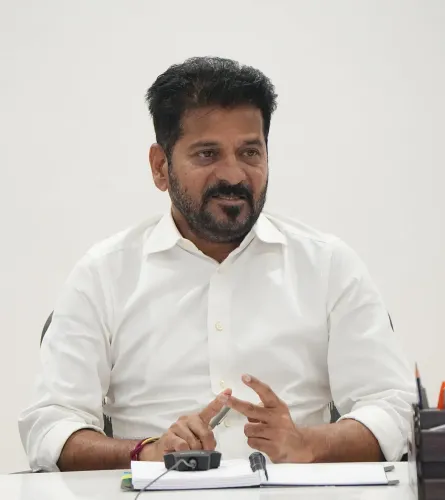
A state government actively courting investment sat down with one of India's sharpest fiscal minds. Telangana Chief Minister A. Revanth Reddy met with former Chief Economic Adviser Arvind Subramanian on Friday, 7 August 2026, for a wide-ranging discussion on strengthening the state's economy, boosting revenue streams, and pushing through meaningful financial reforms.
Posting about the meeting in Telugu, the Chief Minister said the two exchanged views on 'creating new opportunities for the state's economic development by bringing about necessary reforms in excise and GST sectors, and by creating a more conducive environment for businesses and investments.' The government, he added, is 'moving forward in a planned manner to build a strong foundation for development, investments, and employment opportunities.'
Why Arvind Subramanian's counsel matters for Telangana
Arvind Subramanian served as Chief Economic Adviser to the Government of India from 2014 to 2018, a tenure that overlapped with two of the most consequential fiscal events in recent Indian history — the GST rollout in July 2017 and the demonetisation of November 2016. His command of both macro-fiscal architecture and state-level revenue mechanics makes him a particularly relevant interlocutor for a state government wrestling with post-GST revenue constraints. When GST replaced multiple state and central levies in 2017, it fundamentally curtailed states' independent taxation powers. Telangana, like most states, has since had to work harder to plug revenue gaps — particularly in excise, which remains one of the few domains where states retain meaningful pricing latitude. The meeting's explicit focus on excise and GST reforms signals that Hyderabad is looking at both compliance improvements and structural tweaks to extract more from existing revenue heads.A state built on ambition, still searching for fiscal balance
Telangana was carved out of Andhra Pradesh in June 2014, inheriting Hyderabad as its capital and a growth story anchored in IT, pharmaceuticals, and services. But bifurcation also meant starting from a fresh fiscal base — and the state has since pursued a succession of industrial policy updates and investment summits to diversify its economic base beyond services. The Revanth Reddy government, which took office in December 2023, made attracting investment and streamlining state finances a stated priority from day one. Consulting a former national economic adviser fits a pattern visible in states like Tamil Nadu and Karnataka, which have periodically brought in external experts to design business-friendly regulatory changes and address post-GST revenue gaps. The hashtags the Chief Minister chose — #TelanganaRising and #EconomicReforms — underscore that this meeting is being positioned as part of a deliberate, public narrative around economic reinvention. Whether specific policy revisions follow — in the state budget, an industrial policy update, or a revised excise framework — will be the real measure of the conversation's weight.Point of View
Particularly on the revenue side. The emphasis on excise and GST reforms is telling — these are the two domains where state governments have the most immediate leverage after the post-2017 contraction of fiscal autonomy. Bringing in a credentialled, non-partisan economist also serves a political purpose: it projects technocratic seriousness at a time when the government is under pressure to demonstrate fiscal competence. The real test will come in the next budget cycle or industrial policy revision, where the ideas exchanged must translate into concrete, measurable changes.
NationPress
22 Sept 2026
Frequently Asked Questions
Why did Telangana CM Revanth Reddy meet Arvind Subramanian?
CM Revanth Reddy met former Chief Economic Adviser Arvind Subramanian on 7 August 2026 to discuss ways to strengthen Telangana's economy, increase state revenues, and implement reforms in excise and GST sectors to attract more investment.
Who is Arvind Subramanian and what is his connection to Indian economic policy?
Arvind Subramanian is a prominent Indian economist who served as Chief Economic Adviser to the Government of India from 2014 to 2018, advising on fiscal and growth policies including during the GST rollout in 2017.
What specific reforms did Revanth Reddy and Arvind Subramanian discuss?
The discussions focused on reforms in the excise and GST sectors, creating a more business- and investment-friendly regulatory environment, and identifying new avenues for state revenue growth and economic development.
How has GST affected Telangana's state revenues?
The GST rollout in July 2017 replaced multiple state levies and reduced states' independent taxation powers, prompting Telangana and other states to seek alternative revenue strategies, particularly in excise and compliance improvements.
What is Telangana's current economic priority under CM Revanth Reddy?
Since taking office in December 2023, the Revanth Reddy government has prioritised attracting investments, streamlining state finances, and building a stronger foundation for development and employment in Telangana.