Rijiju Addresses Reforms Utsav Marking 12 Years of Minority Welfare
Synopsis
Union Minister Kiren Rijiju addressed 'Reforms Utsav' at Bharat Mandapam in New Delhi, marking 12 years of reforms for inclusive development of minority communities. The Ministry of Minority Affairs event spotlights scholarships, skilling and digital delivery upgrades rolled out since 2014 for Muslims, Christians, Sikhs, Buddhists, Jains and Parsis.
Key Takeaways
Kiren Rijiju addressed 'Reforms Utsav' at Bharat Mandapam, New Delhi, on 4 June 2026.
The event marks 12 years of reforms for inclusive development of minority communities.
It was organised by the Ministry of Minority Affairs, which itself was created in January 2006.
Schemes cover six notified communities: Muslims, Christians, Sikhs, Buddhists, Jains and Parsis.
Delivery has shifted to direct-benefit transfers and digital scholarship portals.
Next Union Budget allocations and any new madrasa modernisation guidelines will be closely watched.
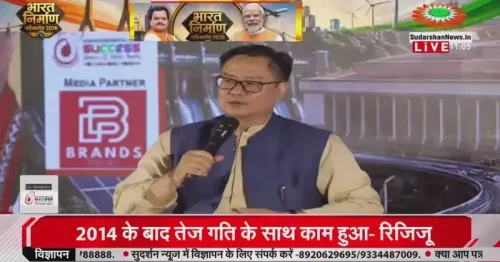
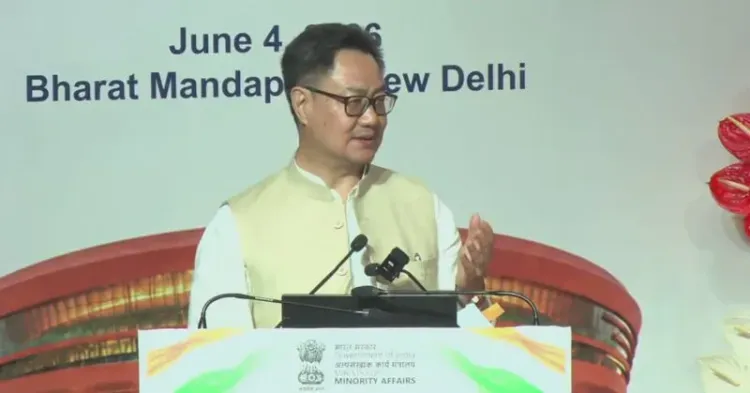
Union Parliamentary Affairs Minister and Minister of Minority Affairs Kiren Rijiju on Thursday, 4 June 2026, addressed the 'Reforms Utsav – Celebrating 12 Years of Reforms for Inclusive Development of Minority Communities' at Bharat Mandapam, New Delhi. The event, organised by the Ministry of Minority Affairs, marks a stocktaking of welfare interventions rolled out for notified minority groups since 2014.
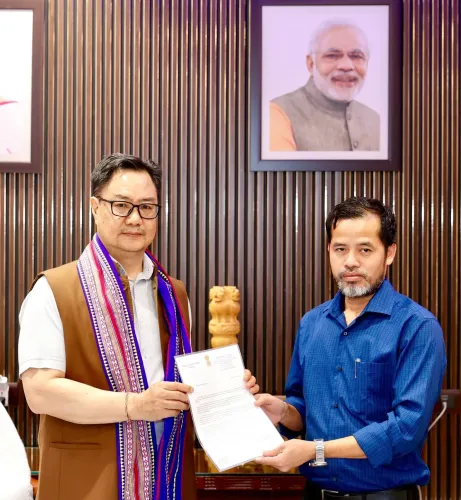
Sharing a live link to his address on X, Rijiju wrote that he was 'Addressing Reforms Utsav – Celebrating 12 Years of Reforms for Inclusive Development of Minority Communities, organised by @MOMAIndia at Bharat Mandapam, New Delhi.' The post was accompanied by a broadcast stream and one image from the venue.
Context
The Reforms Utsav frames a 12-year arc of policy delivery under the Union government, beginning 2014, when the present administration assumed office. The Ministry of Minority Affairs, itself created in January 2006, is the nodal body for the six notified minority communities — Muslims, Christians, Sikhs, Buddhists, Jains and Parsis.
Bharat Mandapam, the Capital's flagship convention complex, has hosted a series of ministry anniversary events and policy showcases in recent years. The choice of venue underscores the government's intent to position minority welfare within its larger inclusive-development narrative.
Policy backdrop
The structural framework for minority welfare in India draws on the Sachar Committee recommendations of the mid-2000s, which led to the creation of the ministry and the rollout of the Prime Minister's 15-Point Programme. After 2014, this architecture was reorganised with a sharper focus on education, skilling and infrastructure.
Key interventions over the past decade have included pre-matric, post-matric and merit-cum-means scholarships, skill programmes such as Seekho Aur Kamao (Learn and Earn), and area-development schemes for minority-concentration districts. Delivery has progressively shifted to direct-benefit transfers and digital scholarship portals, in line with the wider governance reform agenda.
Stakeholders and impact
The principal beneficiaries of the schemes being showcased are students from minority communities, minority educational institutions, artisans and women entrepreneurs covered under skilling and credit programmes. State governments and implementing agencies are also stakeholders, given that scholarship disbursal and infrastructure works pass through state machinery.
For Rijiju, who holds the minority affairs portfolio alongside parliamentary affairs, the event is an opportunity to consolidate the government's messaging that welfare delivery has been non-discriminatory and rules-based. The minister, a senior BJP leader from Arunachal Pradesh, has used recent public engagements to emphasise transparency in scheme implementation.
What's next
Attention will turn to parliamentary questions in the forthcoming session and to allocations for minority welfare schemes in the next Union Budget. Any fresh guidelines on madrasa modernisation, scholarship eligibility or portal-based verification mechanisms flagged at Reforms Utsav will be closely tracked by stakeholder groups.
With the ministry completing two decades in 2026 and the government marking 12 years in office, the event signals continuity in the welfare framework even as delivery systems are recalibrated for the digital-governance era.
Point of View
Rules-based development agenda. By staging the anniversary at Bharat Mandapam, the government is signalling scale and continuity while quietly recalibrating delivery toward digital and DBT-led mechanisms. For Rijiju, balancing the minority affairs portfolio with parliamentary affairs, the optics matter ahead of the next session. The real test will lie in budgetary commitments and scholarship disbursal numbers in the coming fiscal.
NationPress
21 Oct 2026
Frequently Asked Questions
What is Reforms Utsav organised by the Ministry of Minority Affairs?
Reforms Utsav is an event organised by the Union Ministry of Minority Affairs at Bharat Mandapam, New Delhi, to mark 12 years of reforms for inclusive development of minority communities. Union Minister Kiren Rijiju addressed the event on 4 June 2026.
Who is the current Union Minister of Minority Affairs?
Kiren Rijiju is the Union Minister of Minority Affairs and also holds the Parliamentary Affairs portfolio. He is a senior BJP leader from Arunachal Pradesh.
Which communities are covered under the Ministry of Minority Affairs?
The ministry covers six notified minority communities in India: Muslims, Christians, Sikhs, Buddhists, Jains and Parsis. It implements scholarship, skilling and area-development schemes for these groups.
When was the Ministry of Minority Affairs set up?
The Ministry of Minority Affairs was established in January 2006 to give dedicated policy attention to minority welfare. It followed recommendations that emerged around the Sachar Committee's work on the status of minorities.
Where is Bharat Mandapam located?
Bharat Mandapam is a large convention and exhibition complex in New Delhi, located at Pragati Maidan. It hosts major government events, anniversary functions and international summits.