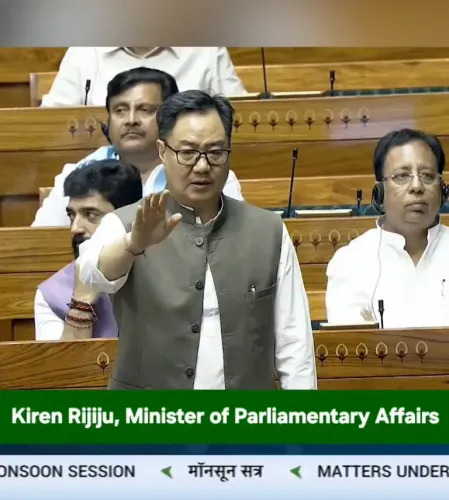
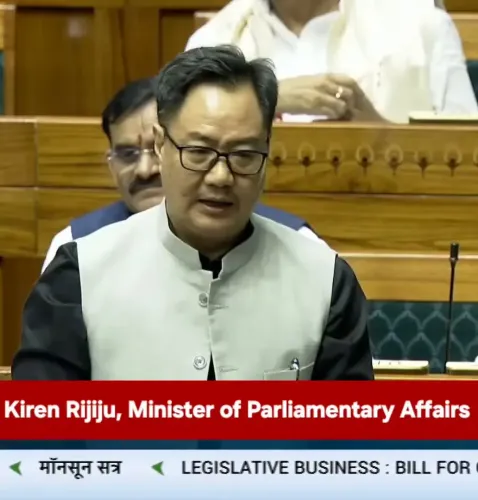
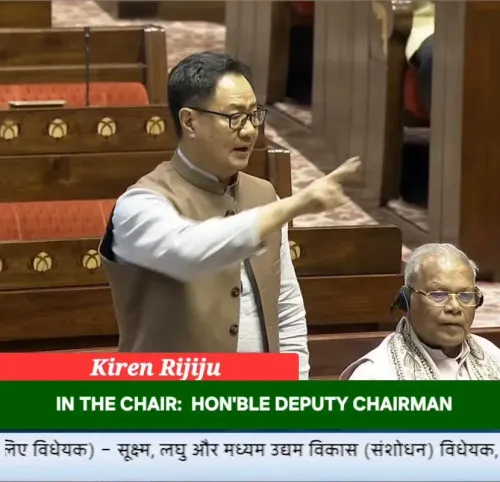
Rijiju: Govt Ready for Full Debate, Opposition Blocking Parliament
Synopsis
Union Parliamentary Affairs Minister Kiren Rijiju declared on 12 August 2026 that the government has nothing to hide and is fully prepared for detailed parliamentary debate, naming Home Minister Amit Shah as ready to engage — if the opposition stops disrupting proceedings.
Key Takeaways
Union Parliamentary Affairs Minister Kiren Rijiju posted on 12 August 2026 asserting the government is ready for discussion 'at all times.' Rijiju directly blamed the opposition for deliberately disrupting Parliament rather than engaging in debate.
He specifically named Home Minister Amit Shah as prepared to lead detailed discussion from the same day.
The statement follows a recurring pattern of opposition disruptions through slogans, walkouts, and forced adjournments in both Lok Sabha and Rajya Sabha .
The government's offer frames the choice as the opposition's to make — cooperate or bear responsibility for lost parliamentary time.
The floor of Parliament fell silent again — not from agreement, but from disruption. On Wednesday, 12 August 2026, Union Parliamentary Affairs Minister Kiren Rijiju fired a direct challenge at the opposition, declaring the government has 'nothing to hide' and is prepared for detailed debate starting immediately, provided opposition parties choose cooperation over chaos.
Posting in Hindi on X, Rijiju stated: 'The government has nothing to hide. We are ready for discussion at all times. The opposition itself does not want discussion — that is why it is continuously creating uproar and disrupting the proceedings of Parliament. There is still time: if the opposition cooperates, Home Minister Amit Shah and the government are fully prepared for detailed discussion from today itself.'
The disruption pattern that keeps repeating
Rijiju's statement fits a well-worn groove in Indian parliamentary history. Across multiple sessions of both Lok Sabha and Rajya Sabha, opposition-led disruptions — slogans, walkouts, forced adjournments — have swallowed hours of scheduled legislative time. Governments of every era have responded with near-identical posture: we are open to debate, the other side is not. What makes Wednesday's intervention notable is the explicit naming of Home Minister Amit Shah as the minister ready to face the floor — a signal that the government is willing to put its most senior political voice on the line.Why the Home Minister's name matters here
In parliamentary convention, demanding or offering a ministerial statement from the Home Minister is rarely routine. The Home Ministry covers internal security, law enforcement, border affairs, and communal matters — precisely the terrain on which oppositions most aggressively seek accountability. By specifically volunteering Shah for 'detailed discussion,' Rijiju is raising the stakes: the government is not offering a junior minister or a written reply, but a full floor engagement from one of the cabinet's heaviest hitters. The ball, Rijiju made clear, is now in the opposition's court.What the next sitting hours will reveal
The critical test is whether opposition parties treat this as a genuine opening or dismiss it as political posturing. If the House proceeds to substantive debate with Shah at the dispatch box, it would mark a rare de-escalation in a session marked by disruption. If the adjournments continue, the government's narrative — that the opposition fears the debate it publicly demands — gets another day's oxygen. Parliamentary watchers will be tracking the notice papers and the Speaker's rulings in the hours that follow. In a democracy, the loudest rooms are not always the most productive ones. Rijiju's challenge is simple: step in, sit down, and debate.Point of View
Which must now either accept and face a formidable minister or continue disrupting and validate the government's narrative. This tactic has a clear electoral dimension: repeated images of a stalled Parliament chip away at opposition credibility with voters who expect legislative productivity. The explicit naming of Shah also signals that whatever the underlying issue is, the government considers it winnable terrain. Whether this leads to genuine debate or hardens into another cycle of adjournments will define the remainder of this session's legacy.
NationPress
26 Sept 2026
Frequently Asked Questions
Why is Kiren Rijiju blaming the opposition for Parliament disruptions?
Rijiju, as Parliamentary Affairs Minister, argues the opposition is deliberately creating uproar to avoid substantive debate rather than engaging on issues through the proper floor process.
What did Kiren Rijiju say about Amit Shah and Parliament debate?
Rijiju stated that Home Minister Amit Shah and the government are fully prepared for detailed discussion from 12 August 2026 itself, if the opposition agrees to cooperate.
What causes Parliament sessions to be disrupted in India?
Opposition parties typically resort to slogans, walkouts, and forcing adjournments to demand ministerial statements, inquiries, or to protest government policy — a pattern seen across multiple sessions of Lok Sabha and Rajya Sabha.
What happens when Parliament is disrupted repeatedly?
Repeated disruptions lead to adjournments, loss of scheduled legislative time, and bills or debates being deferred, reducing the overall productivity of a parliamentary session.
What is the role of the Union Parliamentary Affairs Minister?
The Union Parliamentary Affairs Minister coordinates between the government and Parliament, manages the legislative calendar, liaises with parties on floor strategy, and is the government's primary spokesperson on parliamentary conduct.