Rijiju hails India-Japan ties as Benzaiten book launches
Synopsis
Union Minister Kiren Rijiju has lauded the English release of 'Enoshima: The Sacred Island of Benzaiten,' highlighting the shared devotion to Saraswati and Benzaiten as evidence of India and Japan's deep civilisational friendship, with backing from the Indian Embassy in Tokyo and the MEA.
Key Takeaways
Union Minister Kiren Rijiju congratulated the International Centre for Cultural Studies, Bharat on the release of the English edition of Enoshima: The Sacred Island of Benzaiten on October 19, 2026 .
The book centres on Enoshima Island , one of Japan's most sacred Benzaiten shrine sites, near Kamakura.
Rijiju drew a direct civilisational parallel between Goddess Saraswati (India) and Benzaiten (Japan), both goddesses of wisdom, arts and eloquence sharing common Indian origins.
The Indian Embassy in Tokyo ( @IndianEmbTokyo ) and the Ministry of External Affairs were tagged, indicating official diplomatic backing for the initiative.
India-Japan diplomatic relations were established in 1952 ; cultural links were elevated as a formal bilateral pillar after PM Modi's 2014 Japan visit .
The release fits India's broader Act East Policy soft-power strategy of using shared Hindu-Buddhist heritage to deepen public understanding with Japan.
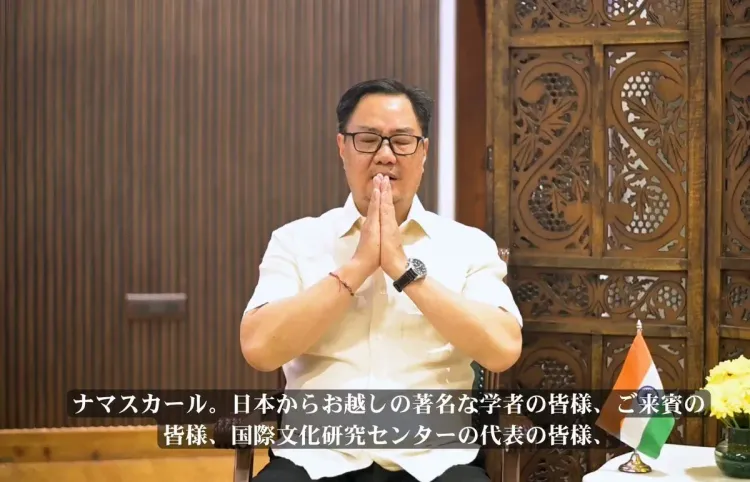
A goddess revered in two civilisations, separated by thousands of kilometres of ocean — and a freshly released English book just made their connection impossible to ignore. Union Parliamentary Affairs Minister Kiren Rijiju on Monday, October 19, 2026, congratulated the International Centre for Cultural Studies, Bharat on the release of the English edition of Enoshima: The Sacred Island of Benzaiten, calling the shared reverence for Goddess Saraswati in India and Benzaiten in Japan a testament to the two nations' 'deep civilisational ties.'
Rijiju extended special appreciation to the Ambassador of India to Japan and the book's translator for 'strengthening cultural understanding and the enduring friendship between our two nations.' The post tagged both @MEAIndia and @IndianEmbTokyo, signalling that this is an embassy-backed cultural initiative, not merely a private scholarly exercise.
Saraswati and Benzaiten: one goddess, two civilisations
The link Rijiju invokes is ancient and well-documented in comparative religious scholarship. Benzaiten — Japan's goddess of everything that flows, from music and eloquence to wisdom and water — arrived in Japan via Buddhist transmission routes from India, her iconography and attributes closely mirroring those of Saraswati, the Hindu goddess of knowledge and the arts. Enoshima Island, near Kamakura, is one of Japan's most revered Benzaiten shrines, drawing millions of pilgrims each year. An English edition of a book centred on that island carries both scholarly and diplomatic weight, making the shared heritage accessible to a global audience.
How the book fits India's Act East cultural strategy
This release is not an isolated gesture. Since diplomatic relations were established in 1952, India and Japan have maintained a sustained architecture of cultural cooperation agreements and people-to-people exchanges. The cadence accelerated after Prime Minister Modi's 2014 visit to Japan, which formally elevated civilisational and spiritual linkages as a pillar of the bilateral strategic partnership — sitting alongside defence, technology, and infrastructure cooperation under the Act East Policy framework.
Cultural publications of this kind serve a deliberate soft-power purpose: they give scholars, students, and general readers a concrete, emotionally resonant entry point into a partnership that is often discussed in the dry language of trade figures and defence pacts. 'Knowledge, wisdom and spirituality connect civilisations across borders,' Rijiju wrote — a framing that positions culture not as decoration around the bilateral relationship, but as its deepest foundation.
Embassy and MEA's quiet role in cultural diplomacy
The tagging of @IndianEmbTokyo and @MEAIndia is deliberately visible. It signals that the Ministry of External Affairs and the Indian Embassy in Tokyo are stakeholders in — and likely facilitators of — this publication. Embassy-backed cultural projects, from language institutes to heritage publications, are a standard tool in India's diplomatic toolkit in Japan, complementing the harder-edged elements of the partnership.
With India-Japan summit cycles and joint statements increasingly referencing people-to-people ties, expect the International Centre for Cultural Studies, Bharat and the Indian Embassy in Tokyo to build on this release with follow-up events — lectures, exhibitions, or further translations — that keep the civilisational narrative alive in public discourse on both sides.
In a bilateral relationship measured as often in missile ranges and semiconductor supply chains as in anything else, a book about a goddess on a sacred island reminds both nations what drew them together long before the strategic spreadsheets arrived.
Point of View
The government signals that civilisational identity, not just strategic interest, underpins the bilateral relationship. This approach has intensified since 2014 and serves domestic audiences as much as Japanese ones — reinforcing a narrative of India as a civilisational power with ancient global reach. The embassy and MEA tags suggest this is coordinated messaging, not a spontaneous appreciation post.
NationPress
19 Oct 2026
Frequently Asked Questions
What is the book 'Enoshima: The Sacred Island of Benzaiten' about?
It is a book focused on Enoshima Island near Kamakura in Japan, one of the country's most revered shrines dedicated to Benzaiten, the Japanese goddess of wisdom, arts and water. The English edition was released with support from the International Centre for Cultural Studies, Bharat, and the Indian Embassy in Tokyo.
What is the connection between Saraswati and Benzaiten?
Benzaiten, Japan's goddess of music, eloquence and wisdom, traces her origins to the Hindu goddess Saraswati, arriving in Japan through Buddhist transmission routes from India. Both goddesses share strikingly similar attributes and iconography, representing a living civilisational link between India and Japan.
Why did Kiren Rijiju congratulate the book's release?
As Union Minister of Parliamentary Affairs and a senior BJP leader, Rijiju regularly engages in cultural diplomacy messaging. He congratulated the International Centre for Cultural Studies, Bharat, and appreciated the Indian Ambassador to Japan and the translator for deepening India-Japan cultural understanding.
What is India's Act East Policy and how does culture fit into it?
India's Act East Policy is a diplomatic framework for deeper engagement with Southeast and East Asian nations, including Japan. Cultural diplomacy — highlighting shared heritage, spiritual traditions and people-to-people ties — is a deliberate complement to the economic, defence and technology cooperation under this framework.
When did India and Japan establish diplomatic relations?
India and Japan established formal diplomatic relations in 1952 . Cultural cooperation has been a sustained strand of the bilateral relationship, significantly elevated after Prime Minister Modi's 2014 visit to Japan.