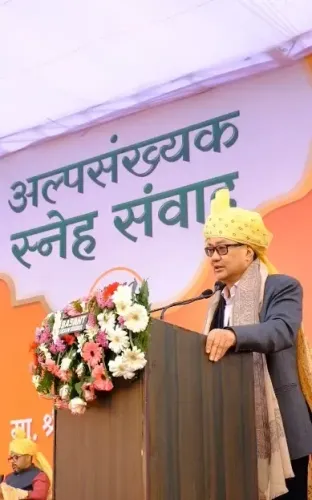
Rijiju: Spreading religious hatred makes you 'rogue and amoral'

Synopsis
Union Minister Kiren Rijiju issued a sharp, unqualified call for religious tolerance on 29 October 2026, labelling those who spread hatred and harm others 'rogue and amoral' — a message he explicitly extended beyond any single faith community.
Key Takeaways
Union Parliamentary and Minority Affairs Minister Kiren Rijiju posted a call for universal religious tolerance on 29 October 2026 .
He described people who harm others and spread hatred as 'rogue and amoral people in the society' — unusually direct language for a ministerial post.
The message was framed as universal, explicitly stating it applies beyond those embracing Buddhism to followers of all faiths.
Rijiju oversees India's Ministry of Minority Affairs , which engages with Muslim, Christian, Sikh, Buddhist, Zoroastrian, and Jain communities.
No specific triggering incident was cited; the statement stands as a broad ethical and moral position from a senior BJP leader.
A senior minister in charge of minority affairs drawing a hard moral line — that is exactly what Union Parliamentary Affairs and Minority Affairs Minister Kiren Rijiju did on Thursday, 29 October 2026, when he posted a blunt call for universal human decency over religious point-scoring.
Rijiju wrote: 'This is not only for people embracing Buddhism. Why to speak bad about other religion? Just be a good human being. Those who harm other human beings and spread hatred are rogue and amoral people in the society.' No party names. No policy footnotes. Just a flat moral verdict — and a pointed one.
A Minority Affairs minister's message on faith and conduct
The post is notably universal in framing. Rijiju opened with a reference to Buddhism — the faith he has spoken about in the context of his home state Arunachal Pradesh and India's northeastern Buddhist communities — but immediately widened the lens to every religion. The message: tolerance is not a concession one faith makes to another; it is the baseline requirement of being human. As Minister of Minority Affairs, Rijiju oversees government engagement with India's religious minorities — Muslims, Christians, Sikhs, Buddhists, Zoroastrians, and Jains. The portfolio carries an implicit mandate to speak across community lines, and this post does exactly that, without carving out exceptions for any group.Why 'rogue and amoral' lands differently from routine political rhetoric
Indian ministers holding minority affairs portfolios periodically issue statements on religious tolerance, typically anchored in constitutional secularism. What stands out here is the register. Rijiju did not reach for legalese or constitutional citations. He used the language of basic ethics — 'good human being,' 'harm,' 'hatred' — and chose two unusually blunt descriptors for those who spread communal hate: 'rogue and amoral.' That framing matters. It strips the argument of ideological cover. A person who harms others and stokes hatred is not a defender of faith, in Rijiju's telling — they are simply a bad actor. India is a society where interfaith fault lines can be politically exploited, and senior BJP leaders speaking this plainly against religious hatred — without qualification or whataboutery — carries weight beyond a routine social media post. Whether the remark was prompted by a specific incident remains unverified; the words stand on their own terms. The real measure of these words will come in Parliament and in the ministry's own programmes — but as a signal of where a senior minister plants his flag, it is unambiguous.Point of View
This post is a deliberate positioning exercise — using the moral vocabulary of basic human decency rather than the political vocabulary of secularism, which has become contested terrain. By anchoring the message in Buddhism but immediately universalising it, Rijiju signals that the appeal is not directed at any single constituency. The choice of the word 'amoral' is analytically precise: it frames religious hatred not as political disagreement but as an ethical failure, making it harder to argue against without appearing to defend the conduct described. Watch for whether this translates into parliamentary floor statements or ministry-level interfaith initiatives in the coming session.
NationPress
29 Oct 2026
Frequently Asked Questions
What did Kiren Rijiju say about religious hatred?
Kiren Rijiju said that people who harm other human beings and spread hatred are 'rogue and amoral people in the society,' urging everyone regardless of faith to simply be a good human being.
Why did Kiren Rijiju mention Buddhism in his post?
Rijiju referenced Buddhism as a starting point but immediately clarified the message was universal — not limited to those embracing Buddhism — extending the call for tolerance to all religious communities.
What ministry does Kiren Rijiju head?
Kiren Rijiju is India's Union Minister of Parliamentary Affairs and Minister of Minority Affairs, a portfolio covering engagement with Muslim, Christian, Sikh, Buddhist, Zoroastrian, and Jain communities.
Is Kiren Rijiju from Arunachal Pradesh?
Yes, Kiren Rijiju is a senior BJP leader from Arunachal Pradesh, a northeastern state with significant Buddhist communities, which contextualises his reference to Buddhism in the post.
What is the significance of a Minority Affairs minister speaking against religious hatred?
As the minister responsible for government outreach to all minority religious communities, Rijiju's statement carries institutional weight — it signals an official position that spreading hatred against any religion is ethically indefensible, not merely politically inconvenient.