Rijiju honours Milkha Singh on birth anniversary

Synopsis
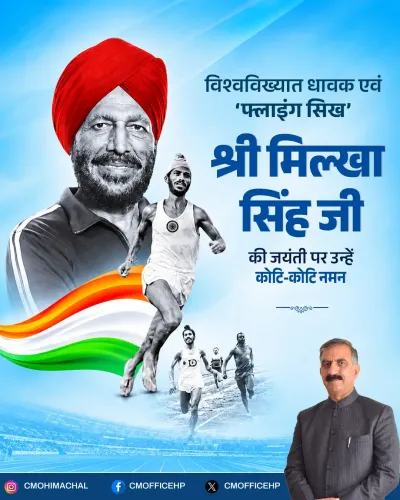
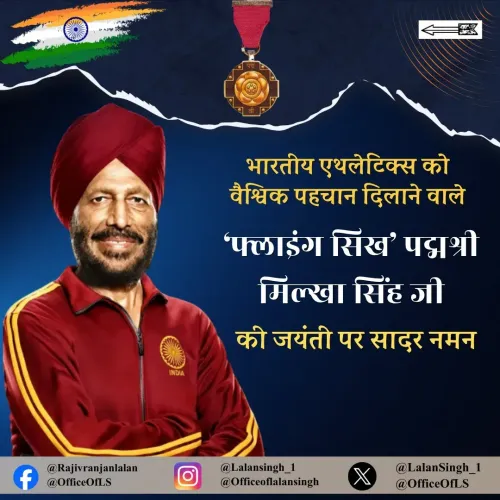
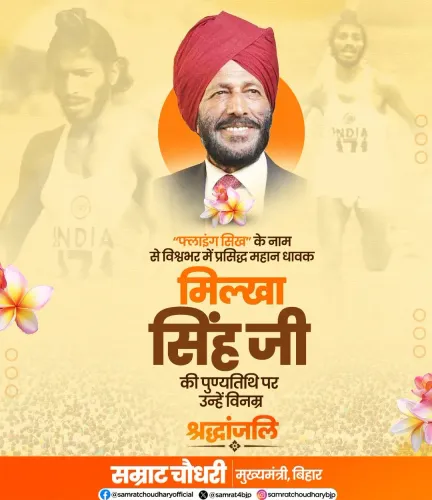
Union Parliamentary Affairs Minister Kiren Rijiju marked the birth anniversary of legendary Indian sprinter Milkha Singh on 20 November 2026, honouring the 'Flying Sikh' who won four Asian Games golds and competed in three Olympics for India.
Key Takeaways
Union Minister Kiren Rijiju paid tribute to sprinting legend Milkha Singh on his birth anniversary, 20 November 2026 .
Milkha Singh, nicknamed 'The Flying Sikh', won four Asian Games gold medals and represented India at the 1956, 1960, and 1964 Olympics .
His fourth-place finish in the 400m final at the 1960 Rome Olympics remains one of independent India's most iconic sporting near-misses.
The title 'The Flying Sikh' was reportedly given to him in Pakistan , making it a symbol of cross-border respect amid partition-era history.
Milkha Singh passed away on 18 June 2021 at the age of 91 .
A sprinter who turned personal tragedy into Olympic-era legend is being remembered today — Union Parliamentary Affairs Minister Kiren Rijiju paid tribute to Milkha Singh, 'The Flying Sikh', on his birth anniversary, Friday, 20 November 2026.
Rijiju posted in both English and Hindi, writing: 'भारत के महान धावक फ्लाइंग सिख मिल्खा सिंह जी की जयंती पर कोटि-कोटि नमन।' — 'Countless salutations to India's great sprinter, the Flying Sikh Milkha Singh, on his birth anniversary.' He added that through 'indomitable willpower, discipline, and relentless hard work', Milkha Singh gave India a distinctive identity in world athletics.
The legacy that earned a nickname from a nation
Milkha Singh's journey from a partition-scarred childhood to the global athletics stage remains one of independent India's most resonant sporting stories. He won four gold medals at the Asian Games and represented India at three consecutive Olympics — 1956 (Melbourne), 1960 (Rome), and 1964 (Tokyo). His fourth-place finish in the 400 metres final at the 1960 Rome Olympics — missing a bronze medal by a fraction of a second — became a defining symbol of India's near-miss with Olympic glory, and of the relentless pursuit that defined his career.
The title 'The Flying Sikh' was reportedly bestowed upon him in Pakistan after a race there, a detail that carried particular poignancy given the partition violence he had survived as a child. He passed away on 18 June 2021, aged 91, leaving behind a legacy that continues to shape how India sees its athletic ambitions.
Official commemoration and a pattern of sporting memory
Rijiju's tribute follows a well-established pattern of senior Indian ministers publicly honouring sporting icons on birth and death anniversaries — a form of institutional memory-keeping that keeps post-independence athletic achievements visible in the national conversation. As a minister who has previously overseen sports portfolios, Rijiju's salute carries particular resonance within that tradition.
Milkha Singh's story was introduced to a generation of younger Indians through the 2013 biographical film that dramatised his life and his Rome Olympics race, cementing his place not just in sporting history but in popular culture. His name remains a benchmark invoked whenever Indian sprinters step onto a world stage.
Decades on from Rome, the Flying Sikh's standard — discipline, sacrifice, and that last-stride pursuit of a podium — still sets the bar for Indian athletics. The question India's coaches and fans return to every Olympic cycle is the same one Milkha Singh never stopped asking himself: how close can we get?
Point of View
Who has a long association with sports governance, the salute to Milkha Singh also resonates personally — the sprinter's story of triumph through discipline mirrors the Northeast minister's own narrative of persistence in national politics. Such commemorations quietly build a broader 'sporting nationalism' frame that the BJP has consistently used to connect state identity with individual heroism. The pattern suggests these are not merely ceremonial posts but deliberate acts of soft-power memory-making.
NationPress
20 Nov 2026
Frequently Asked Questions
When is Milkha Singh's birth anniversary?
Milkha Singh's birth anniversary is celebrated on 20 November . He was born in 1929 in what is now Pakistan.
Why was Milkha Singh called the Flying Sikh?
The nickname 'The Flying Sikh' was reportedly given to Milkha Singh in Pakistan after a race there, in recognition of his extraordinary speed and his Sikh identity.
How many Olympic Games did Milkha Singh compete in?
Milkha Singh represented India at three consecutive Olympic Games — Melbourne 1956 , Rome 1960 , and Tokyo 1964 .
What was Milkha Singh's best Olympic result?
His most celebrated performance was a fourth-place finish in the 400 metres final at the 1960 Rome Olympics , where he narrowly missed a bronze medal.
When did Milkha Singh pass away?
Milkha Singh passed away on 18 June 2021 at the age of 91 .