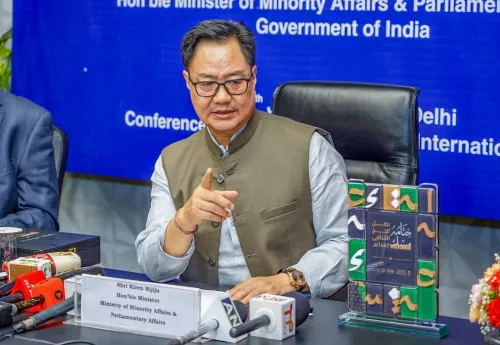
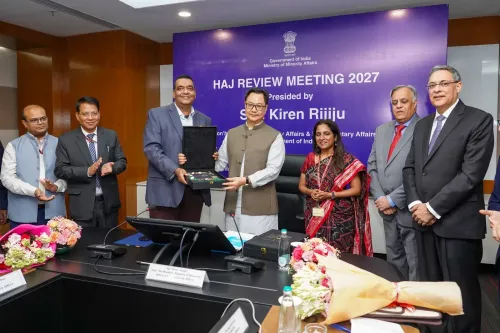
Rijiju launches Haj Policy 2027, opens pilgrim applications
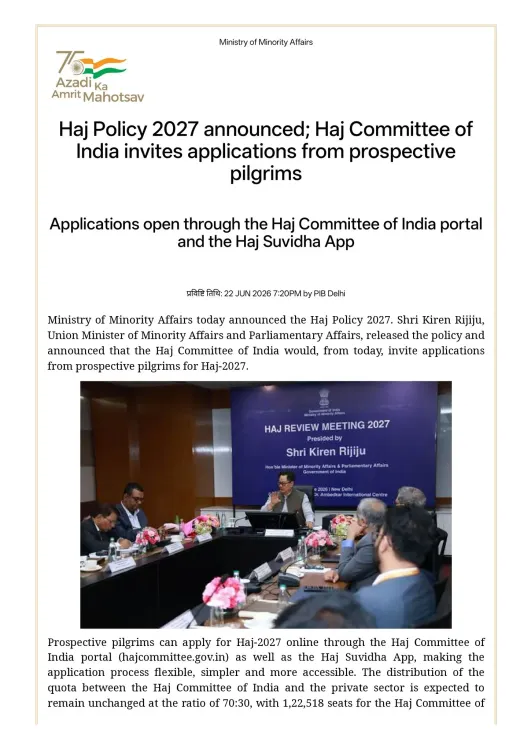
Synopsis
Union Minister Kiren Rijiju on 22 June 2026 unveiled the Haj Policy 2027 and opened applications through the Haj Committee of India portal and Haj Suvidha App, promising AI-enabled multilingual support, continued Short Haj Package, and stronger medical screening for Indian pilgrims.
Key Takeaways
Haj Policy 2027 was announced by Union Minister Kiren Rijiju on 22 June 2026 .
Applications are now open via the Haj Committee of India portal and the Haj Suvidha App .
The policy continues the Short Haj Package , a reduced-duration option designed to lower costs for pilgrims.
New technology features include AI-enabled assistance in multiple Indian languages for pilgrims.
Enhanced medical screening and on-ground support are key pillars of the 2027 policy.
The policy involves coordination between the Ministry of Minority Affairs , Ministry of External Affairs , and Indian missions in Jeddah and Riyadh .
Union Parliamentary Affairs and Minority Affairs Minister Kiren Rijiju on Monday, 22 June 2026, announced the Haj Policy 2027 and formally opened applications for the Haj-2027 season through the Haj Committee of India portal and the Haj Suvidha App. The new policy builds on reforms introduced for Haj-2026 and centres on greater comfort, safety, transparency, and dignity for every Indian pilgrim.
Context
Announcing the policy on social media, Rijiju stated that the Haj Policy 2027 introduces 'enhanced on-ground support, continuation of the Short Haj Package, strengthened medical screening and technology-driven services, including AI-enabled assistance in multiple Indian languages.' The minister added that the government 'remains committed to making the Haj pilgrimage more accessible, seamless and pilgrim-centric for every Indian Haj pilgrim.'
The Haj Committee of India, a statutory body under the Ministry of Minority Affairs, manages registration, logistics, and support services for Indian pilgrims. The Haj Suvidha App serves as the official mobile platform for pilgrim tracking, information, and service delivery, and has been progressively expanded since its rollout in 2020.
Policy Backdrop
India's Haj administration has undergone significant reform over the past decade. Following Supreme Court directions, the Haj subsidy was phased out from 2018 onwards, with the government pivoting toward enhanced transparency, self-reliance, and digital infrastructure for pilgrims. Online portals and the Haj Suvidha App replaced much of the earlier paper-based process.
The Short Haj Package, a reduced-duration pilgrimage option, was introduced to lower costs and widen access for Indian Muslims. Its continuation in the 2027 policy signals the government's intent to retain affordability as a core objective even as it layers in new technology. The integration of AI-enabled multilingual assistance aligns with the broader adoption of digital public infrastructure across government welfare programmes.
Stakeholders and Impact
The primary beneficiaries are Indian Muslim pilgrims who apply through the Haj Committee of India for the annual pilgrimage to Mecca, Saudi Arabia. Enhanced medical screening protocols are aimed at reducing health risks for older and first-time pilgrims, a segment that has historically required closer logistical support.
The policy also involves close coordination between the Ministry of Minority Affairs and the Ministry of External Affairs, along with Indian consular missions in Jeddah and Riyadh, to manage on-ground logistics and diplomatic arrangements with Saudi authorities. AI-assisted services in multiple Indian languages are intended to ease communication barriers for pilgrims from non-Hindi-speaking states.
What's Next
With applications now open on the Haj Committee of India portal and the Haj Suvidha App, the immediate focus shifts to application volumes and processing timelines ahead of mandatory medical screening deadlines for the 2027 season. The government's ability to handle digital applications at scale will be an early test of the technology-first approach embedded in the new policy.
As successive annual Haj policies have built incrementally on one another, the 2027 edition's emphasis on AI-driven multilingual services could set a template for technology integration in other minority welfare and pilgrimage-support programmes administered by the Ministry of Minority Affairs.
Point of View
Which has sought to reframe state support for pilgrims around digital infrastructure and logistical efficiency rather than direct financial transfers. The introduction of AI-enabled multilingual assistance is the most visible new layer in this trajectory, signalling that the Ministry of Minority Affairs is extending the Centre's broader digital-public-infrastructure push into minority welfare delivery. For Rijiju, who holds the dual portfolio of Parliamentary Affairs and Minority Affairs, the announcement also carries political weight ahead of the pilgrimage season, demonstrating administrative responsiveness to a key constituency. Whether the technology promises translate into measurable improvements in pilgrim experience will determine the policy's legacy beyond the announcement cycle.
NationPress
21 Sept 2026
Frequently Asked Questions
What is the Haj Policy 2027?
The Haj Policy 2027 is the Indian government's annual framework governing Haj pilgrimage arrangements for Indian Muslims, announced on 22 June 2026 by Union Minister Kiren Rijiju . It covers application processes, logistics, medical screening, and technology-driven support services for the 2027 pilgrimage season.
How can I apply for Haj 2027 from India?
Applications for Haj-2027 can be submitted through the Haj Committee of India official portal and the Haj Suvidha App , both of which were opened for registrations on 22 June 2026 .
What is the Short Haj Package?
The Short Haj Package is a reduced-duration pilgrimage option introduced by the Indian government to lower overall costs and make the Haj pilgrimage more financially accessible for Indian Muslims. It has been continued in the Haj Policy 2027 .
What new features are in Haj Policy 2027?
Haj Policy 2027 introduces AI-enabled assistance available in multiple Indian languages, enhanced on-ground support, strengthened medical screening protocols, and technology-driven services, building on the reforms implemented for the Haj-2026 season.
Who is responsible for Haj arrangements in India?
The Haj Committee of India , a statutory body under the Ministry of Minority Affairs , is responsible for registration, logistics, and support for Indian Haj pilgrims. The ministry is currently headed by Union Minister Kiren Rijiju .