Rijiju: Vande Mataram belongs to every Indian

Synopsis
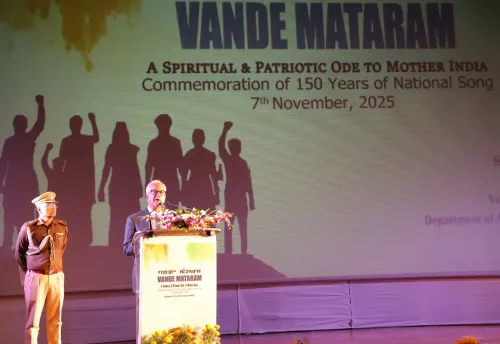
Union Parliamentary Affairs Minister Kiren Rijiju declared that Vande Mataram transcends party, group, and religion, calling it the united spirit of every Indian. The national song, composed by Bankim Chandra Chattopadhyay and adopted by the Constituent Assembly in 1950, has long been a touchstone in debates over cultural nationalism and inclusive identity.
Key Takeaways
Kiren Rijiju , Union Minister of Parliamentary Affairs and Minority Affairs, posted that Vande Mataram 'does not belong to any single party, group or religion.' He described the song as carrying 'the united spirit of every Indian.' Vande Mataram was composed by Bankim Chandra Chattopadhyay in his 1882 novel Anandamath and became a rallying anthem of India's independence movement.
The Constituent Assembly adopted it as India's national song on 24 January 1950 .
Indian political leaders across parties have periodically issued similar statements asserting the non-partisan nature of national symbols.
A national song that outlasted empires and united a subcontinent — Union Parliamentary Affairs Minister Kiren Rijiju invoked it on Friday, 21 August 2026, with a message aimed squarely at the fault lines of contemporary politics: Vande Mataram is no one party's property.
Posting under the hashtag #VandeMataram, Rijiju wrote: 'Vande Mataram does not belong to any single party, group or religion. It carries the united spirit of every Indian.' Spare. Deliberate. And in the current political climate, pointed.
From Bankim Chandra's novel to the Constituent Assembly
The song's journey to national symbol is itself a story of contested ownership. Bankim Chandra Chattopadhyay composed Vande Mataram as part of his 1882 novel Anandamath, a work set against British colonial rule. It became an anthem of the independence movement — sung at protests, in prisons, on the streets of a nation demanding freedom. The Constituent Assembly formally adopted it as India's national song on 24 January 1950, just days after the Constitution came into force. That history gives the song a weight no single political formation can claim. It predates every party currently in Parliament.A recurring pattern in Indian political discourse
Rijiju's statement fits a well-worn but important tradition: Indian leaders across party lines periodically reassert the non-partisan character of national symbols — the flag, the anthem, the national song — precisely because those symbols are periodically pulled into partisan contest. The reassertion is itself a signal that the contest exists. For a BJP minister and senior leader from Arunachal Pradesh, framing Vande Mataram as belonging equally to 'every Indian' — cutting across party, group, and religion — is also a direct address to debates about cultural nationalism and minority inclusion that have run through Indian public life for decades. The kicker: when a minister of the ruling party has to remind the country that a national song belongs to everyone, the reminder itself tells you something about the moment.Point of View
Above-politics image — a move that carries particular weight coming from a senior BJP leader who also holds the Minority Affairs portfolio. The statement implicitly pushes back against narratives that associate Vande Mataram with a specific ideological or religious identity. It reflects a broader BJP communications strategy of reclaiming national symbols as universal rather than sectarian. Whether it shifts the underlying discourse or merely signals intent is the real question to watch.
NationPress
21 Aug 2026
Frequently Asked Questions
What did Kiren Rijiju say about Vande Mataram?
Rijiju stated that Vande Mataram does not belong to any single party, group, or religion, and that it carries the united spirit of every Indian.
Who wrote Vande Mataram and when?
Bankim Chandra Chattopadhyay wrote Vande Mataram as part of his 1882 Bengali novel Anandamath . It became a prominent anthem during India's independence movement.
When was Vande Mataram adopted as India's national song?
The Constituent Assembly adopted Vande Mataram as India's national song on 24 January 1950 , shortly after the Constitution of India came into effect.
What is the difference between India's national anthem and national song?
India's national anthem is Jana Gana Mana , composed by Rabindranath Tagore. Vande Mataram holds the status of national song — equal honour is accorded to both, but they serve different ceremonial contexts.
Who is Kiren Rijiju?
Kiren Rijiju is a senior BJP leader from Arunachal Pradesh serving as Union Minister of Parliamentary Affairs and Minister of Minority Affairs in the Indian Cabinet.