Tejashwi Yadav Flags Bihar Fiscal Crisis, Slams NDA Govt
Synopsis
RJD leader Tejashwi Yadav has accused Bihar's NDA government of engineering a severe fiscal crisis, alleging a 5.8% GSDP deficit — the highest among major Indian states in 2025-26 — a four-fold rise in public debt, and cuts to the Student Credit Card scheme.
Key Takeaways
Tejashwi Yadav posted on 21 August 2026 accusing the Bihar NDA government of plunging the state into a severe economic crisis.
He alleged Bihar's fiscal deficit reached 5.8 percent of GSDP in 2025-26, claiming it was the highest among major Indian states.
Total public debt has reportedly grown by more than four times , with record borrowings over the past two years leaving the treasury empty.
Government employees, pensioners, social security beneficiaries, and contractors are cited as facing delayed payments.
The Bihar Student Credit Card scheme has seen disbursement amounts reduced, and scholarships are being wound down, according to Yadav.
Yadav demanded accountability, asking where Bihar's money is going and calling the NDA administration corrupt and incompetent.
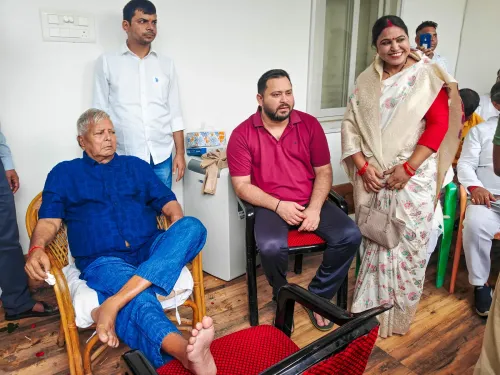
Bihar's treasury is empty, its debt has quadrupled, and its students are losing credit — so says RJD leader and Leader of the Opposition Tejashwi Yadav, who on Friday, 21 August 2026 launched one of his sharpest fiscal broadsides yet against the ruling NDA government in Bihar.
The numbers Tejashwi is putting on the table
In a lengthy post on X, Yadav cited what he called a 5.8 percent fiscal deficit relative to Bihar's Gross State Domestic Product (GSDP) for the financial year 2025-26 — which he claimed was the highest among India's major states that year. He alleged that total public debt has grown by more than four times, and that the state has taken record borrowings over the past two years while the treasury remains drained. 'Saaraa khazaana khaali hai' ('the entire treasury is empty'), he wrote, capturing the charge in a single line.
Yadav specifically named government employees, pensioners, social security beneficiaries, and contractors as groups facing delayed or withheld payments. He also flagged that the Bihar Student Credit Card scheme — a flagship education-loan programme — has seen its disbursement amounts cut, and that scholarships are being wound down.
The political target: Bihar's Chief Minister
Yadav did not stop at numbers. He trained his fire on the state's Chief Minister, describing him as an 'anaadi' ('novice') 'Gujarat se manoneeth' ('nominated from Gujarat') who, in his telling, lacks any grasp of expenditure management, debt management, or fiscal deficit control. The characterisation is a pointed political jab — framing the CM as an outsider parachuted into the role rather than a leader rooted in Bihar's ground realities.
He accused the NDA coalition of running what he called a 'double engine sarkar' that has become a vehicle for 'bhrashtachar aur sangathit loot' — corruption and organised plunder — asking bluntly: 'Where is all of Bihar's money going? Every citizen of Bihar knows the answer.'
Bihar's fiscal record and why the charge lands
Bihar has historically carried one of the lowest own-tax-revenue-to-GSDP ratios among Indian states, making it structurally dependent on central transfers and market borrowings. The state adopted a Fiscal Responsibility and Budget Management framework in the 2010s to cap deficits, but post-pandemic spending pressures — felt across nearly every Indian state — have strained those guardrails. Opposition parties have consistently used CAG reports and budget documents to spotlight the gap between borrowing levels and visible development outcomes.
Yadav's Rashtriya Janata Dal (RJD) has made fiscal accountability a central campaign plank ahead of any electoral cycle, arguing that the NDA's 'double engine' narrative — a coalition of state and central governments from the same alliance — has delivered debt rather than development.
The specific figures Yadav cites — the 5.8 percent GSDP deficit and the four-fold debt increase — have not been independently verified, and the NDA government has not yet responded publicly to this post. Bihar's next budget session and any forthcoming CAG audit report on state finances will be the real stress-test for these claims.
For now, Tejashwi Yadav has framed Bihar's finances not as a technocratic problem but as a moral one — and he is asking voters to decide who bears the cost.
Point of View
Framing fiscal mismanagement as an outsider problem. If CAG reports or revised budget estimates corroborate even part of the debt trajectory Yadav describes, the NDA's 'double engine' branding faces a serious credibility test in a state where welfare payments and student schemes are politically sensitive. The silence from the ruling coalition in the immediate aftermath will itself become a data point opposition campaigners will use.
NationPress
21 Aug 2026
Frequently Asked Questions
What is Tejashwi Yadav saying about Bihar's economy?
Tejashwi Yadav claims Bihar is in a severe fiscal crisis, alleging the state's fiscal deficit hit 5.8 percent of GSDP in 2025-26 — the highest among major Indian states — and that total public debt has grown more than four times under the NDA government.
What is the Bihar Student Credit Card scheme and why is it in the news?
The Bihar Student Credit Card is a state government programme that provides education loans to students. Tejashwi Yadav has alleged that the NDA government has reduced the disbursement amounts under this scheme due to fiscal pressure.
Is Bihar's fiscal deficit really the highest among Indian states?
Tejashwi Yadav has claimed Bihar recorded a fiscal deficit of 5.8 percent of GSDP in 2025-26, calling it the highest among major Indian states. These figures have not been independently verified and the state government has not publicly responded.
Who is the Bihar Chief Minister Tejashwi Yadav is criticising?
Tejashwi Yadav referred to Bihar's Chief Minister as a 'novice nominated from Gujarat' without naming him directly, alleging the CM lacks understanding of expenditure, debt, and fiscal deficit management.
What is the NDA government in Bihar?
The National Democratic Alliance (NDA) in Bihar is a coalition primarily comprising the Janata Dal (United) and the Bharatiya Janata Party, which has governed the state in various configurations. Tejashwi Yadav's RJD is the principal opposition party.