Rajnath Singh slams Congress over Vande Mataram row, calls it unconstitutional
Synopsis
Defence Minister Rajnath Singh has called Congress’s alleged refusal to honour Vande Mataram ‘a very serious matter’ from a constitutional perspective, invoking the 1937 Muslim League resolution and Partition in a sweeping attack that transforms a song dispute into a full-scale loyalty debate — and a clear BJP electoral signal.
Key Takeaways
Defence Minister Rajnath Singh on 21 August attacked Congress over its alleged “formal refusal” to honour Vande Mataram .
Singh called the stance “entirely unconstitutional and reprehensible” in a post on X .
He invoked the Congress resolution of 1937 , alleging it was passed under pressure from the Muslim League and linking it to India’s Partition .
Singh warned that Congress “surrendering to radical elements” is “a serious warning sign for the future of the country.” Congress had not issued a formal public response to Singh’s charges at the time of this report.
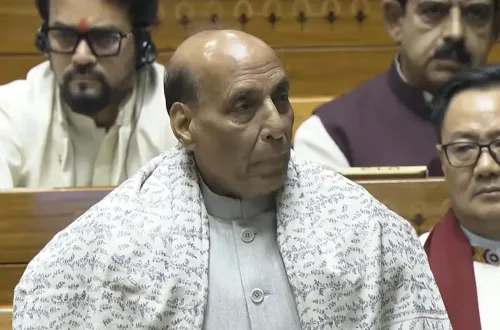
Defence Minister Rajnath Singh on Friday, 21 August launched a sharp attack on the Indian National Congress over what he described as the party's “formal refusal” to honour Vande Mataram, calling the alleged stance “extremely regrettable” and “a very serious matter” from a constitutional standpoint. Singh made his remarks in a post on X, escalating a political row over the national song into a broader debate on constitutional loyalty and patriotism.
What Rajnath Singh Said
Singh argued that Parliament occupies the supreme position in India’s constitutional framework and that its laws are binding on every citizen. “According to the Constitution of India, Parliament is the supreme institution of the country, and any law passed by Parliament is binding on every individual. If someone refuses to abide by it, their loyalty to the Constitution certainly comes under suspicion, and if someone refuses to honour the national song, a question mark is placed on their patriotism as well,” he said.
He went further, terming the Congress’ alleged position “entirely unconstitutional and reprehensible” and warned it would “create a serious crisis in the future of the country.”
The 1937 Resolution and Partition Argument
Singh also invoked the Congress resolution of 1937, alleging it was adopted under pressure from the Muslim League and drawing a direct line from that decision to the Partition of India. “The resolution of 1937 that the Congress refers to was one that the Congress passed by bowing down to the radical demands of the Muslim League, and its consequence was witnessed by the country in the future in the form of partition,” he said.
This historical reference is a recurring argument in Bharatiya Janata Party (BJP) political messaging, linking Congress’s past positions on religious accommodation to what it characterises as a pattern of appeasement. Critics of this framing, however, contend that the 1937 resolution reflected a pluralist consensus, not capitulation.
Accusations of Surrendering to Radical Elements
The Defence Minister further accused Congress of once again compromising with what he called “radical elements,” warning that such an approach carried grave consequences. “Compromising with radical elements has always proven fatal for the country, and today, when the Congress is surrendering in the same manner to radical elements, it is a serious warning sign for the future of the country,” Singh said.
He concluded by accusing the opposition party of revealing “foolish and dangerous intentions” through its alleged opposition to Vande Mataram. Congress has not yet issued a formal public response to Singh’s specific charges as of the time of this report.
Context and Political Background
The Vande Mataram debate has historically been a flashpoint in Indian politics, touching on questions of religion, nationalism, and constitutional rights. The song, composed by Bankimchandra Chattopadhyay, was adopted as the national song at the time of Independence but has periodically drawn objections from some communities over its religious connotations. This latest episode comes amid heightened political tensions between the BJP and Congress ahead of several upcoming state elections, making the row as much an electoral signal as a constitutional argument.
With Singh framing the issue as both a patriotism test and a constitutional crisis, the controversy is likely to intensify in the coming days as Congress is expected to respond formally.
Point of View
But deploying it through a serving Defence Minister gives it institutional weight that a party spokesperson’s statement would not carry. What is missing from this exchange is Congress’s actual, on-record position: Singh characterises it as a ‘formal refusal,’ yet no official Congress resolution to that effect has been cited. Until that is established, the constitutional argument rests on a contested premise. The timing — with multiple state elections approaching — suggests the row is as much about voter mobilisation as constitutional principle.
NationPress
5 Oct 2026
Frequently Asked Questions
What did Rajnath Singh say about Congress and Vande Mataram?
Defence Minister Rajnath Singh said Congress’s alleged formal refusal to honour Vande Mataram is ‘extremely regrettable’ and ‘a very serious matter’ from a constitutional perspective. He called the position ‘entirely unconstitutional and reprehensible’ in a post on X on 21 August.
Why did Rajnath Singh bring up the 1937 Congress resolution?
Singh cited the 1937 Congress resolution to argue that the party has a historical pattern of yielding to what he called radical demands, linking that resolution to the eventual Partition of India. He used this historical argument to reinforce his charge that Congress is again compromising with radical elements.
What is the constitutional status of Vande Mataram in India?
Vande Mataram is India’s national song, distinct from the national anthem Jana Gana Mana. While the national anthem carries a statutory obligation, the legal compulsion around the national song is a matter of ongoing political and legal debate in India.
Has Congress responded to Rajnath Singh’s attack?
As of the time of this report, Congress had not issued a formal public response to the specific charges made by Rajnath Singh on 21 August.
Why is the Vande Mataram debate significant politically?
The Vande Mataram row has historically intersected with questions of religion, nationalism, and minority rights in India. Its resurfacing ahead of state elections makes it a politically charged issue, with the BJP framing it as a loyalty and patriotism test for the opposition.