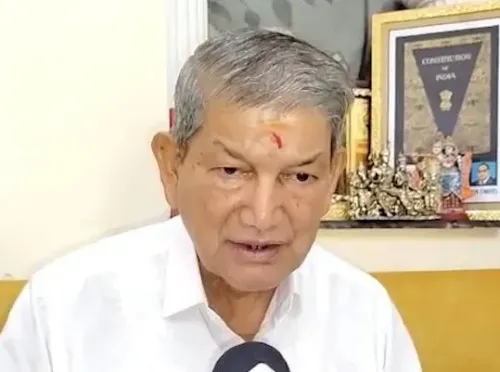
Lalan Singh slams Congress over Vande Mataram stanza row
Synopsis
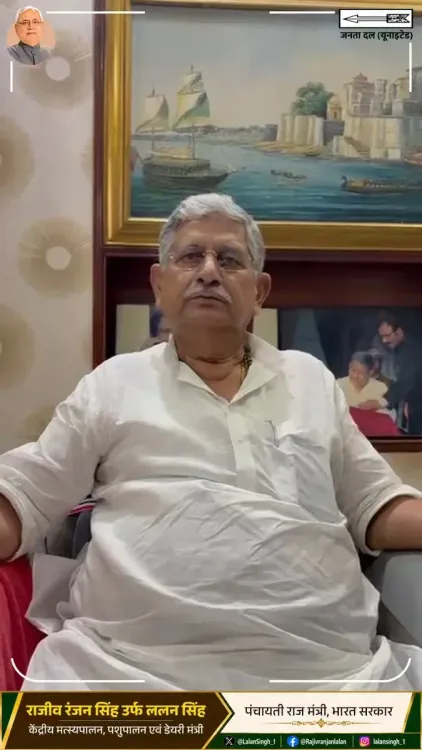
Union Minister Rajiv Ranjan Singh attacked Congress on August 20 for restricting Vande Mataram to two stanzas, calling it appeasement politics that places vote-bank calculations above national pride, and predicted the party will continue to shrink.
Key Takeaways
Union Minister Rajiv Ranjan Singh publicly attacked Congress on August 20, 2026 over its practice of singing only the first two stanzas of Vande Mataram .
The Congress Working Committee originally adopted the two-stanza limit in 1937 to accommodate communities that objected to verses invoking goddess imagery.
Singh argued the third and fourth stanzas — referencing Bharat Mata and Maa Durga — are being deliberately skipped to appease a specific community.
He credited the Modi government with giving Vande Mataram formal legal recognition as the national song, contrasting it with Congress's partial adoption.
Singh predicted Congress will 'keep shrinking' as voters recognise what he called appeasement politics prioritised over patriotism.
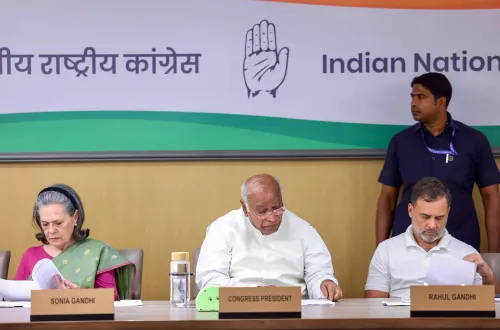
A Congress Working Committee decision to sing only the first two stanzas of Vande Mataram has drawn sharp fire from Union Minister Rajiv Ranjan Singh, who called it proof that the party places vote-bank politics above national commitment — and predicted Congress will keep shrinking as voters see through it.
The 1937 decision that never went away
The fault line is not new. As far back as 1937, the Congress Working Committee resolved to sing only the opening two stanzas of Vande Mataram — a call to accommodate communities that objected to later verses invoking goddess imagery. That decision has never been formally reversed, and it has remained a live grievance in India's culture wars ever since.
Singh's post goes straight at the reasoning. The third stanza, he argues, describes Bharat Mata as a form of divine power; the fourth invokes Maa Durga. His charge: Congress skips those verses deliberately, to appease a specific section of society. 'Their appeasement has risen above love of country — it is unfortunate,' he wrote.
Vande Mataram's place in India's freedom struggle
Vande Mataram — 'I bow to thee, Mother' — was composed by Bankim Chandra Chattopadhyay and became the most electrifying anthem of the independence movement. Singh invoked that lineage pointedly: freedom fighters carried the flag on their shoulders singing this song, he said, and it stirred mass awakening across the country.
The Modi government has reinforced the song's standing as the national song with formal legal recognition, a move Singh cited as a direct contrast to Congress's partial adoption. 'PM Narendra Modi's government gave it the status of national song, gave it legal rights, established it — and now they say they won't sing beyond two stanzas,' he said.
Appeasement charge and the BJP's cultural-nationalist playbook
The attack fits a pattern that has defined BJP-Congress exchanges since at least 2014: BJP leaders regularly frame Congress's secular accommodations as minority appeasement at the cost of national symbols, while Congress defends the position as inclusive pluralism. Singh's post adds ministerial weight to that familiar charge.
He closed with a political forecast: 'The public is recognising these people. Congress is shrinking and will keep shrinking.' Whether that prediction holds will be tested in the string of state elections ahead — but the Vande Mataram debate has now been firmly re-injected into the national conversation.
Point of View
And a senior NDA minister amplifying it now signals the party intends to keep cultural identity at the centre of electoral discourse. For Congress, the 1937 CWC position remains a structural vulnerability: defending it as pluralism reads as appeasement to a large swathe of voters. Watch for whether Congress issues a formal clarification or lets the charge stand unanswered.
NationPress
5 Oct 2026
Frequently Asked Questions
Why does Congress sing only two stanzas of Vande Mataram?
The Congress Working Committee resolved in 1937 to sing only the first two stanzas of Vande Mataram to accommodate communities that objected to later verses containing Hindu goddess imagery. That position has not been formally reversed.
What do the third and fourth stanzas of Vande Mataram say?
According to Minister Lalan Singh's statement, the third stanza describes Bharat Mata as a form of divine power, and the fourth stanza invokes Maa Durga. These are the verses Congress omits.
Is Vande Mataram India's national anthem or national song?
Vande Mataram is India's national song, distinct from the national anthem Jana Gana Mana. The Modi government has given it formal legal recognition as the national song.
Who is Lalan Singh and which party does he belong to?
Lalan Singh, formally Rajiv Ranjan Singh, is a senior leader of Janata Dal (United) and serves as Union Minister of Panchayati Raj, Fisheries, Animal Husbandry and Dairying in the NDA government.
What is the BJP's position on Vande Mataram?
BJP leaders consistently advocate singing Vande Mataram in full and frame Congress's two-stanza limit as minority appeasement. They contrast this with the Modi government's move to give the song formal legal standing as the national song.