Pradhan Slams Congress Over Vande Mataram Retreat
Synopsis
Union Education Minister Dharmendra Pradhan has accused Congress of repeating its 1937 decision to limit Vande Mataram, calling the Congress Working Committee's reported retreat from the full national song an act of vote-bank appeasement, and demanding Rahul Gandhi publicly clarify the party's priorities.
Key Takeaways
Union Education Minister Dharmendra Pradhan posted a sharp attack on Congress on 20 August 2026 over the party's reported decision not to sing the complete Vande Mataram .
Pradhan linked the move to the 1937 Congress Working Committee resolution that limited the song to its first two stanzas, attributing that decision to vote-bank pressure.
He drew a direct connection between Congress's 1937 appeasement and the 1947 Partition , framing both as consequences of the same political tendency.
Pradhan credited the Modi government with extending legal protection to the complete Vande Mataram on the occasion of the song's 150th anniversary .
He posed a pointed public challenge to Rahul Gandhi : whether Congress prioritises national honour over its vote bank.
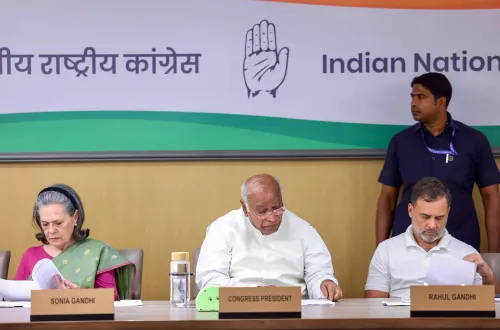
A national song composed in 1874–75 has reignited one of India's sharpest political fault lines — and Union Education Minister Dharmendra Pradhan is not holding back. On Thursday, 20 August 2026, Pradhan fired a pointed salvo at the Indian National Congress, accusing the party of repeating a 1937 act of 'appeasement' by stepping back from the full singing of 'Vande Mataram' at a Congress Working Committee session.
Pradhan's post, written in Hindi, opens with a blunt charge: 'Kaangres ka tushtikaaran phir saamne hai' — 'Congress's appeasement is on display again' — and names the target squarely: India's national song, Vande Mataram. He writes that the Congress Working Committee's decision to retreat from the complete rendition of the song is 'not merely a political decision, but a repetition of its old politics of appeasement.'
The 1937 Decision That Haunts Congress
The BJP's critique of Congress on this issue has deep historical roots. In 1937, the Congress Working Committee resolved to limit the singing of Vande Mataram to its first two stanzas, a concession widely attributed to sensitivities within the Muslim League over the song's later verses. Pradhan invokes that moment directly, arguing that 'the appeasement politics of that era gave strength to forces that weakened national unity' — and draws a straight line to the Partition of 1947.
It is a well-worn BJP narrative, but one that lands with particular force in the context of a song that has, since Bankim Chandra Chattopadhyay composed it, served as a rallying cry through colonial resistance. The song's first verse — 'Vande Mataram, Sujalaam, Suphalaam' — became the battle-hymn of the freedom movement. To limit it, Pradhan argues, is to limit the memory of that struggle.
Modi Government's Move on the 150th Anniversary
Pradhan anchors his attack to a recent government action: he states that Prime Minister Narendra Modi's government has, on the occasion of Vande Mataram's 150th year, extended legal protection to the complete song — framing it as a correction of what he calls a 'historic blunder.' Note: the precise contours and timing of this legal protection have not been independently confirmed.
The political contrast Pradhan is constructing is deliberate. With the Modi government positioned as the restorer of the full song's dignity, the Congress Working Committee's reported decision to not sing it in full becomes, in this framing, an act of ideological regression — not administrative convenience.
The Challenge to Rahul Gandhi
Pradhan's sharpest line is reserved for Rahul Gandhi, the Leader of Opposition. He demands Gandhi answer a direct question: 'Is the nation's honour more important to Congress, or its vote bank?' The phrasing is surgical — it forces a public response or leaves the silence to speak.
Pradhan closes with a declaration that reads almost like a constitutional assertion: 'The country will never compromise on the honour of Vande Mataram.' In the BJP's political vocabulary, this is standard but effective — it places the national song beyond negotiation and dares Congress to argue otherwise.
Whether Congress responds with a defence of its historical position or reframes the debate around the song's contested stanzas, the exchange is now live — and Vande Mataram's 150th year has become the stage for a fight over who owns India's freedom-movement inheritance.
Point of View
Invoke Partition as the ultimate consequence, and force the opposition to either defend an uncomfortable historical record or stay silent. The timing — on the claimed 150th anniversary of Vande Mataram — is not accidental; anniversaries amplify symbolic stakes. For Congress, the challenge is structural: any defence of the 1937 decision risks validating the BJP's framing, while silence cedes the patriotism narrative entirely to its rival. This exchange is less about a song and more about which party gets to claim the freedom movement as its own.
NationPress
4 Oct 2026
Frequently Asked Questions
Why is Vande Mataram controversial in India?
Vande Mataram has been contested since the colonial era because some of its later verses contain references that certain Muslim communities found objectionable. The 1937 Congress Working Committee limited its official singing to the first two stanzas for this reason, and the debate over the complete song has periodically resurfaced in Indian politics.
What did the Congress Working Committee decide about Vande Mataram?
According to Union Education Minister Dharmendra Pradhan's post, the Congress Working Committee decided to retreat from singing the complete Vande Mataram at its session, a decision Pradhan equated with the party's 1937 resolution to limit the song to its first two stanzas.
What did the Modi government do for Vande Mataram's 150th anniversary?
Pradhan stated that the Modi government extended legal protection to the complete Vande Mataram on the occasion of the song's 150th year. The precise details and scope of this legal protection have not been independently confirmed.
Who composed Vande Mataram and when?
Vande Mataram was composed by Bengali author and social reformer Bankim Chandra Chattopadhyay between 1874 and 1875 . It was first published in his novel 'Anandamath' and became a rallying anthem during India's independence movement.
What is Dharmendra Pradhan's criticism of Rahul Gandhi?
Pradhan challenged Rahul Gandhi, the Leader of Opposition, to publicly clarify whether Congress considers the nation's honour more important than its vote bank — framing the Congress Working Committee's Vande Mataram decision as evidence of the party choosing electoral calculation over national sentiment.