Tejashwi Yadav Slams Bihar Govt: Rs 4 Lakh Crore Debt Exposed
Synopsis
Tejashwi Yadav rocked the Bihar Assembly during the trust vote debate, alleging a Rs 4 lakh crore debt crisis and branding the Samrat Choudhary-led government as a coalition of political defectors. His 'Lalu School of Politics' jibe and turban remark signal Bihar's 2025 election battle has truly begun.
Key Takeaways
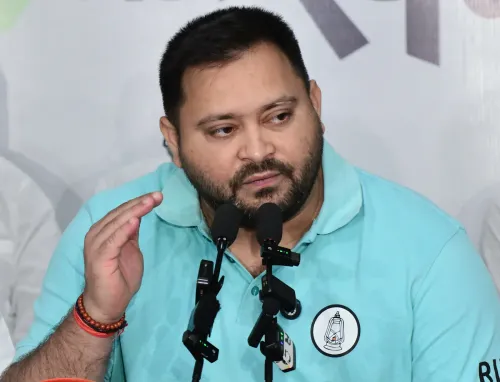
Tejashwi Yadav attacked the Samrat Choudhary-led Bihar government during the trust vote debate on April 25 in the Bihar Legislative Assembly .
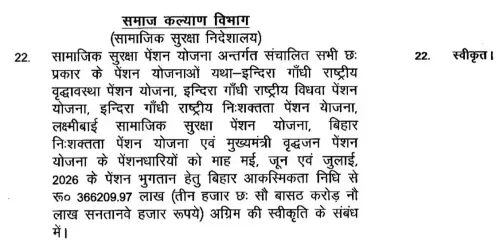
He alleged Bihar's total debt stands at nearly Rs 4 lakh crore , with pension payments reportedly under financial strain.
Tejashwi described Bihar as a "political laboratory" , citing five government changes in five years as proof of chronic instability.
He named Vijay Kumar Chaudhary (ex-Congress), Bijendra Prasad Yadav (ex-RJD), and Nitish Kumar (ex-RJD) as evidence that the ruling coalition is built on political defectors.
His "Lalu School of Politics" jibe targeted Chief Minister Nitish Kumar's political origins and the ideological incoherence of the NDA alliance in Bihar.
The trust vote debate signals the beginning of an aggressive opposition campaign ahead of Bihar's 2025 assembly elections .
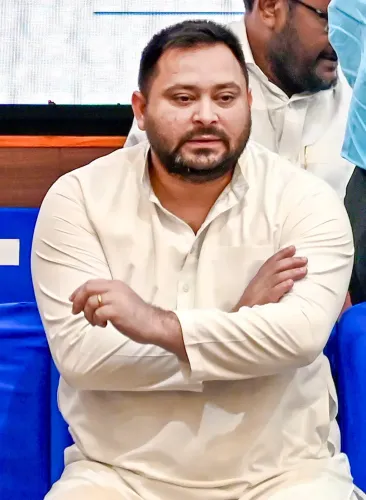
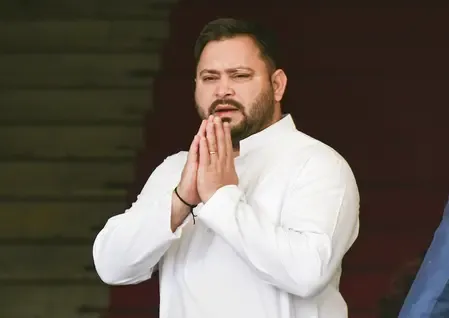
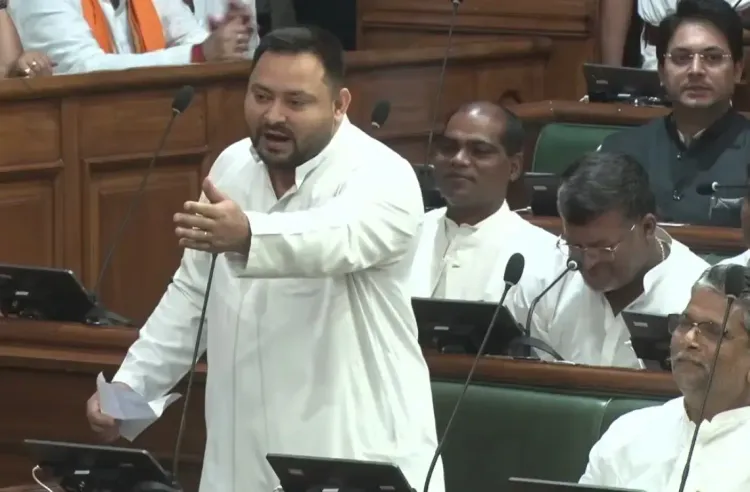
Patna, April 25: Leader of Opposition Tejashwi Yadav delivered a scathing indictment of the Samrat Choudhary-led Bihar government during the trust vote debate in the Bihar Legislative Assembly on Friday, April 25, alleging that the state's treasury has been drained dry and that Bihar is now staggering under a debt burden of nearly Rs 4 lakh crore. His remarks, sharp and politically layered, turned the floor of the Assembly into a battleground over Bihar's fiscal health and the legitimacy of the ruling coalition.
Bihar's Fiscal Crisis: The Rs 4 Lakh Crore Debt Alarm
Tejashwi Yadav alleged that Bihar's state exchequer is under severe financial strain, with the government struggling to meet even basic obligations. He specifically pointed out that pension payments — a fundamental commitment to retired government employees — are reportedly facing delays due to liquidity pressures.
He questioned how a government burdened with such colossal debt could credibly pursue infrastructure and development projects. The Rs 4 lakh crore debt figure, if accurate, would represent one of the most severe fiscal positions among India's major states, raising serious questions about Bihar's long-term financial sustainability.
This comes amid broader concerns about India's state-level fiscal deficits, with several opposition-led and ruling-party-led states alike grappling with revenue shortfalls post-COVID. However, critics argue that Bihar's dependence on central transfers — which account for a disproportionately large share of its revenue — makes it especially vulnerable to any slowdown in central disbursements.
Political Instability: Five Governments in Five Years
Tejashwi described Bihar as a "political laboratory" — a state where governments are assembled and dismantled with alarming frequency. He cited the churn of five governments in five years as stark evidence that the National Democratic Alliance (NDA) has failed to provide stable, consistent governance to the people of Bihar.
He took direct aim at the ruling coalition's campaign slogan "2025 se 30, phir se Nitish" — a rallying cry for Chief Minister Nitish Kumar's return — dismissing it as a manufactured political narrative designed to mislead voters rather than reflect ground realities.
Notably, Bihar has witnessed dramatic political realignments in recent years, with Nitish Kumar switching alliances between the NDA and the INDIA bloc multiple times, making the state a textbook case of opportunistic coalition politics in Indian democracy.
"Not Original BJP" — Tejashwi's Attack on the Ruling Coalition's Ideological Roots
In one of his most pointed attacks, Tejashwi Yadav argued that the current ruling dispensation is populated not by ideologically committed BJP members but by political defectors from rival parties. He named senior leaders including Vijay Kumar Sinha, Vijay Kumar Chaudhary, and Bijendra Prasad Yadav to illustrate his point.
He specifically stated that Vijay Kumar Chaudhary had migrated from the Congress, Bijendra Prasad Yadav from the RJD, and that even Chief Minister Nitish Kumar himself was originally a product of the RJD's political ecosystem. This, Tejashwi argued, breeds ideological inconsistency and internal friction within the coalition.
His "Lalu School of Politics" jibe was a particularly layered provocation — suggesting that Nitish Kumar, despite years of distancing himself from Lalu Prasad Yadav, still carries the political DNA of that era, as do several of his cabinet colleagues who once served under Lalu's political umbrella.
Sarcastic Turban Remark: A Warning About Coalition Cracks
Tejashwi offered a sarcastic piece of advice to the Chief Minister, telling him to hold firmly onto his turban — a metaphorical warning that internal dissent and power struggles within the ruling coalition could destabilize his position sooner than expected.
The remark is significant given the BJP's decision not to declare a pre-announced Chief Ministerial candidate ahead of elections. Tejashwi argued that this deliberate ambiguity has fueled uncertainty and political instability in Bihar, leaving governance in a state of drift.
Political analysts have long noted that the absence of a declared CM face in coalition arrangements often becomes a fault line — one that opposition parties exploit effectively during floor debates and election campaigns alike.
What This Means for Bihar's Political Landscape Ahead
The trust vote debate has effectively set the stage for what promises to be a fiercely contested political battle in Bihar as the state moves closer to the 2025 assembly election cycle. Tejashwi Yadav's strategy appears focused on two fronts: exposing fiscal mismanagement to erode public confidence in the NDA government, and deepening the narrative of ideological incoherence within the ruling alliance.
With the RJD positioning itself as the credible alternative, and the INDIA bloc seeking to consolidate opposition votes, the coming months will test whether Tejashwi's aggressive Assembly performance translates into tangible electoral momentum on the ground.
As Bihar's fiscal situation and political stability remain under intense scrutiny, all eyes will be on the state budget sessions and upcoming local body elections for early signals of the public mood.
Point of View
And that it is ideologically hollow. The Rs 4 lakh crore debt claim, if substantiated, exposes a fundamental contradiction in the NDA's 'development' narrative — a state that cannot pay pensions cannot credibly promise progress. More tellingly, Tejashwi's 'defector' attack reveals the BJP's structural vulnerability in Bihar: a coalition stitched together from political rivals may win floor numbers but struggles to project unified governance. Bihar's voters, who have witnessed five governments in five years, deserve answers — not slogans.
NationPress
6 Oct 2026
Frequently Asked Questions
What did Tejashwi Yadav say during the Bihar trust vote debate?
Tejashwi Yadav alleged that Bihar is burdened with a debt of nearly Rs 4 lakh crore and that the state treasury is under severe financial strain. He also attacked the ruling coalition for comprising political defectors and questioned the government's ability to fund development projects.
What is Bihar's current debt situation according to Tejashwi Yadav?
Tejashwi Yadav claimed Bihar's total debt stands at approximately Rs 4 lakh crore, with even pension payments reportedly facing financial constraints. He argued this fiscal crisis makes the government's development promises unrealistic.
Why did Tejashwi Yadav call Bihar a political laboratory?
Tejashwi used the term 'political laboratory' to highlight that Bihar has seen five governments in five years, reflecting chronic political instability. He blamed the NDA's lack of a pre-declared Chief Ministerial face for contributing to this uncertainty.
What was Tejashwi Yadav's 'Lalu School of Politics' remark about?
The remark was a layered political attack suggesting that Chief Minister Nitish Kumar and several ruling coalition members — who originally belonged to the RJD or Congress — carry the political imprint of Lalu Prasad Yadav's style of governance. Tejashwi used it to highlight ideological inconsistency within the NDA.
What is the significance of the Bihar trust vote in 2025?
The trust vote debate in the Bihar Legislative Assembly is a critical political moment ahead of the 2025 state elections. It has exposed fault lines within the ruling NDA coalition and provided the opposition RJD a platform to raise fiscal and governance concerns before the electorate.