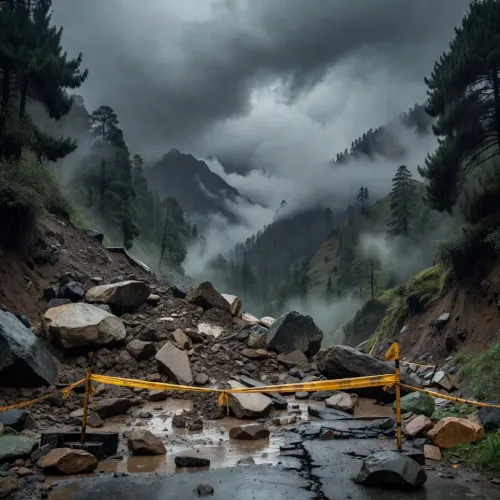
HP CM Office on Kadu Nala Rockfall: Tata Sumo Crushed

Synopsis
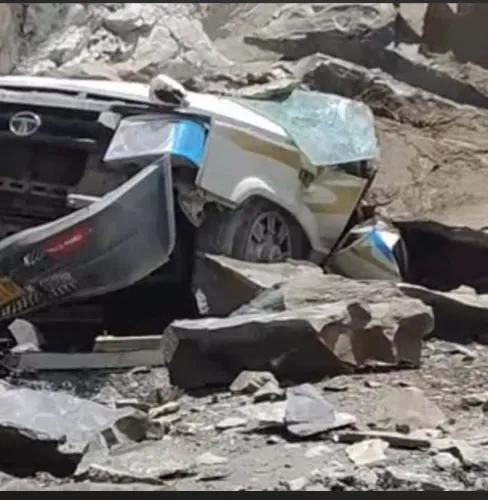
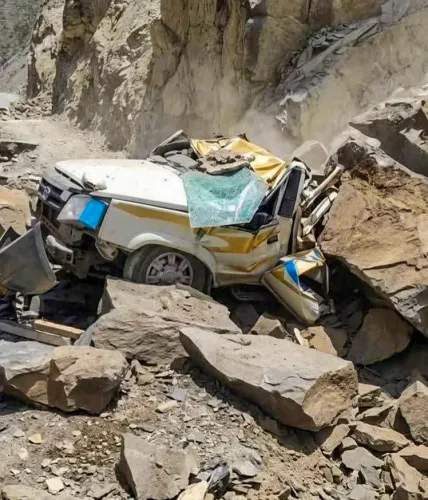
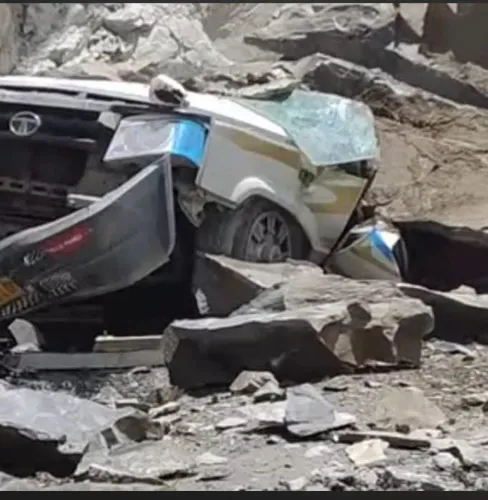
The Himachal Pradesh CMO confirmed multiple fatalities after a rockfall crushed a Tata Sumo at Kadu Nala on the Pangi–Lahaul-Spiti border on 24 July 2026, stating the impact was so sudden that no rescue was possible. The CMO received details via phone from the RC Pangi.
Key Takeaways
A rockfall at Kadu Nala , on the border of Pangi and Lahaul-Spiti districts, struck a Tata Sumo vehicle on 24 July 2026 .
Multiple people were killed; the CMO described the disaster as so severe that no opportunity to save the occupants existed .
The Chief Minister's Office of Himachal Pradesh obtained first-hand information by calling the RC Pangi (Revenue Circle officer).
Kadu Nala is a remote, high-risk corridor between Chamba and Lahaul-Spiti , prone to rockfalls especially during monsoon.
SDRF deployment and ex-gratia relief for victims' families are expected as immediate next steps.
The incident highlights the urgent need for slope-stabilisation and early-warning systems on Himachal Pradesh border roads.
The Chief Minister's Office of Himachal Pradesh on Friday, 24 July 2026, confirmed that multiple people have lost their lives after a rockfall struck a Tata Sumo vehicle at Kadu Nala, a border-area stretch between Pangi and Lahaul-Spiti districts. The CMO stated it had spoken by phone with the RC Pangi (Revenue Circle officer, Pangi) to obtain first-hand details of the tragedy.
The post, written in Hindi, reads in translation: 'Pangi aur Lahaul-Spiti jile ke seemavarti kshetra Kadu Nala mein ek Tata Sumo vahan par chattan girne se anek logon ke nidhan ke baad RC Pangi se phone par batcheet kar ghatna ki jaankari prapt ki.' ('After the deaths of several people due to a boulder falling on a Tata Sumo vehicle in the border area of Kadu Nala between Pangi and Lahaul-Spiti districts, information about the incident was obtained by speaking on the phone with RC Pangi.') The statement added that the grief deepened upon learning the disaster was so severe that no opportunity to save the occupants could be found.
Context
Kadu Nala lies along one of the most treacherous road corridors in Himachal Pradesh, connecting the remote Pangi valley in Chamba district with the high-altitude expanse of Lahaul-Spiti. The terrain is characterised by near-vertical cliff faces, loose scree slopes, and roads barely wide enough for a single vehicle. The Tata Sumo, a workhorse utility vehicle widely used for inter-village transport in these hills, was travelling through this stretch when the rockfall occurred.
The CMO's direct outreach to the RC Pangi — the Revenue Circle administrative officer stationed in the valley — underscores how thin the communication infrastructure is in this region. Satellite or single-bar mobile connectivity often makes phone contact the only available channel for real-time disaster reporting.
Policy Backdrop
Himalayan districts of Himachal Pradesh, particularly Pangi and Lahaul-Spiti, experience recurrent rockfalls and landslides, especially during and after the monsoon season when soil saturation loosens boulder formations. The state has periodically announced slope-stabilisation and road-widening projects for border roads, many of which fall under the Border Area Development Programme (BADP) and central schemes administered by the Border Roads Organisation (BRO).
Despite these efforts, the combination of extreme elevation, seismic sensitivity, and seasonal precipitation continues to make these corridors among the most hazard-prone in the country. Local administrations rely heavily on district-level revenue officials — such as the RC — for first-response coordination before specialised rescue teams can be mobilised from district headquarters, which may be several hours away.
Stakeholders and Impact
The immediate victims are the occupants of the Tata Sumo vehicle, whose identities had not been publicly confirmed at the time of the CMO's post. Residents of the Pangi valley and travellers on the Kadu Nala stretch depend on this route for access to markets, hospitals, and government services. Any prolonged road blockage following a rockfall can cut off entire hamlets for days.
The CMO's acknowledgement that 'no opportunity to save the occupants could be found' points to the instantaneous and total nature of the impact — a grim reality that rescue teams and local authorities in these terrains often face. The statement reflects both official grief and an implicit admission of the limits of disaster response in such geography.
What's Next
Authorities are expected to dispatch State Disaster Response Force (SDRF) teams and district administration personnel to Kadu Nala to retrieve the vehicle, confirm casualties, and assess whether the road can be cleared for emergency access. The state government is also likely to announce ex-gratia relief for the families of the deceased.
The incident will renew pressure on the Himachal Pradesh government to accelerate slope-protection works and install early-warning rockfall sensors along high-risk corridors in Pangi and Lahaul-Spiti ahead of the remaining monsoon weeks — a window during which the risk of further rockfalls remains elevated.
Point of View
Even when the news is wholly grim. The incident fits a persistent pattern: border-area roads in Himachal Pradesh receive periodic infrastructure attention but remain structurally vulnerable during monsoon, exposing a gap between policy intent and on-ground safety outcomes. With elections and tourism seasons both sensitive to perceptions of road safety, the state government faces mounting pressure to move beyond reactive condolences toward credible, funded slope-protection timelines. How quickly relief reaches the victims' families and whether the road is secured before the next rainfall will be the real test of administrative capacity in this terrain.
NationPress
23 Oct 2026
Frequently Asked Questions
What happened at Kadu Nala in Himachal Pradesh on 24 July 2026?
A large boulder fell on a Tata Sumo vehicle at Kadu Nala, a stretch on the border between Pangi and Lahaul-Spiti districts of Himachal Pradesh, killing multiple occupants. The Chief Minister's Office confirmed the tragedy after speaking with the local Revenue Circle officer.
Where exactly is Kadu Nala located?
Kadu Nala is a border-area road corridor between Pangi sub-division in Chamba district and Lahaul-Spiti district in Himachal Pradesh. It is a remote, mountainous stretch known for narrow roads and rockfall hazards.
How many people died in the Kadu Nala rockfall?
The Himachal Pradesh CMO confirmed that 'several' (anek) people died. Specific casualty figures had not been officially released at the time of the post on 24 July 2026.
Why are rockfalls so common in Pangi and Lahaul-Spiti?
Both regions sit in high-altitude Himalayan terrain with steep cliff faces, loose geological formations, and roads carved into narrow valleys. Monsoon rains saturate the slopes and trigger frequent rockfalls and landslides, making these among the most hazard-prone corridors in India.
What relief or rescue measures are expected after the Kadu Nala accident?
State Disaster Response Force teams and district administration officials are expected to be deployed to the site. The Himachal Pradesh government is also likely to announce ex-gratia compensation for the families of those killed, in line with standard disaster-relief protocols.