CM Bhagwant Mann pays tribute to Jassa Singh Ahluwalia on death anniversary
Synopsis
Punjab Chief Minister Bhagwant Mann marked the death anniversary of Sardar Jassa Singh Ahluwalia on October 23, 2026, saluting the 18th-century Sikh military commander known as Sultan-ul-Qaum for leading the Khalsa Panth through its most turbulent years.
Key Takeaways
CM Bhagwant Mann posted a tribute on October 23, 2026 marking the death anniversary of Sardar Jassa Singh Ahluwalia .
Ahluwalia ( 1718–1783 ) led the Ahluwalia Misl and earned the title Sultan-ul-Qaum ('King of the Nation') for commanding Sikh forces against Mughal and Afghan powers.
He was a key figure in unifying the Dal Khalsa and is considered a forerunner to the eventual rise of the Sikh Empire.
Mann described his leadership as immortal on the 'golden pages of Sikh history,' offering koti-koti pranaam — a million salutations.
Public tributes to 18th-century Sikh leaders are a long-standing tradition among Punjab 's political figures.
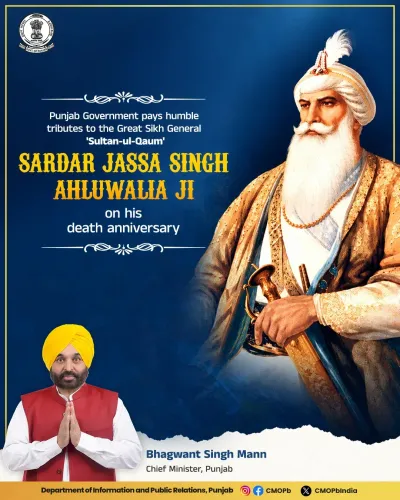
On the death anniversary of one of Sikhism's most revered 18th-century commanders, Punjab Chief Minister Bhagwant Mann on Friday, October 23, 2026 offered his deepest respects to Sardar Jassa Singh Ahluwalia, honouring a general whose defiance against imperial powers shaped the course of Sikh history.
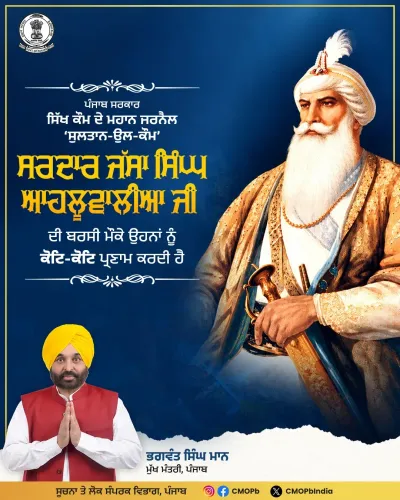
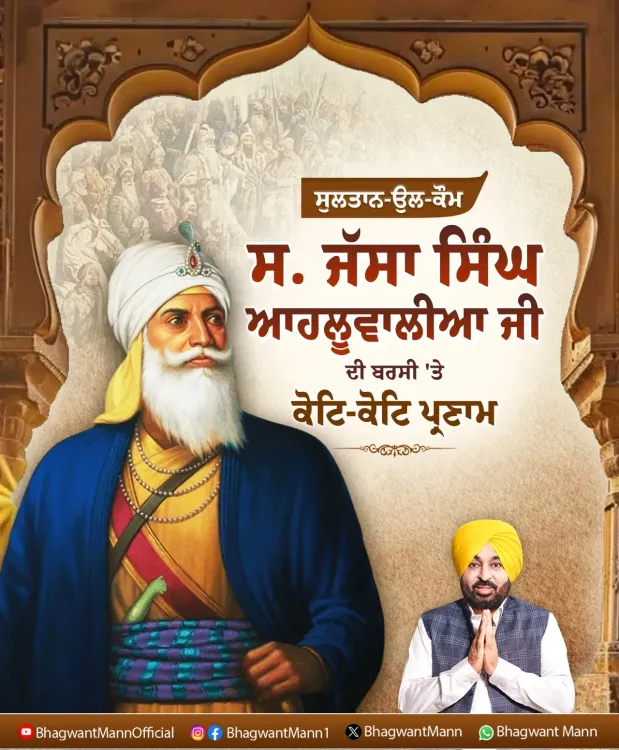
Posting in Punjabi, CM Mann wrote: 'ਕੋਟਿ-ਕੋਟਿ ਪ੍ਰਣਾਮ' — 'a million salutations' — to the 'great general of the Sikh nation and Sultan-ul-Qaum,' adding that his 'wise and steadfast leadership of the Khalsa Panth during the most trying of times will remain immortal on the golden pages of Sikh history.'
The warrior who earned the title Sultan-ul-Qaum
Sardar Jassa Singh Ahluwalia (1718–1783) rose to lead the Ahluwalia Misl, one of the twelve confederacies that formed the backbone of Sikh military power in the 18th century. His battlefield command against Mughal and Afghan forces — at a time when the Sikh community faced severe persecution — earned him the Persian honorific Sultan-ul-Qaum, meaning 'King of the Nation.' The title was no ceremonial gesture; it reflected the trust an entire people placed in one man during an existential crisis.
His leadership helped consolidate the Dal Khalsa, the unified Sikh army, and his campaigns pushed back repeated invasions, preserving both the faith and the political aspirations of the Punjabi heartland. Historians regard him as a foundational figure in the eventual rise of the Sikh Empire under Maharaja Ranjit Singh decades later.
Remembrance as a political and cultural constant in Punjab
For Punjab's political class, public tributes to 18th-century Sikh heroes are a deeply rooted practice — part cultural reverence, part acknowledgment of the community's historical memory. CM Mann's post follows a long tradition of state leaders marking the anniversaries of Sikh commanders, scholars, and martyrs, reaffirming continuity between contemporary governance and the region's storied past.
The post, accompanied by an image, reached Mann's large following on X, where tributes to Sikh historical figures consistently draw significant engagement from the Punjabi diaspora as well as residents of the state.
Three centuries on, the legacy of Jassa Singh Ahluwalia endures not just in history books but in the living memory of a community that still measures courage by the standard he set.
Point of View
Mann signals cultural custodianship to a community for which 18th-century military heroes remain living symbols. The gesture carries low policy weight but significant identity-politics value, reinforcing AAP's push to be seen as the authentic voice of Punjabi heritage. Over time, the consistency of such tributes builds a cumulative narrative that governance and Sikh memory are inseparable.
NationPress
23 Oct 2026
Frequently Asked Questions
Who was Sardar Jassa Singh Ahluwalia?
Sardar Jassa Singh Ahluwalia (1718–1783) was an 18th-century Sikh military leader who headed the Ahluwalia Misl and commanded the Dal Khalsa against Mughal and Afghan forces. He was given the title Sultan-ul-Qaum, meaning 'King of the Nation,' for his role in protecting and unifying the Sikh community.
What does Sultan-ul-Qaum mean?
Sultan-ul-Qaum is a Persian honorific meaning 'King of the Nation.' It was conferred on Jassa Singh Ahluwalia in recognition of his leadership of Sikh forces during some of the most turbulent decades of the 18th century.
Why did Bhagwant Mann pay tribute to Jassa Singh Ahluwalia?
Punjab Chief Minister Bhagwant Mann posted the tribute on October 23, 2026, to mark the death anniversary of Jassa Singh Ahluwalia, honouring his contributions to Sikh history and the Khalsa Panth.
What was the Ahluwalia Misl?
The Ahluwalia Misl was one of the twelve Sikh confederacies that formed the military and political structure of the Sikh community in 18th-century Punjab, playing a central role in resisting Mughal and Afghan incursions.
What is the significance of Jassa Singh Ahluwalia in Sikh history?
Jassa Singh Ahluwalia is regarded as a foundational figure in Sikh military history. His consolidation of the Dal Khalsa and successful campaigns against imperial powers laid the groundwork for the eventual emergence of the Sikh Empire under Maharaja Ranjit Singh.