Punjab CM Bhagwant Mann pays tribute to Jassa Singh Ahluwalia
Synopsis
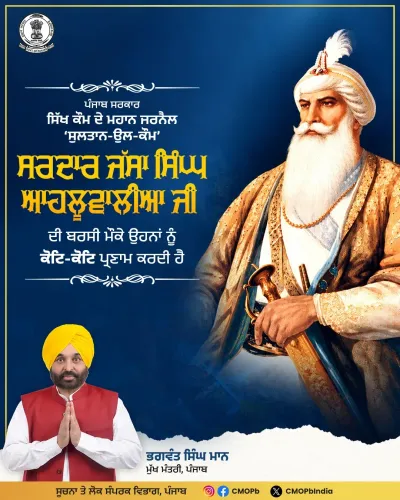
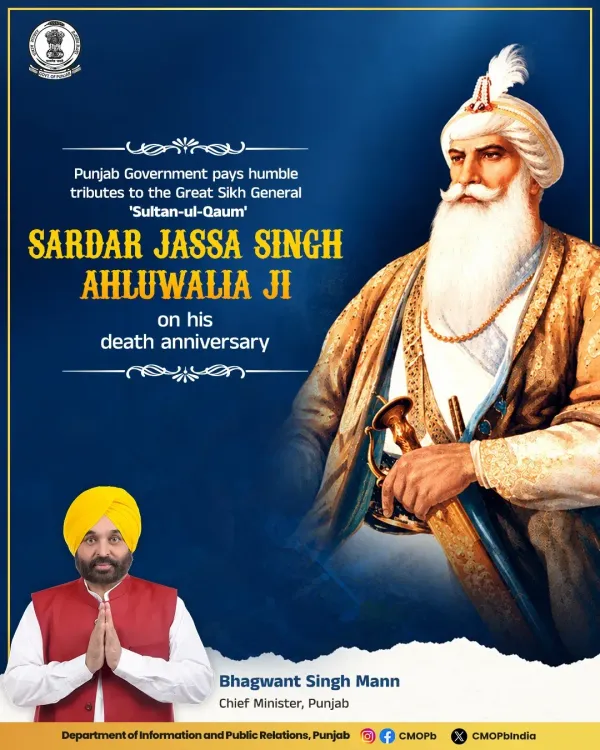
The Chief Minister's Office of Punjab, under CM Bhagwant Mann, paid official tributes on 23 October 2026 to Sardar Jassa Singh Ahluwalia — the 18th-century Sikh general titled 'Sultan-ul-Qaum' — on his death anniversary, reaffirming the state's commitment to Sikh historical memory.
Key Takeaways
The Chief Minister's Office of Punjab posted a formal tribute on 23 October 2026 marking the death anniversary of Sardar Jassa Singh Ahluwalia .
Sardar Jassa Singh Ahluwalia was the 18th-century leader of the Ahluwalia Misl , one of twelve Sikh confederate warrior clans.
He holds the title Sultan-ul-Qaum ('King of the Nation'), bestowed by the Sikh community for his military leadership against Mughal and Afghan forces.
The tribute was issued under the Bhagwant Mann -led Aam Aadmi Party government, which has been in office since 2022 .
Punjab state governments have a long tradition of issuing official commemorations for key Sikh historical figures as an affirmation of regional cultural identity.
On the death anniversary of the revered 18th-century Sikh general Sardar Jassa Singh Ahluwalia, the Chief Minister's Office of Punjab on Friday, 23 October 2026 offered formal state tributes, honouring a commander whose battlefield defiance shaped the Sikh confederacy against Mughal and Afghan power.
Who was Sultan-ul-Qaum — and why the title matters
Sardar Jassa Singh Ahluwalia is one of the most venerated figures in Sikh military history. Born in the early 18th century, he rose to lead the Ahluwalia Misl — one of the twelve confederate Sikh warrior clans — and was accorded the honorific Sultan-ul-Qaum, meaning 'King of the Nation,' by the Sikh community in recognition of his extraordinary leadership. He commanded Sikh forces at a time when the Punjab plains were a theatre of repeated Mughal repression and Afghan invasion, most notably under Ahmad Shah Durrani. His military campaigns helped consolidate Sikh territorial and political authority across the region.
A tradition of state remembrance in Punjab
The Chief Minister Bhagwant Mann-led Aam Aadmi Party government's tribute follows a long-standing practice of Punjab's official machinery marking the anniversaries of Sikh historical figures. For a state whose identity is deeply intertwined with Sikh heritage, such formal commemorations carry cultural and political resonance well beyond ceremony. The tribute was posted from the official CMO Punjab account on X, reflecting the government's use of digital platforms to reach the broader Sikh diaspora and residents of the state simultaneously.
The post described Ahluwalia as the 'Great Sikh General' and used his full honorific, signalling the government's deliberate framing of the occasion as one of reverence and pride — not merely administrative routine. Punjab's Sikh community across the state and internationally observes this anniversary as a moment to recall a chapter of resilience that predates and, in many ways, laid the groundwork for the later Sikh Empire under Maharaja Ranjit Singh.
History remembered in Chandigarh's corridors of power is history kept alive for millions. For the Mann government, this tribute is also a quiet signal of cultural continuity — proof that the state machinery still knows whose shoulders it stands on.
Point of View
They serve a political function: reinforcing the ruling party's legitimacy within a community that holds its history sacred. The choice to name Ahluwalia's honorific 'Sultan-ul-Qaum' prominently also underscores a quiet but consistent messaging strategy — that the current government does not merely administer Punjab, but sees itself as a custodian of its civilisational legacy.
NationPress
23 Oct 2026
Frequently Asked Questions
Who was Sardar Jassa Singh Ahluwalia?
Sardar Jassa Singh Ahluwalia was an 18th-century Sikh military commander and founder of the Ahluwalia Misl, one of the twelve Sikh confederate clans. He led Sikh forces against Mughal and Afghan invasions and was given the title 'Sultan-ul-Qaum,' meaning 'King of the Nation.'
What does 'Sultan-ul-Qaum' mean?
'Sultan-ul-Qaum' is a Punjabi and Persian honorific meaning 'King of the Nation.' It was bestowed upon Sardar Jassa Singh Ahluwalia by the Sikh community in recognition of his outstanding military and political leadership.
Why did the Punjab government pay tribute to Jassa Singh Ahluwalia on 23 October 2026?
23 October 2026 marks the death anniversary of Sardar Jassa Singh Ahluwalia. The Chief Minister's Office of Punjab, under CM Bhagwant Mann, issued an official tribute as part of the state government's practice of commemorating major Sikh historical figures.
What is the Ahluwalia Misl?
The Ahluwalia Misl was one of the twelve Sikh confederate warrior clans that operated across Punjab in the 18th century. Led by Sardar Jassa Singh Ahluwalia, it played a significant role in defending Sikh territory against Mughal and Afghan forces.
Who is Bhagwant Mann?
Bhagwant Mann is the Chief Minister of Punjab, in office since March 2022, leading the Aam Aadmi Party government. His administration has regularly issued official statements marking Sikh historical and cultural anniversaries.