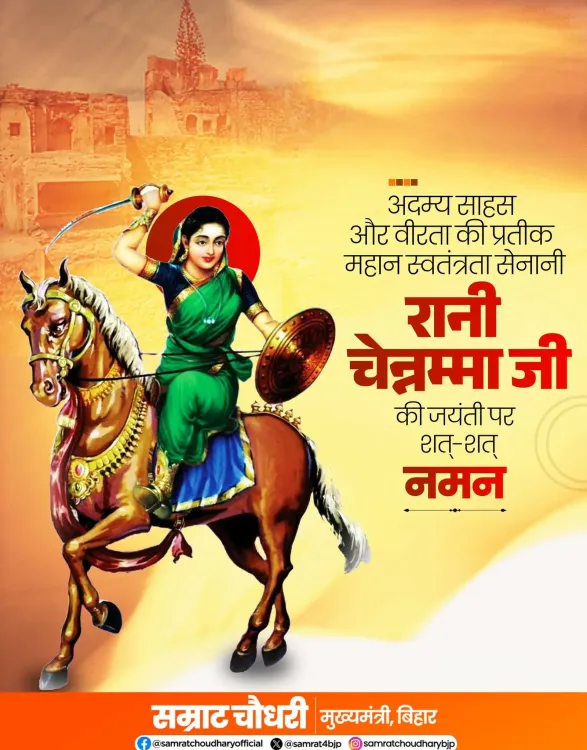
CM Samrat Choudhary pays tribute to Rani Chennamma on her Jayanti
Synopsis
Bihar Chief Minister Samrat Choudhary marked Rani Chennamma Jayanti on 23 October 2026, honouring the Kittur queen who led one of India's earliest armed revolts against the British East India Company in 1824, calling her sacrifice an enduring national inspiration.
Key Takeaways
Bihar CM Samrat Choudhary paid tribute to Rani Chennamma on her Jayanti on 23 October 2026 .
Rani Chennamma was the queen of Kittur in present-day Karnataka who led an armed revolt against the British East India Company in 1824 .
Her uprising is one of the earliest recorded instances of armed resistance to colonial rule in India — more than 33 years before the 1857 revolt.
CM Choudhary described her as a symbol of 'indomitable courage, valour, and unwavering dedication to the motherland.' BJP leaders across state units routinely commemorate regional freedom fighters to link local histories with a broader national patriotic narrative.
A warrior queen who took up arms against the British East India Company nearly two centuries before India's independence received fresh homage on Friday, 23 October 2026, as Bihar Chief Minister Samrat Choudhary offered a heartfelt tribute to Rani Chennamma of Kittur on her birth anniversary.
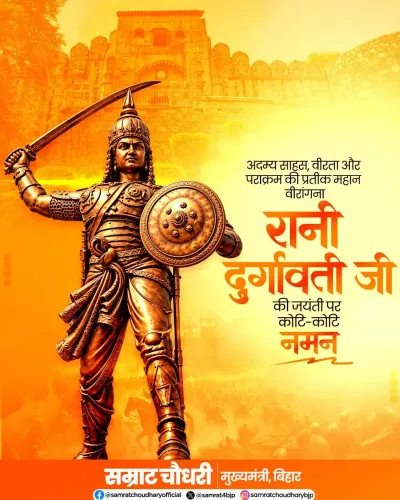
In his post on X, CM Choudhary wrote — 'Aatam sahas, shaurya aur matrubhumi ke prati atoot samarpan ki prateek' — hailing her as a symbol of 'indomitable courage, valour, and unwavering dedication to the motherland.' He expressed his deep reverence with the salutation 'shat-shat naman' — a respectful bow a hundredfold — and affirmed that her sacrifice and spirit of patriotism 'will continue to inspire the countrymen forever.'
Kittur's queen and the 1824 revolt against Company rule
Rani Chennamma was the queen of Kittur, a small princely state in present-day Karnataka. In 1824, she led an armed uprising against the British East India Company when it attempted to annex Kittur under the Doctrine of Lapse — one of the earliest recorded armed resistances to colonial rule on the subcontinent, predating the more widely known revolt of 1857 by over three decades. Her defiance made her a pioneering figure in India's long freedom struggle.
BJP's tradition of honouring pre-1857 regional freedom fighters
BJP leaders across state units have made it a consistent practice to publicly commemorate birth anniversaries of regional figures associated with early anti-colonial resistance. The tributes serve to weave local histories — from Karnataka's Kittur to Bengal's Sannyasi Rebellion — into a single, continuous national narrative of patriotism. Rani Chennamma Jayanti is observed annually, with particularly prominent ceremonies held in Karnataka.
For a leader based in Patna, reaching across geographies to honour a Karnataka queen underscores how such commemorations have become a shared idiom of national politics, cutting across state boundaries to build a collective memory of resistance.
Point of View
Broadening the party's patriotic canvas beyond familiar North Indian icons. By invoking a Karnataka queen from Bihar's capital, the gesture signals that the BJP's 'freedom struggle' narrative is consciously pan-regional. This approach also helps the party build cultural equity in states like Karnataka, where it has electoral stakes, without making any direct policy announcement. Such commemorations are low-cost but high-frequency tools of symbolic politics.
NationPress
23 Oct 2026
Frequently Asked Questions
Who was Rani Chennamma?
Rani Chennamma was the queen of Kittur, a princely state in present-day Karnataka, who led an armed revolt against the British East India Company in 1824 — one of the earliest anti-colonial uprisings in Indian history.
When is Rani Chennamma Jayanti celebrated?
Rani Chennamma Jayanti is observed on 23 October each year to mark her birth anniversary, with major ceremonies held especially in Karnataka.
What did Samrat Choudhary say about Rani Chennamma?
Bihar CM Samrat Choudhary called her a symbol of 'indomitable courage, valour, and unwavering dedication to the motherland,' offering her a respectful salute and saying her spirit of patriotism would inspire Indians forever.
Why is Rani Chennamma significant in Indian history?
Her 1824 revolt against British annexation of Kittur predates the more widely known 1857 uprising by over three decades, making her one of the first leaders to mount an armed resistance to colonial rule in India.
Why do BJP leaders frequently tribute regional freedom fighters?
BJP leaders regularly honour regional figures linked to early anti-colonial resistance to weave local histories into a single national patriotic narrative, broadening the party's cultural and political appeal across state boundaries.