Royal Bengal Tiger returns to Arunachal sanctuary after 20 years
Synopsis
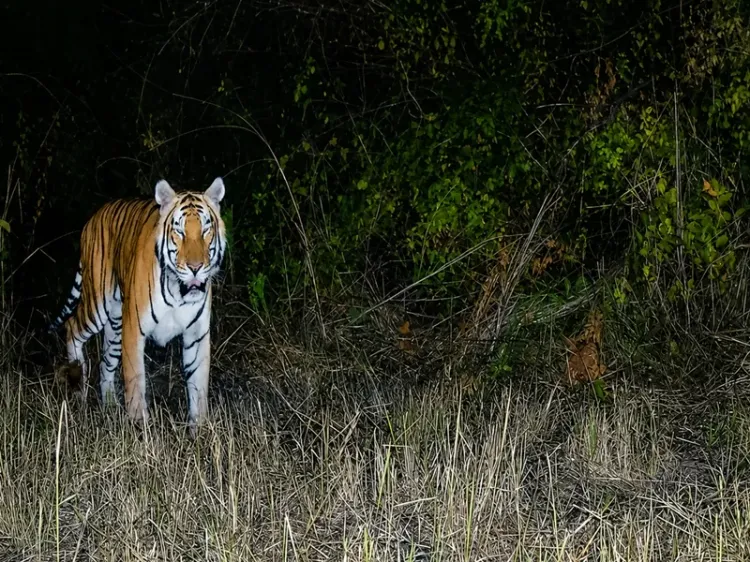
A Royal Bengal Tiger has been photographically confirmed inside Arunachal Pradesh's D Ering Memorial Wildlife Sanctuary for the first time since 2005 — ending a near-20-year absence that a 2014 WWF survey had attributed to rampant poaching. Camera trap images, backed by ATREE, mark a rare conservation turnaround in one of India's most ecologically distinct riparian grassland habitats.
Key Takeaways
A Royal Bengal Tiger has been camera-trap confirmed at D Ering Memorial Wildlife Sanctuary (DEMWS) , Arunachal Pradesh, for the first time since 2005 .
The sighting was documented through surveys supported by ATREE and confirmed by the Arunachal Pradesh Forest and Wildlife Department on 8 May 2025 .
A 2014 WWF baseline survey had found zero tiger evidence, attributing the absence to rampant poaching.
The survey also recorded the Critically Endangered Chinese Pangolin and the Endangered Hispid Hare , underscoring the sanctuary's ecological richness.
DEMWS spans 190 sq km near Pasighat in East Siang district and is the only riparian grassland protected area of its kind in Arunachal Pradesh.
A Royal Bengal Tiger has been recorded at Arunachal Pradesh's D Ering Memorial Wildlife Sanctuary (DEMWS) for the first time in nearly two decades, with officials on Friday, 8 May 2025 confirming the sighting through camera trap evidence collected inside the sanctuary near Pasighat. The landmark documentation ends a prolonged absence that had conservationists fearing the species had been locally extirpated from one of the state's most ecologically significant protected areas.
Camera Trap Evidence Confirms the Return
An official of the Arunachal Pradesh Forest and Wildlife Department confirmed that the sighting was captured through camera trap surveys conducted within the sanctuary, with technical support from the Ashoka Trust for Research in Ecology and Environment (ATREE). The latest camera trap images, officials said, convincingly established the tiger's presence in the landscape.
The last confirmed tiger evidence inside DEMWS dates to 2005, with only unverified sightings reported until around 2007–08. Subsequent years yielded no photographic proof despite multiple surveillance rounds, though forest officials had observed indirect signs of possible tiger movement over the past year before finally recording the big cat on camera.
A Grim Baseline and the Road to Recovery
A baseline survey published by the World Wide Fund (WWF) for Nature in 2014 had painted a stark picture, finding no pugmarks or camera trap evidence of tigers and citing rampant poaching as the likely cause of their disappearance. The new documentation represents a dramatic turnaround from that low point.
Signs of renewed tiger activity in the broader landscape had already been emerging. As recently as January 2026, foresters of the Jonai forest range in Assam reported spotting pugmarks of an adult Royal Bengal Tiger in Kobu Chapori, a proposed reserve forest situated adjacent to the sanctuary along the Assam–Arunachal Pradesh boundary.
What Officials and Experts Said
Divisional Forest Officer Kempi Ete described the moment as deeply moving.
Point of View
But the backstory demands scrutiny. A 2014 WWF survey found the sanctuary effectively emptied of tigers by poachers — meaning this is not a natural recovery but a hard-won reversal achieved through sustained community-led effort. The simultaneous documentation of the Critically Endangered Chinese Pangolin and the Endangered Hispid Hare suggests the sanctuary's riparian grassland ecosystem is recovering broadly, not just symbolically. The real policy question now is whether India's protected area management will treat DEMWS as a replicable model — or a one-off headline.
NationPress
22 Sept 2026
Frequently Asked Questions
Where was the Royal Bengal Tiger spotted in Arunachal Pradesh?
The Royal Bengal Tiger was confirmed inside the D Ering Memorial Wildlife Sanctuary (DEMWS), located approximately 13 km from Pasighat in East Siang district, Arunachal Pradesh. The sighting was captured through camera trap surveys supported by ATREE.
When was the last confirmed tiger sighting at D Ering Memorial Wildlife Sanctuary?
The last confirmed tiger evidence inside DEMWS dates to 2005, with only unverified sightings reported until around 2007–08. No photographic proof was recorded in the years that followed until the latest survey.
Why had tigers disappeared from the sanctuary?
A 2014 WWF baseline survey found no pugmarks or camera trap evidence of tigers and cited rampant hunting by poachers as the likely cause of their disappearance from the sanctuary.
What other rare species were found during the survey?
The recent survey also documented the Critically Endangered Chinese Pangolin and the rare Endangered Hispid Hare, further reinforcing the ecological importance of the sanctuary's unique riparian grassland ecosystem.
What is the D Ering Memorial Wildlife Sanctuary?
D Ering Memorial Wildlife Sanctuary is a protected area spanning approximately 190 sq km near Pasighat in Arunachal Pradesh's East Siang district. Established in 1978 and surrounded by the Siang and Sibya rivers, it is the only riparian grassland protected area of its kind in Arunachal Pradesh and is a key habitat for tigers, leopards, wild buffaloes, and migratory birds.