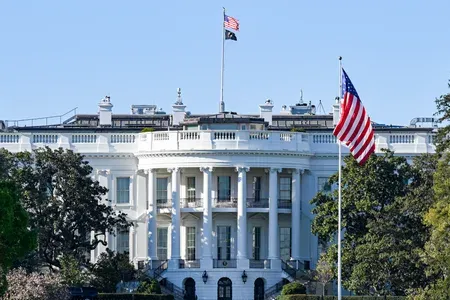
Trump Names Stephen Miller as New White House Chief of Staff
Synopsis
President Donald Trump announced Stephen Miller as White House Chief of Staff effective November 9, 2026, replacing Susie Wiles, who transitions to lead the Trump Political Operation. Miller, a senior Trump advisor since 2017 and key immigration policy architect, takes on Washington's most powerful unelected role.
Key Takeaways
Stephen Miller will become White House Chief of Staff starting Monday, November 9, 2026 .
Miller currently serves as Deputy Chief of Staff and has been a senior Trump advisor since January 2017 .
Susie Wiles , the outgoing Chief of Staff, moves to lead the Trump Political Operation — she is not leaving the Trump orbit.
President Trump publicly praised Wiles, calling her transition a recognition of her 'outstanding' service.
Miller is widely regarded as the chief architect of the Trump administration's hard-line immigration policy.
The appointment places one of the administration's most ideologically defined figures at the apex of White House operational control.
A major reshuffling at the top of the Trump White House landed on Friday night: President Donald J. Trump announced that Stephen Miller, his longtime trusted advisor and current Deputy Chief of Staff, will take over as Chief of Staff starting Monday, November 9, 2026. Outgoing Chief of Staff Susie Wiles moves to lead the Trump Political Operation — a lateral shift that keeps her inside the broader Trump orbit.
Miller's rise from immigration architect to the Oval Office's top gatekeeper
Stephen Miller has been one of the most consequential — and polarising — figures in Trump-world since the administration's earliest days. First appointed as a senior advisor in January 2017, Miller built his reputation as the chief architect of the administration's hard-line immigration agenda, shaping some of the most debated executive actions of Trump's political career. His elevation to Deputy Chief of Staff signalled growing operational responsibility; Saturday's announcement completes that journey, placing him at the nerve centre of White House decision-making.
The Chief of Staff role is often described as the most powerful unelected position in Washington — the gatekeeper who controls the President's schedule, filters information reaching the Oval Office, and coordinates the entire executive branch machinery. That desk now belongs to Miller.
Wiles exits gracefully — but stays in the fight
Susie Wiles, who served as Chief of Staff and was praised by Trump as having done 'an outstanding job' and 'a great job', transitions to helm the Trump Political Operation. The move is explicitly framed as a thank-you, not a dismissal — and placing a seasoned organiser atop the political machinery has obvious strategic logic as the administration's political calendar intensifies.
Presidential administrations routinely reconfigure senior staff to match shifting priorities, and the Wiles-to-political-operation pivot follows a well-worn Washington playbook: trusted loyalists are often repositioned rather than removed, keeping institutional knowledge close while redeploying it where it is most needed.
What the transition signals for White House policy direction
Miller's appointment sends an unmistakable signal about the administration's future orientation. As the most publicly identified face of hawkish immigration and domestic policy positions within Trump's inner circle, his ascent to Chief of Staff suggests those policy instincts will now have an even more direct line to the President's agenda-setting process. For foreign governments, allied capitals, and policy watchers in New Delhi and beyond who track Washington closely, the question is straightforward: does a Miller-run White House accelerate or recalibrate the administration's posture on trade, immigration, and bilateral engagements? The coming weeks — beginning Monday, November 9 — will start to answer that.
Point of View
This one signals intensification. Susie Wiles's repositioning to the political operation also hints at a White House entering a more electorally conscious, campaign-mode phase of governance. For governments and businesses engaged with Washington — including India — anticipating shifts in trade, visa, and bilateral negotiation dynamics under a Miller-run White House will be essential statecraft in the months ahead.
NationPress
7 Nov 2026
Frequently Asked Questions
Who is Stephen Miller and why is he significant?
Stephen Miller is a long-time Trump advisor first appointed in January 2017, best known as the principal architect of the Trump administration's immigration policies. His appointment as Chief of Staff makes him the most powerful unelected official in the US executive branch.
When does Stephen Miller become White House Chief of Staff?
Stephen Miller officially takes over as White House Chief of Staff starting Monday, November 9, 2026, as announced by President Trump.
What happens to Susie Wiles after leaving as Chief of Staff?
Susie Wiles moves to lead the Trump Political Operation. President Trump praised her service, framing the transition as a repositioning rather than a departure from the Trump inner circle.
What does the White House Chief of Staff actually do?
The Chief of Staff is the highest-ranking member of the Executive Office of the President, controlling access to the Oval Office, coordinating policy across the administration, managing the President's schedule, and serving as a primary liaison between the White House and other branches of government.
How does Stephen Miller's appointment affect US policy direction?
Miller's appointment is widely seen as a signal that the administration's hawkish stances on immigration and domestic policy will have a more direct influence over White House operations, given his long-standing role as the ideological driver of those positions.