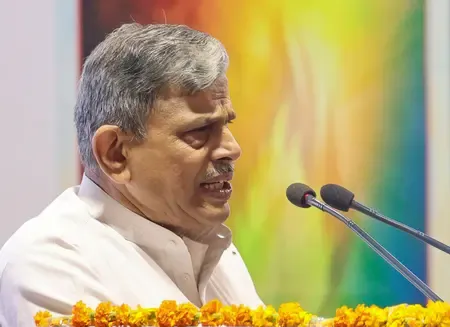
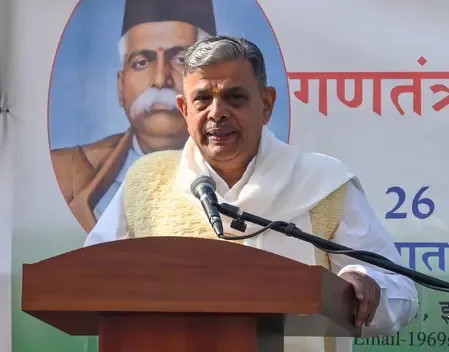
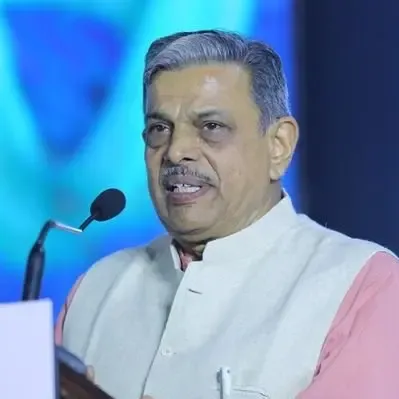
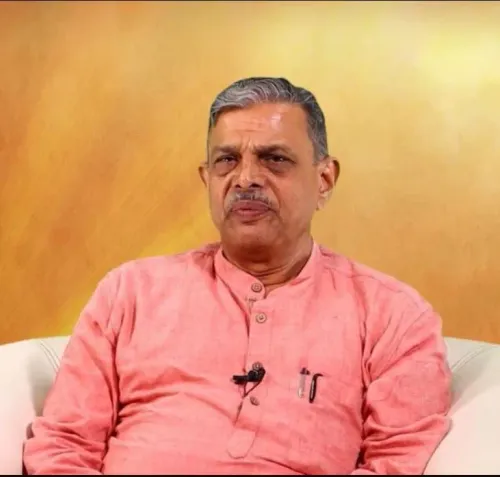
RSS General Secretary Dattatreya Hosabale: Indian Diaspora Should Prioritize Host Nation Loyalty
Synopsis
In a significant address, RSS General Secretary Dattatreya Hosabale emphasized the importance of Indian expatriates prioritizing their allegiance to their host countries while maintaining cultural ties to India. This framework reflects the RSS's dual approach of integration and civilizational connection.
Key Takeaways
Host Nation Loyalty: Indians abroad should prioritize their allegiance to the country they reside in.
Cultural Connection: Maintaining ties to Indian culture is equally important.
Vasudhaiva Kutumbakam: The philosophy of viewing the world as one family is central to RSS beliefs.
Global Challenges: Indian cultural values can play a role in addressing contemporary international issues.
Interfaith Dialogue: Encouraging broader spiritual engagement can help bridge community divides.
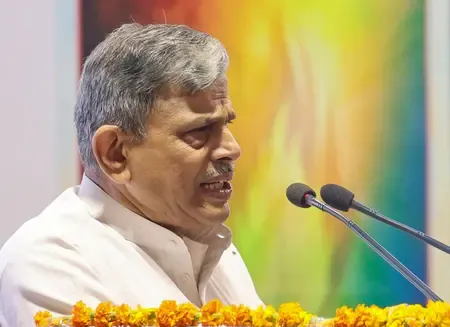
Stanford, April 18 (NationPress) The Rashtriya Swayamsevak Sangh (RSS) has outlined a comprehensive framework for the Indian diaspora, as articulated by General Secretary Dattatreya Hosabale. He emphasized that Indians residing overseas should prioritize their commitment to their host nation above all, while still cherishing their cultural ties to India.
In an interview celebrating a century of the RSS, Hosabale explained that the organization's engagement with the diaspora adheres to a two-fold strategy: integration with local communities and maintaining a civilizational connection with India.
“Swayamsevaks in various countries have worked to organize local Hindu communities,” he mentioned, noting that their contributions extend beyond community ties to significant societal impact.
“Their primary duty is to pledge allegiance to their host nation, show loyalty, and actively contribute to the welfare and improvement of that society,” Hosabale stated.
This principle underscores a deliberate effort to ensure diaspora groups remain responsible citizens of their adopted countries while keeping their cultural heritage intact.
“At the same time, due to cultural ties, they are also serving Bharat from afar,” he noted.
Hosabale linked this approach to the philosophical concept of Vasudhaiva Kutumbakam—the idea that the world is one family—which he described as fundamental to the RSS's ethos.
“This message—that the world is one family—is embedded deeply; it is not merely a slogan, but a way of life,” he said, connecting it to daily interactions and societal efforts.
He added that this philosophy encourages individuals to see people across nations as part of a shared human family, thereby reducing conflict and encouraging collaboration.
The RSS leader also highlighted India's recent global communications, including the theme of “one earth, one family, one future,” which he said mirrors the same civilizational perspective.
Elaborating on the international context, Hosabale indicated that the RSS envisions a role for Indian cultural values in tackling modern global issues, such as geopolitical strife, religious discord, and societal fragmentation.
“We are living in critically challenging times,” he remarked, identifying “hegemony,” “religious violence,” and environmental degradation as pressing concerns.
He cautioned that religious extremism remains a “danger to humanity,” even if it is not prominently discussed in public discourse today.
“Violence committed in the name of religion represents a threat to humanity,” he asserted.
Hosabale pointed out the global decline of family structures, attributing it to consumerism, diminishing trust, and weakening social connections.
“Healthy families lead to healthy societies, which in turn create healthy nations,” he emphasized, highlighting the significance of “love and compassion” as the bedrock of stable communities.
He argued that these issues are interlinked and necessitate a holistic response based on cultural and ethical values.
“While diversity exists, universal oneness must be practiced,” he urged, calling for harmony across families, communities, and nations.
He stressed that sustainability and ecological balance should take precedence, warning against unchecked technological and economic expansion.
“Advancements in science and technology are welcome, but not at the expense of our environmental equilibrium,” he insisted.
In the context of the RSS's global role, he portrayed the organization as a builder of “human social capital” through a blend of cultural principles and organizational integrity.
“The RSS is structured as an organization, but it operates as a movement with an impactful presence. Ultimately, the RSS embodies a lifestyle,” he remarked, suggesting that its model could be adapted globally.
He clarified that the goal is not to replicate the RSS organizationally in other countries but to promote similar values that enhance social unity and human welfare.
“This model can be applicable anywhere in the world for the benefit of society,” he stated.
Hosabale also addressed misunderstandings regarding the organization’s role on the international stage, stressing that it does not aim to overshadow national identities or political frameworks.
“We aspire for the betterment of each society within its local context,” he reiterated, underscoring that national loyalty and context are of utmost importance.
Regarding interfaith relations, he urged global religious leaders to transcend rigid institutional boundaries and engage with broader spiritual concepts.
“Religion does not equate to spirituality. Spirituality transcends religion,” he suggested, proposing that such a perspective could bridge divides among communities.
He acknowledged that each religion has its unique civilizational roots, and understanding these can promote greater unity among people.
“If we grasp these civilizational foundations, achieving unity among humankind will be more attainable,” he noted.
Within India, Hosabale reaffirmed the necessity of balancing religious freedom with national allegiance.
“Everyone has the freedom to practice their faith, but loyalty to the nation should also be a priority,” he emphasized.
The focus on diaspora responsibilities comes at a time when Indian-origin communities are increasingly influential in politics, business, and academia across countries such as the United States, the United Kingdom, and various Gulf nations.
Point of View
The RSS's emphasis on diaspora responsibility underscores the importance of integrating into host societies while retaining cultural connections. This balanced approach promotes social cohesion and acknowledges the evolving role of Indian communities globally.
NationPress
18 Sept 2026
Frequently Asked Questions
What is the primary message from Dattatreya Hosabale regarding the Indian diaspora?
Dattatreya Hosabale highlighted that Indians living abroad should prioritize their allegiance to their host nations while maintaining cultural ties to India.
How does the RSS view its role in the global context?
The RSS envisions promoting Indian cultural values to address contemporary international challenges such as geopolitical tensions and social fragmentation.
What philosophy does Hosabale associate with the RSS's approach to the diaspora?
Hosabale associates the RSS's approach with the philosophy of Vasudhaiva Kutumbakam, which advocates for viewing the world as one family.
What are the key concerns highlighted by Hosabale regarding the current global situation?
Hosabale pointed out critical issues such as hegemony, violence in the name of religion, and environmental stress as significant global challenges.
What does Hosabale suggest about interfaith relations?
He encouraged religious leaders to move beyond rigid frameworks and engage with broader spiritual principles to foster unity.