Sachin Pilot Demands Accountability From NTA Over UGC-NET 2026 Complaints

Synopsis
Congress general secretary Sachin Pilot on August 17, 2026, demanded accountability from the Ministry of Education and the NTA after the agency acknowledged complaints in UGC-NET 2026 papers — English, Commerce, and Sociology — renewing scrutiny of India's centralised examination system.
Key Takeaways
The NTA acknowledged complaints received for UGC-NET 2026 across three papers: English, Commerce, and Sociology .
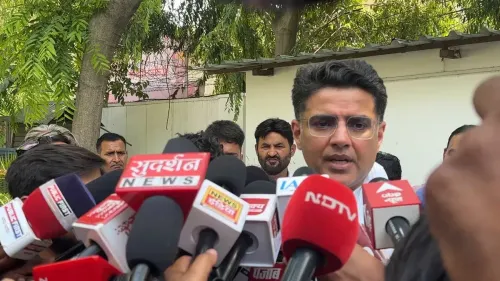
Sachin Pilot , Congress general secretary and Chhattisgarh in-charge, publicly called out the NTA on August 17, 2026 .
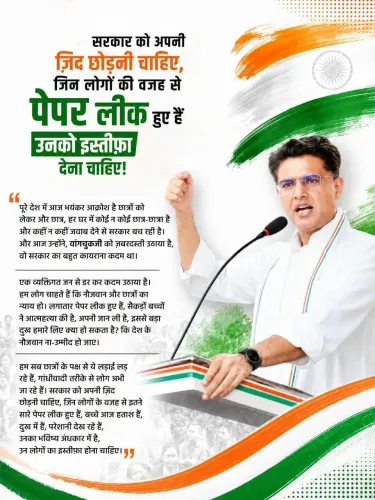
Pilot questioned not just the NTA's competence but the fundamental fairness of the examination system for students.
The NTA was established in 2017 to centralise national examinations, but has faced recurring criticism over administrative failures.
Pilot demanded accountability directly from the Ministry of Education , which oversees the NTA.
The issue is expected to feature in upcoming parliamentary sessions as opposition pressure on examination reforms intensifies.
Students preparing for UGC-NET 2026 are once again caught in the crossfire of an examination system under fire — and Congress leader Sachin Pilot, general secretary of the Indian National Congress and Chhattisgarh in-charge, is demanding answers. On Monday, August 17, 2026, Pilot called out the National Testing Agency (NTA) after the agency acknowledged receiving complaints across multiple papers — English, Commerce, and Sociology — raising fresh doubts about the integrity of one of India's most consequential eligibility tests.
NTA Acknowledges Complaints Across Three UGC-NET 2026 Papers
The NTA's own acknowledgment of complaints is what sharpens this moment. Pilot's post draws directly from the agency's admission, pointing to problems across the English, Commerce, and Sociology papers of UGC-NET 2026. The University Grants Commission National Eligibility Test determines eligibility for assistant professorship and Junior Research Fellowships — roles that shape who teaches at India's universities. When the exam stumbles, it is not an administrative footnote. It is a career derailed.
Pilot's framing cuts to the core: 'The question is not merely whether this agency can conduct examinations, but how fair and just the system is. Students pay the price.' That line is not rhetoric — it is a precise articulation of what is at stake for hundreds of thousands of aspirants who spend months, sometimes years, preparing for a test they trust to be reliable.
A Pattern the NTA Has Not Escaped
The National Testing Agency was established in 2017 to centralise major national examinations previously managed by CBSE and other bodies — a structural reform meant to bring uniformity and efficiency. The promise was a single, credible, technology-driven testing authority. The reality, as opposition leaders including Pilot have repeatedly noted, has been a recurring cycle of technical failures, administrative lapses, and public controversy that has eroded confidence in centralised testing.
Each episode renews the same political and parliamentary pressure: who is accountable when millions of students are affected? The Ministry of Education, which oversees the NTA, has faced sustained scrutiny over whether its oversight mechanisms are adequate. Pilot's question — 'where is the accountability of the Ministry and NTA?' — is one that parliamentary committees and student groups have echoed across multiple examination cycles.
What Pilot Is Asking — and Why It Matters Now
The Congress leader is not calling for a minor administrative fix. He is questioning the structural fairness of a system that centralises enormous power over student futures in a single agency, then fails to deliver reliably. With UGC-NET 2026 complaints now officially acknowledged by the NTA itself, the political pressure on the Ministry of Education to respond publicly — and concretely — will be difficult to deflect.
Parliamentary sessions provide the next natural checkpoint: questions on NTA performance and possible examination reforms are expected to feature in upcoming legislative business, and the opposition has fresh ammunition to press the government on what accountability for the agency actually looks like in practice.
For the students waiting on their results — and the ones still mid-preparation — the answer to that question cannot come soon enough.
Point of View
Failures here carry institutional weight beyond individual careers. The political cost for the Ministry of Education rises each time the cycle repeats without structural reform.
NationPress
17 Aug 2026
Frequently Asked Questions
What complaints have been raised about UGC-NET 2026?
The NTA acknowledged receiving complaints related to the UGC-NET 2026 examination across three papers — English, Commerce, and Sociology . The specific nature of the complaints has not been officially detailed, but their acknowledgment by the agency itself has drawn political scrutiny.
What is the NTA and who oversees it?
The National Testing Agency (NTA) is an autonomous body established in 2017 under the Ministry of Education to conduct major national-level entrance and eligibility examinations, including UGC-NET, previously managed by CBSE and other bodies.
What is UGC-NET and why does it matter?
The University Grants Commission National Eligibility Test (UGC-NET) determines eligibility for assistant professorship and Junior Research Fellowships at Indian universities. It is a critical gateway exam for lakhs of postgraduate students aspiring to academic and research careers.
What did Sachin Pilot say about NTA?
Sachin Pilot said the NTA's 'proven track record of incompetence' raises questions not just about whether the agency can conduct exams, but about the fairness of the system itself. He demanded accountability from both the NTA and the Ministry of Education , stating that 'students pay the price.'
Has NTA faced criticism before UGC-NET 2026?
Yes. The NTA has faced recurring criticism over technical and administrative failures across multiple examination cycles since its establishment in 2017. Opposition leaders and student groups have repeatedly called for stronger ministerial oversight and structural reform of the agency.