Sachin Pilot Flags Punjab Law-Order Crisis After AAP Sarpanch Killing

Synopsis
Congress general secretary Sachin Pilot on October 20 condemned the killing of AAP Sarpanch Ashwani Devgan in Tarn Taran, calling it evidence of Punjab's collapsing law and order, and demanding accountability from both the AAP state government and the BJP over drug and weapons smuggling.
Key Takeaways
Ashwani Devgan , an AAP Sarpanch in Tarn Taran , Punjab, was killed, prompting a sharp political response from Congress.
Congress leader Sachin Pilot posted on October 20, 2026 calling Punjab's law-and-order situation a 'worrying collapse.' Pilot accused both the AAP and BJP governments of failing to ensure border security and internal safety.
He cited inadequate witness protection for families of victims, following personal ground visits by Congress leaders.
Tarn Taran is a border district with a documented history of cross-border narcotics and weapons smuggling.
The post tagged multiple senior Punjab Congress leaders, signalling a coordinated party-level campaign on the issue.
A sitting village head is dead, criminal networks are moving freely, and Congress leader Sachin Pilot says the silence from the government is deafening. On Tuesday, October 20, 2026, the Congress general secretary took to X to call out a deepening security crisis in Punjab, pointing to the killing of Ashwani Devgan, an AAP Sarpanch in Tarn Taran, as a stark signal of how far law and order has eroded in the border state.
A Sarpanch's Killing in Tarn Taran Triggers a Political Storm
Tarn Taran sits on Punjab's southwestern edge, sharing a border with Pakistan — a corridor long flagged in central and state security assessments for cross-border smuggling of narcotics and illegal firearms. The killing of Devgan, a ground-level elected representative belonging to the ruling Aam Aadmi Party, underscores the reach of criminal networks that officials have repeatedly pledged to dismantle.
Pilot did not mince words. 'Illegal weapons and drugs have penetrated deep into Punjab, with little accountability from the government,' he wrote, adding that 'the failure of both the BJP and AAP governments to ensure border security and internal safety demands answers.' It is a pointed double indictment — placing historical blame on the Bharatiya Janata Party's prior tenures while squarely targeting AAP, which swept to power in Punjab in 2022 on a platform of clean governance and zero tolerance for drugs.
Witness Families Under Threat, Pilot Says After Ground Visits
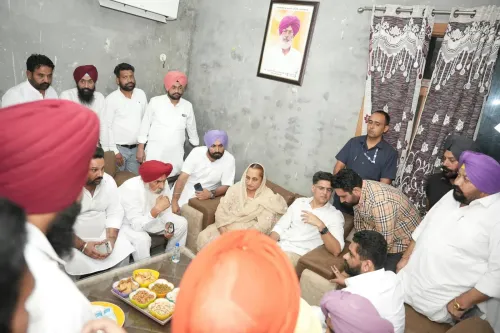
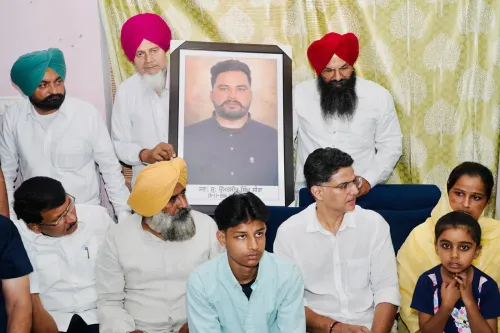
Pilot's post carries weight beyond a press-release condemnation — he states that Congress leaders have personally visited affected families, and those families are living under threat with 'inadequate witness protection.' That detail shifts the critique from rhetorical to operational: it raises a concrete policy failure around victim-witness security that courts and civil liberties bodies have flagged repeatedly in high-crime districts across India.
'Law and order is the government's fundamental responsibility,' Pilot wrote. 'There can be no excuses or political blame games when it comes to the deteriorating law and order situation in Punjab.' The post tagged senior Punjab Congress leaders including Pargat Singh, Partap Singh Bajwa, Charanjit Singh Channi, and Sukhjinder Singh Randhawa, signalling a coordinated party-level push rather than a solo statement.
Punjab's Persistent Drug-Arms Corridor and the Record of Multiple Governments
Punjab's struggle with narcotics and weapons trafficking predates any single government. Central and state security assessments since the mid-2010s have consistently flagged the Punjab-Pakistan border as a transit point for drugs and small arms, with drone-drops emerging as the latest modality. Every ruling formation — Congress, Shiromani Akali Dal, BJP, and now AAP — has faced accusations of under-policing the network's civilian nodes. What changes is who holds the levers; the network, critics argue, has proven resilient to all of them.
The killing of a Sarpanch — an elected local official, not a militant or a rival criminal — is a qualitatively alarming data point. It suggests perpetrators are willing to target representatives of the state apparatus itself, in broad daylight, with apparent impunity.
The next move belongs to the AAP government in Chandigarh and the Union Ministry of Home Affairs — because when an elected village head can be killed in a border district, a press release will not be enough.
Point of View
Congress positions itself as the sole accountability voice in Punjab without carrying the baggage of incumbency. The mention of family visits and witness-protection gaps gives the critique operational texture, moving it beyond partisan point-scoring. For AAP, whose 2022 mandate rested heavily on an anti-drugs promise, a Sarpanch's killing in a border district is a reputational liability with direct electoral consequences. The statement also signals that Congress's Punjab unit, still rebuilding after its 2022 rout, is using law-and-order as its primary wedge issue heading into future cycles.
NationPress
20 Oct 2026
Frequently Asked Questions
Who was Ashwani Devgan?
Ashwani Devgan was an AAP Sarpanch — an elected village-level official — from Tarn Taran district in Punjab, whose killing Sachin Pilot cited as evidence of the state's deteriorating law-and-order situation.
Why is Tarn Taran significant for Punjab's security?
Tarn Taran is a district in Punjab that shares a border with Pakistan and has been repeatedly flagged in security assessments for cross-border smuggling of narcotics and illegal weapons, making it a persistent hotspot.
What did Sachin Pilot say about Punjab's law and order?
Pilot said Punjab is witnessing a 'worrying collapse of law and order,' pointing to the killing of an AAP Sarpanch, deep penetration of illegal weapons and drugs, and inadequate witness protection for threatened families.
Which governments did Sachin Pilot blame for Punjab's security failure?
Pilot held both the Aam Aadmi Party 's current state government and the Bharatiya Janata Party accountable, saying the failure of both parties to ensure border security and internal safety 'demands answers.'
Is Punjab's drug and weapons problem a new issue?
No. Central and state security assessments since the mid-2010s have flagged the Punjab-Pakistan border as a corridor for narcotics and illegal firearms. Successive governments under different parties have all faced criticism for inadequate enforcement.