CM Saini: Opposition Can't Disrupt Parliament and Demand Answers Too
Synopsis
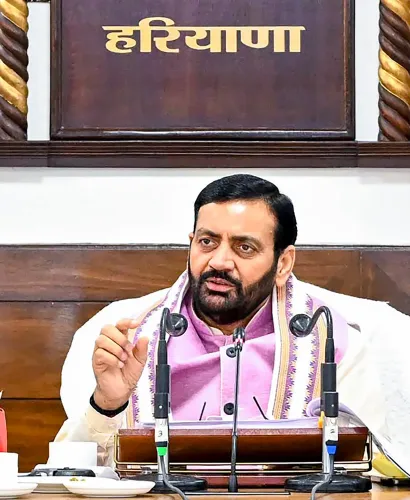
Haryana CM Nayab Singh Saini challenged the opposition on August 12, 2026, saying it cannot simultaneously demand answers and disrupt Parliament. Citing Home Minister Amit Shah's readiness for debate on all subjects, Saini placed the responsibility for smooth House functioning squarely on opposition leaders, warning that the public is watching.
Key Takeaways
Haryana CM Nayab Singh Saini posted on August 12, 2026 , targeting the opposition over parliamentary disruptions.
Union Home Minister Amit Shah had stated the government is ready to discuss every subject in Parliament.
Saini argued that demanding answers while obstructing proceedings are mutually exclusive positions.
He placed equal responsibility for smooth parliamentary functioning on opposition leaders.
The post ended with a direct public appeal: 'The people of this country are watching everything.' The statement reflects a long-standing procedural standoff between treasury and opposition benches in Indian Parliament.
The standoff between India's ruling alliance and the opposition over parliamentary conduct sharpened on Wednesday, August 12, 2026, when Haryana Chief Minister Nayab Singh Saini issued a pointed challenge: you cannot demand accountability from the government while simultaneously shutting the House down.
Posting in Hindi on X, CM Saini cited Union Home Minister Amit Shah's assurance that the government is ready to discuss every subject on the floor. 'सरकार हर विषय पर चर्चा के लिए तैयार है' ('The government is ready for discussion on every subject'), Shah had stated — and Saini used that as the foundation for a direct counter to the opposition.
The core contradiction Saini is targeting
The argument is blunt and structurally clear: demanding answers requires the House to be in session. Saini wrote that the responsibility for smooth parliamentary functioning rests equally on opposition leaders — not just the treasury benches. 'If the opposition genuinely wants discussion on public-interest issues, it will have to let the House run,' he said.
The final line carried the sharpest edge: 'देश की जनता सब देख रही है' — 'The people of this country are watching everything.' That is not a rhetorical flourish; it is a direct appeal over the heads of opposition MPs to the electorate itself.
A recurring battle over who controls the clock
This is not a new script. Indian parliamentary sessions have been repeatedly interrupted across decades, with ruling parties asserting openness to debate while accusing the opposition of manufactured disruption. Opposition benches, in turn, argue that adjournments and walkouts are the only leverage available when the government refuses to take up their preferred agenda.
Amit Shah, as Home Minister and the government's key parliamentary strategist, has been central to managing House proceedings in multiple sessions. His public readiness for 'discussion on every subject' is itself a well-worn move — it shifts the burden of proof onto the opposition to either sit down and debate, or own the disruption.
The dynamic Saini is describing — simultaneous demands for answers and procedural obstruction — captures a genuine structural tension in India's Parliament. Disruptions deny the government a platform to answer, which then becomes the opposition's evidence that the government is not answering. The loop is self-reinforcing, and both sides know it.
Whether the opposition tables formal notices or accepts the government's debate offer in the next sitting will determine which side the public ledger falls on — and both camps are acutely aware that the gallery, and the voter, are indeed watching.
Point of View
Then reframe every opposition disruption as a self-defeating contradiction. The 'public is watching' closer is significant — it signals the BJP intends to take this argument to the electorate rather than resolve it inside the House. Across multiple sessions, this framing has proven electorally effective even when it fails procedurally, because it positions the opposition as the obstacle to governance rather than its watchdog. The real test is whether any formal debate notices follow, or whether the impasse hardens into the next adjournment.
NationPress
26 Sept 2026
Frequently Asked Questions
What did Haryana CM Nayab Singh Saini say about Parliament disruptions?
Saini said the opposition cannot simultaneously demand answers from the government and disrupt parliamentary proceedings — both positions cannot coexist. He called on opposition leaders to let the House function if they genuinely want public-interest issues discussed.
What did Amit Shah say about parliamentary discussions?
Union Home Minister Amit Shah stated that the government is ready for discussion on every subject, which Saini cited as evidence that the onus for disruptions lies entirely with the opposition.
Why does the Indian Parliament get disrupted so often?
Parliamentary disruptions in India reflect a recurring structural tension: the opposition uses adjournments and walkouts as leverage when it believes the government is avoiding debate, while the ruling side argues it is always open to discussion. Both sides have incentives to frame the other as the obstructionist.
What is the government's position on debating opposition issues?
The government, through Home Minister Amit Shah, has stated readiness to discuss all subjects. This is a standard treasury-bench position that shifts the burden onto the opposition to participate rather than obstruct.
What does 'the public is watching' mean in Saini's post?
The phrase is a direct appeal over opposition MPs to the voting public, signalling that the BJP intends to hold the opposition politically accountable for any parliamentary deadlock in the court of public opinion.