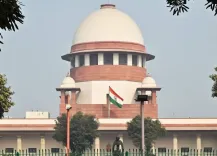
Did the SC grant bail to ex-Rajasthan Minister in the Rs 900 crore Jal Jeevan Mission scam?
Click to start listening

Synopsis
In a significant legal development, the Supreme Court has granted bail to former Rajasthan Minister Mahesh Joshi after nearly seven months in jail. The case revolves around the alleged Rs 900 crore Jal Jeevan Mission scam, highlighting issues of corruption and political implications. What does this mean for Joshi and the ongoing investigation?
Key Takeaways
- Supreme Court grants bail to Mahesh Joshi after 7 months.
- Joshi was arrested in connection with Rs 900 crore scam.
- Arguments for bail highlighted lack of evidence of bribery.
- ED expressed concerns over witness tampering.
- The case underscores the ongoing issues of political corruption.
Jaipur, December 3 (NationPress) The Supreme Court has granted bail to former Rajasthan Minister and Congress politician Mahesh Joshi on Wednesday, following nearly seven months of imprisonment at Jaipur Central Jail.
Joshi was taken into custody by the Enforcement Directorate (ED) on April 24, as part of the inquiry into the alleged Rs 900 crore Jal Jeevan Mission (JJM) scam. His initial bail request was denied by the Rajasthan High Court on August 26, prompting him to seek relief from the apex court.
A bench comprising Justice Dipankar Datta and Justice A.G. Masih issued the ruling on Wednesday, almost two weeks post the judgment reservation on November 21.
Tragically, Joshi’s wife passed away just days after his arrest on April 28. Although he was granted a temporary bail for four days, he has remained in custody since.
In representing Joshi, senior lawyers Siddharth Luthra and Vivek Jain contended that he has been incarcerated for seven months without the trial commencing. They argued that the ED's evidence does not convincingly demonstrate bribery.
The attorneys highlighted that the ED claims Joshi accepted Rs 55 lakh as a bribe concerning a loan for his son's business, yet this sum was subsequently returned. They questioned, “If this was indeed a bribe, why was it returned?” asserting that the ED did not provide a satisfactory explanation.
Countering the bail request, the ED indicated that Joshi's involvement is evident in additional FIRs filed by the ACB. They stated that the Rs 55 lakh transaction represents misconduct related to the tendering process, and returning the amount does not eliminate the potential for criminal intent.
The agency further asserted that Joshi could potentially influence witnesses if released.
As part of the Jal Jeevan Scheme, the state and central governments were expected to share funding equally.
The complaint alleges that required DI (ductile iron) pipelines were substituted with HDPE pipelines. Payments were made for the installation of new pipelines, but in many cases, the work was never completed. It is claimed that contractors colluded with officials to claim payments for non-existent pipeline installations. Contractor Padmachand Jain reportedly utilized stolen pipelines from Haryana, misrepresenting them as new materials. Jain allegedly secured the tender using fraudulent company documents, which were overlooked by officials due to purported political affiliations.
Joshi’s release is anticipated to occur soon after the necessary formalities are completed.
Point of View
I believe that the recent bail granted to Mahesh Joshi by the Supreme Court underscores the complex interplay of law, politics, and accountability. It raises critical questions about corruption and governance in our political system. We must closely monitor the developments in this case as they will have significant implications for public trust and the integrity of our institutions.
NationPress
03/12/2025
Frequently Asked Questions
What is the Jal Jeevan Mission scam about?
The Jal Jeevan Mission scam involves allegations of corruption related to the implementation of the Jal Jeevan Scheme, where it is claimed that contractors colluded with officials to claim payments for non-existent pipeline installations.
Who is Mahesh Joshi?
Mahesh Joshi is a former Rajasthan Minister and Congress leader who was arrested in connection with the Jal Jeevan Mission scam and has recently been granted bail by the Supreme Court.
Why was Mahesh Joshi arrested?
Joshi was arrested by the Enforcement Directorate on allegations of accepting a bribe related to a loan for his son's business as part of the investigation into the Jal Jeevan Mission scam.
What were the arguments for and against Joshi's bail?
Joshi's lawyers argued that he had been in jail for seven months without trial, and the evidence did not conclusively support bribery. The ED contended that Joshi's release could influence witnesses and that evidence of misconduct existed.
What are the implications of Joshi's bail?
Joshi's bail could impact ongoing investigations into the Jal Jeevan Mission scam and raise questions about the accountability of political figures in corruption cases.