Did the SC Justify Quashing Criminal Case Against an Advocate?
Synopsis
In a landmark ruling, the Supreme Court has dismissed criminal charges against an advocate linked to a sexual assault case, citing vague allegations and insufficient evidence. This decision underscores the importance of clear and credible accusations in legal proceedings.
Key Takeaways
The Supreme Court dismissed the case due to vague allegations.
Clear and specific evidence is crucial in criminal proceedings.
The ruling highlights the importance of a fair legal process.
Proceedings will continue against other accused individuals.
Professional conduct of lawyers cannot be equated with intimidation.
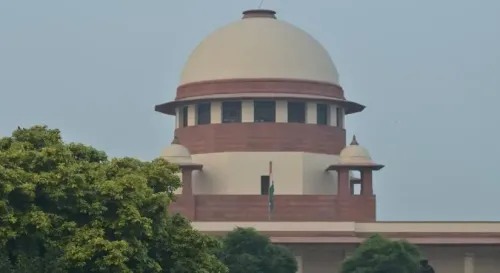
New Delhi, Jan 30 (NationPress) The Supreme Court has dismissed criminal proceedings against an advocate accused of criminal intimidation in a sexual assault case, asserting that the vague and belated allegations, alongside an "improved" statement from the prosecutrix, were inadequate legally to bring him to trial.
A Bench comprising Justices Aravind Kumar and Prasanna B. Varale granted the appeal lodged by Bеri Manoj, overturning a decision by the Andhra Pradesh High Court that had refused to quash the proceedings before the trial began.
The appellant was listed as accused No. 5 in an FIR filed in 2022 under Sections 328, 376, and 506 of the Indian Penal Code in conjunction with Sections 3 and 4 of the Protection of Children from Sexual Offences (POCSO) Act.
In its ruling, the apex court highlighted that the primary charge against the appellant was limited to criminal intimidation under Section 506 IPC.
Upon reviewing the case files, the Justice Kumar-led Bench remarked that in the prosecutrix’s statement recorded under Section 161 of the Criminal Procedure Code (CrPC), there were no allegations of any threat against the appellant.
Moreover, it was noted that it was only after a span of seven days, in her statement under Section 164 CrPC, that the appellant’s name was mentioned through a general allegation.
“At the initial stage, we observe that in the statement recorded under Section 161 of the CrPC, the prosecutrix, for reasons best known, did not even hint at any threat being posed by the appellant,” the ruling stated.
The apex court indicated that the subsequent statement represented an improvement, citing the relevant section where the prosecutrix claimed that “Chandu Tej’s father, uncle, and two aunts came there and threatened me.”
“This inconsistency in the timeline creates substantial doubt regarding the prosecution’s narrative, or in other words, the appellant’s name appeared after seven days through a vague reference to ‘an uncle,’ further undermining the prosecution’s case,” the Justice Kumar-led Bench concluded.
It reiterated that mere threats, devoid of an intention to create alarm, do not qualify as criminal intimidation under Section 506 IPC.
“In fact, the mere expression of words, without any intention to alarm, cannot represent criminal intimidation,” the apex court stated, adding that the allegations in the Section 164 statement were “insufficient in law to act against the appellant.”
It further elaborated that prosecution for criminal intimidation necessitates a clear intention to induce alarm, regardless of whether the victim felt alarmed or not.
“In the absence of such clarity, the continuation of prosecution against the appellant based solely on a vague reference to the term ‘an uncle’ cannot denote any offense,” it commented, labeling such claims as “vague” and lacking prima facie credible evidence.
The apex court also acknowledged the appellant’s professional standing, noting that the mere presence of a lawyer fulfilling professional obligations, such as giving advice or suggestions, cannot equate to intimidation, particularly when foundational facts were strikingly absent.
In granting the appeal, the Supreme Court nullified the proceedings concerning the appellant, while clarifying that the case against the other accused would persist before the relevant trial court.
“Thus, the appeal is granted. The disputed order is annulled,” ordered the Justice Kumar-led Bench.
Point of View
We stand by the principle that the justice system should operate on the foundations of clarity and evidence. The Supreme Court's decision reinforces the need for credible accusations in serious cases, ensuring that individuals are not wrongly prosecuted based on ambiguous claims. We advocate for a balanced approach that protects the rights of all parties involved.
NationPress
29 Sept 2026
Frequently Asked Questions
What was the Supreme Court's ruling regarding the advocate?
The Supreme Court quashed the criminal proceedings against the advocate, citing vague and belated allegations as insufficient for a trial.
What were the charges against the advocate?
The advocate was initially accused under Sections 328, 376, and 506 of the Indian Penal Code and related POCSO Act provisions.
How did the court justify its decision?
The court found that there was a lack of credible evidence and that the allegations lacked clarity and specificity, especially regarding threats.
Will the case continue against other accused?
Yes, the Supreme Court clarified that proceedings would continue against the remaining accused in the trial court.
What does this ruling imply for future cases?
This ruling emphasizes the necessity of clear and substantial evidence in criminal cases, particularly concerning serious allegations.