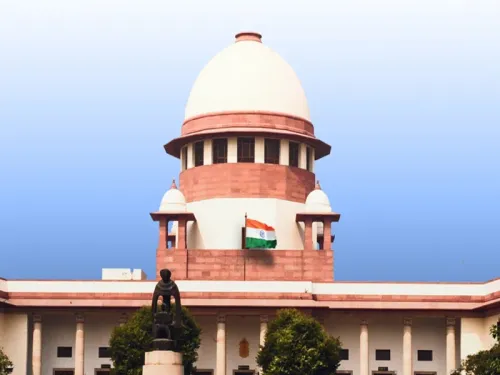
Why Did the SC Reject the PIL Challenging Bottled Water Standards?

Synopsis
In a notable ruling, the Supreme Court of India rejected a PIL questioning bottled water standards, calling it 'luxury litigation.' The court emphasized the need to align legal standards with ground realities rather than foreign benchmarks.
Key Takeaways
The Supreme Court rejected a PIL challenging bottled water standards.
Emphasis on aligning regulations with India’s realities.
Petitioner's reliance on foreign standards was criticized.
Opportunity for representation to government authorities was provided.
Health risks associated with antimony and DEHP highlighted.
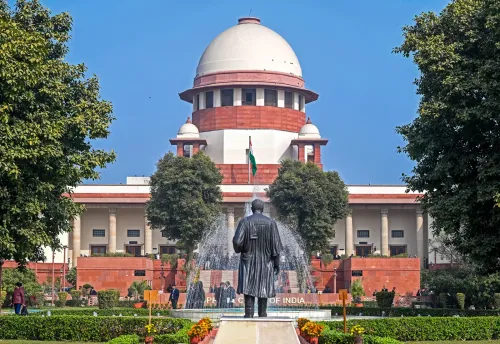
New Delhi, Dec 18 (NationPress) The Supreme Court on Thursday declined to consider a public interest litigation (PIL) that questioned India's current quality standards for bottled drinking water and the use of plastic packaging.
A bench led by Chief Justice of India (CJI) Surya Kant and Justice Joymalya Bagchi pointed out that the petition exhibited a disconnection from the realities faced in the country.
The PIL challenged the regulations set by the Food Safety and Standards Authority of India (FSSAI) and the Bureau of Indian Standards (BIS), particularly concerning allowable levels of antimony and DEHP (Di(2-ethylhexyl) phthalate) in packaged drinking water and plastic bottles.
During the proceedings, the CJI, Surya Kant, highlighted the petitioner's dependence on foreign standards and guidelines.
"Given the circumstances we are dealing with, do you (the petitioner) believe we can apply US guidelines? Be aware of ground realities. You are referencing Australian and Saudi Arabian guidelines, which is merely theoretical," the apex court stated, emphasizing that India cannot presently adopt standards from developed nations.
"If the petitioner had advocated for water supply in villages lacking access, we could understand. However, debating the labeling on water bottles is merely luxury litigation," the bench added.
The Supreme Court dismissed the petition but permitted the petitioner to approach government authorities with their concerns.
"Please submit a representation to the authorities. We are confident it will be taken into consideration," the bench remarked.
The petition, submitted under Article 32 of the Constitution by advocate Shrishti Agnihotri, sought to annul FSSAI and BIS notifications regarding permissible limits of antimony and DEHP in drinking water and plastic packaging, claiming these standards were ultra vires Article 14 of the Constitution and at odds with the Food Safety and Standards Act, 2006.
The PIL asserted that India, as a signatory to the Universal Declaration of Human Rights and the International Covenant on Economic, Social and Cultural Rights, is obligated to implement international health and safe drinking water norms through domestic law.
The petitioner contended that Indian standards permit higher concentrations of antimony and DEHP in drinking water compared to the safe limits established by the World Health Organization and other countries.
The plea further accused the FSSAI of failing to fulfill its statutory obligations under Section 18 of the FSSAI Act, 2006, which requires consideration of international standards in regulatory frameworks and mandates an open and transparent public consultation during the development or modification of standards.
Arguing that elevated exposure to antimony and DEHP poses significant health risks, including cardiovascular, respiratory, and organ-related disorders, the petitioner claimed that the current standards infringe upon the right to health and the right to clean drinking water as guaranteed under Article 21 of the Constitution.
Point of View
It's crucial to maintain a balanced perspective. The Supreme Court's decision to reject the PIL highlights the importance of contextualizing legal standards within India's unique challenges. While health safety is paramount, the court's emphasis on practicalities over foreign benchmarks resonates with the broader public interest.
NationPress
3 Oct 2026
Frequently Asked Questions
What did the Supreme Court rule regarding the PIL?
The Supreme Court ruled to dismiss the PIL that challenged India's bottled water standards, stating it reflected a disconnect from the country's realities.
Who filed the PIL against bottled water standards?
The PIL was filed by advocate Shrishti Agnihotri under Article 32 of the Constitution.
What were the main concerns raised in the PIL?
The PIL raised concerns about permissible levels of antimony and DEHP in packaged drinking water and claimed existing standards violate constitutional rights.
What did the Supreme Court suggest to the petitioner?
The Supreme Court suggested that the petitioner submit a representation to the relevant government authorities for consideration.
Why did the court mention foreign guidelines?
The court criticized the petitioner's reliance on foreign guidelines, indicating that they are not applicable to India's current situation.