Will the Supreme Court Address Concerns Over Hate Speech?
Click to start listening
Synopsis
The Supreme Court has postponed its ruling on petitions regarding hate speech, addressing critical concerns about enforcement inadequacies. With discussions surrounding regulatory frameworks and specific incidents of hate crimes, the court's deliberation may pave the way for more stringent measures against communal discord.
Key Takeaways
- The Supreme Court is addressing critical petitions related to hate speech.
- Concerns have been raised about the effectiveness of law enforcement.
- There is a focus on the 2021 hate crime against a Muslim cleric.
- Media's role in amplifying hate speech is being scrutinized.
- Potential for new guidelines to combat hate speech is on the table.
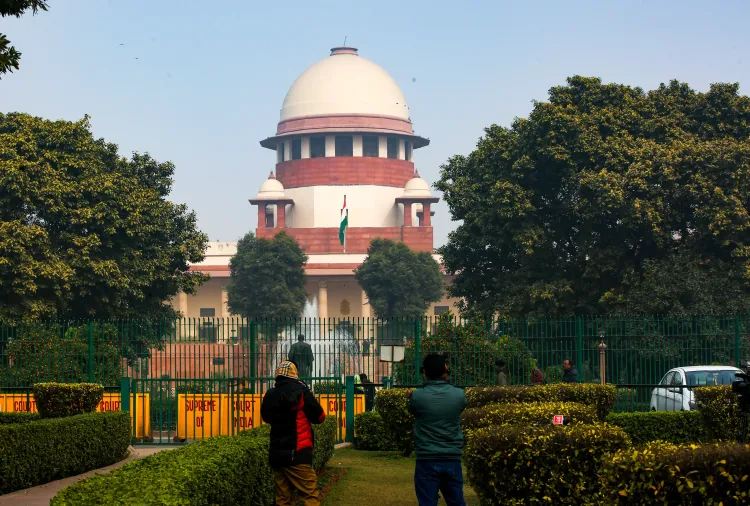
New Delhi, Jan 20 (NationPress) The Supreme Court has reserved its judgment on a series of petitions that express serious concerns regarding hate speech and the perceived ineffectiveness of the authorities to enforce existing regulatory frameworks.
Instructing all involved parties to provide concise written submissions, the Bench led by Justices Vikram Nath and Sandeep Mehta suggested that most petitions might be dismissed, with the option to seek legal remedies, with the exception of one case.
The Justice Nath-led Bench has opted to proceed with the hearing related to a 2021 hate crime involving a Muslim cleric in Noida, Uttar Pradesh, to evaluate the trial's current status and subsequent actions taken.
The collection of petitions, submitted starting in 2020, emerged in the context of alleged hate speeches connected to the 'Corona Jihad' narrative on social media, the controversial 'UPSC Jihad' program broadcasted by a TV channel, and incendiary remarks made during religious gatherings, including Dharam Sansads.
Earlier in 2023, the Supreme Court instructed all states and Union Territories (UTs) to initiate FIRs suo motu, even in the absence of formal complaints, in instances of communal hate speech.
During the hearing on Tuesday, advocate Nizam Pasha, representing the petitioners, argued that the challenge was not the lack of adequate laws but rather the reluctance of enforcement agencies to take action, particularly when alleged offenders are connected to ruling factions.
He pointed out that hate speech events are frequently publicly advertised and that prior interventions by the top court have successfully deterred such occurrences.
Pasha also mentioned an application requesting the removal of an AI-generated video allegedly circulated by a political party’s Assam unit, claiming a direct correlation between hate speech and subsequent hate crimes.
Senior advocate M.R. Shamshad, representing Jamiat Ulama-i-Hind, stated that beyond general hate speeches, there is a growing trend of targeting religious figures, with police often refusing to register FIRs under the pretext that prior sanction is necessary.
Additional Solicitor General S.V. Raju, representing the Centre, affirmed that there has been substantial compliance with the Supreme Court's previous directives, noting that FIRs have been filed in most cases cited in contempt petitions.
Senior advocate Sanjay Hegde emphasized the role of both social and mainstream media in exacerbating hate due to commercial motives.
Referring to past apex court decisions, he questioned whether measures could be developed to render hate speech financially unappealing.
Senior advocate Dama Seshadri Naidu, on behalf of the Election Commission of India, confirmed that the poll panel already has guidelines and enforcement mechanisms to tackle hate speech during elections and is open to enhancing them if necessary.
After considering all perspectives, the Justice Nath-led Bench requested brief written notes from the parties and reserved its orders on the broader question of whether additional guidelines or mechanisms are needed to combat the hate speech menace.
Point of View
The Supreme Court’s deliberation on hate speech reflects a crucial moment in addressing societal divides. With voices from various legal representatives highlighting enforcement gaps and ongoing hate crimes, it is imperative for the judiciary to take a firm stand that upholds justice while ensuring public safety. The future of communal harmony may very well depend on the court's response to these pressing issues.
NationPress
21/01/2026
Frequently Asked Questions
What was the Supreme Court's decision regarding hate speech petitions?
The Supreme Court has reserved its decision on several petitions concerning hate speech and the enforcement of existing regulatory frameworks.
What is the significance of the 2021 hate crime case in Noida?
The Supreme Court is continuing to hear the case related to the alleged hate crime against a Muslim cleric in Noida, which is a focal point in the broader discussion on hate speech.
What actions have been taken regarding hate speech since 2023?
In 2023, the Supreme Court directed all states and Union Territories to register FIRs suo motu in cases of communal hate speech, even without formal complaints.
What concerns were raised about enforcement agencies?
Petitioners argued that the real issue is the reluctance of enforcement agencies to act on hate speech cases, particularly when the offenders are linked to ruling establishments.
What role does media play in hate speech incidents?
Legal experts pointed out that both social and mainstream media contribute to amplifying hate speech due to commercial motivations, raising concerns about their impact on societal harmony.