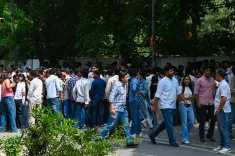
NEET-UG 2026 paper leak: SC issues notices, slams NTA over repeat failures
Synopsis
The Supreme Court's blunt 'they have not learnt their lesson' rebuke captures the crisis: two years after the NEET-UG 2024 scandal, a fresh paper leak in 2026 has landed the NTA back before the apex court — this time facing petitions that want the agency dissolved, the exam digitised immediately, and the CBI to report on its investigation.
Key Takeaways
The Supreme Court issued notices to the Centre and NTA on 25 May 2026 over the alleged NEET-UG 2026 paper leak .
The Bench remarked: 'It's sad that they have not learnt their lesson,' referencing unresolved post-2024 reforms.
The NTA must file an affidavit on compliance with the monitoring committee constituted on 14 November 2024 .
Radhakrishnan must separately submit an affidavit on implementation of the high-powered committee's recommendations.
Petitions seek immediate CBT transition , NTA dissolution, court-monitored oversight, and a CBI status report on the leak probe.
The NEET-UG 2026 exam , held on 3 May , was cancelled on 12 May following allegations of 'guess paper' circulation.
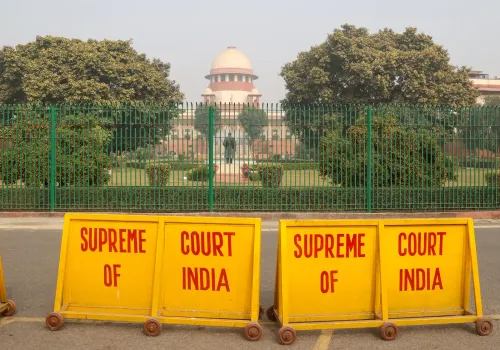
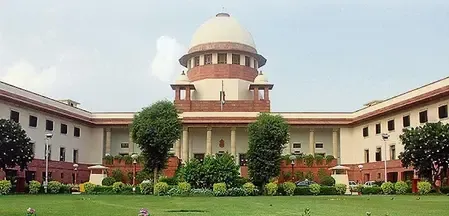
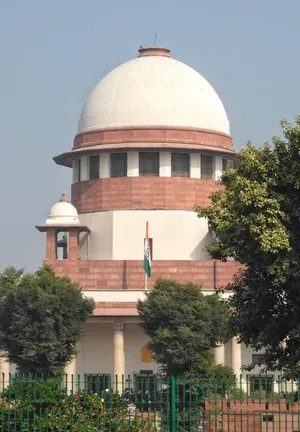
The Supreme Court on Monday, 25 May issued notices to the Centre, the National Testing Agency (NTA), and other authorities on petitions demanding structural overhaul of the NEET-UG examination — including an immediate shift to computer-based testing (CBT) — following the alleged NEET-UG 2026 paper leak controversy. The apex court's sharp rebuke signals deepening judicial impatience with the examination body's repeated integrity failures.
Court's Remarks and Key Directions
A Bench of Justices P.S. Narasimha and Alok Aradhe did not mince words. 'It's sad that they have not learnt their lesson,' the Bench orally observed, recalling that a high-powered committee had already been constituted after the NEET-UG 2024 controversy, its recommendations had been accepted, and a monitoring mechanism had been put in place — yet concerns over examination integrity had resurfaced.
The Bench directed the NTA to file an affidavit clarifying the current status of compliance with recommendations of the monitoring committee constituted on 14 November 2024, including details of its functioning. Separately, Prof. K. Radhakrishnan, Chairman of the high-powered committee and former ISRO Chairman, was directed to submit a personal affidavit on steps taken to implement the panel's recommendations and comply with earlier court directions.
Copies of the petitions were directed to be served on Solicitor General Tushar Mehta, the Centre's second-highest law officer. The matter is listed for further hearing on Friday, 29 May.
What the Petitions Demand
The petitions — filed by the Federation of All India Medical Association (FAIMA) and the United Doctors Front, among others — seek wide-ranging accountability and systemic reforms. Key demands include an immediate transition of NEET-UG to a fully computer-based test (CBT) mode, arguing that the existing pen-and-paper framework, which involves physical printing, transportation, and storage of confidential material, remains 'inherently vulnerable'.
Notably, the petitions point out that the Union government had already publicly announced a planned NEET-UG transition to CBT from 2027 — which, they argue, itself amounts to an acknowledgement that technological reform is necessary. The petitioners contend the examination has continued under 'substantially the same pen-and-paper framework' despite post-2024 recommendations.
Calls to Dissolve or Replace the NTA
One petition challenged the 'systemic failure' of the NTA and sought dissolution of the agency in its present form as a society registered under the Societies Registration Act, 1860. Another sought its replacement with a 'new independent, transparent and professionally regulated National Examination Authority' with statutory accountability, judicial oversight, and advanced technological safeguards.
The petitions also sought constitution of a court-monitored committee to oversee national examination reforms, along with implementation of encrypted digital paper transmission, biometric verification, AI-based surveillance, and stricter cybersecurity protocols.
The 2026 Controversy and the Pattern It Follows
The immediate trigger is the alleged circulation of 'guess papers' ahead of the NEET-UG examination held on 3 May 2026, which was subsequently cancelled on 12 May 2026. The petitions argue this is part of a recurring pattern affecting national-level competitive examinations, not an isolated incident.
The petitions also sought strict criminal prosecution of those allegedly involved in paper leaks and organised cheating rackets, and called for a status report from the Central Bureau of Investigation (CBI) on the progress of its investigation into the alleged NEET-UG 2026 paper leak.
What Comes Next
With the matter returning before the Supreme Court on 29 May, the NTA and Prof. Radhakrishnan's affidavits will be closely watched. The court's tone suggests it may not accept procedural compliance as a substitute for substantive reform — and the question of whether NEET-UG's CBT transition can be accelerated beyond the government's own 2027 timeline may well be on the table.
Point of View
And it has now failed again. The government's own admission of a 2027 CBT transition deadline is a tacit concession that the pen-and-paper model is indefensible, yet it chose not to accelerate the shift. The NTA's continued operation as a society under the 1860 Societies Registration Act — without statutory accountability — is the root governance gap that no monitoring committee can paper over. Until Parliament legislates a replacement body with enforceable standards, judicial directions risk becoming a recurring ritual rather than a lasting fix.
NationPress
19 Sept 2026
Frequently Asked Questions
What is the NEET-UG 2026 paper leak controversy?
The NEET-UG 2026 examination, held on 3 May 2026, was cancelled on 12 May 2026 following allegations that 'guess papers' had been circulated before the test. The controversy prompted petitions in the Supreme Court seeking structural reforms and a CBI investigation into the alleged leak.
What did the Supreme Court say about the NTA on 25 May?
A Bench of Justices P.S. Narasimha and Alok Aradhe orally remarked, 'It's sad that they have not learnt their lesson,' noting that despite a high-powered committee, accepted recommendations, and a monitoring mechanism set up after the 2024 controversy, examination integrity concerns had resurfaced.
What affidavits has the Supreme Court asked for?
The court directed the NTA to file an affidavit on its compliance with the monitoring committee's recommendations constituted on 14 November 2024. Prof. K. Radhakrishnan, Chairman of the high-powered committee, was separately asked to submit an affidavit on implementation steps and compliance with earlier court directions.
What reforms are the petitioners demanding?
The petitions seek an immediate shift of NEET-UG to computer-based testing, dissolution of the NTA in its current form, creation of a new statutory examination authority with judicial oversight, a court-monitored reform committee, encrypted digital paper transmission, biometric verification, AI-based surveillance, and strict criminal prosecution of those allegedly involved in the leak.
When is the next Supreme Court hearing on NEET-UG 2026?
The Supreme Court has listed the matter for further hearing on Friday, 29 May 2026, by which time the NTA and Prof. Radhakrishnan are expected to have filed their respective affidavits.