Supreme Court to examine Aadhaar misuse as citizenship, age proof; notice issued

Synopsis
The Supreme Court has agreed to scrutinise one of Aadhaar's most contested grey zones — its routine use as proof of citizenship, age, and domicile despite a statutory bar under the Aadhaar Act. With notice issued to the Centre, all states, the ECI, and UIDAI, the case could force a nationwide reckoning with how India's foundational identity document is actually being applied on the ground.
Key Takeaways
The Supreme Court on 16 June agreed to hear a PIL challenging the use of Aadhaar as proof of citizenship, domicile, age, and address.
A bench of CJI Surya Kant and Justice V.
Mohana issued notice to the Centre , all states and UTs , the ECI , and UIDAI .
Section 9 of the Aadhaar Act, 2016 expressly bars Aadhaar from being used as evidence of citizenship or domicile.
The PIL specifically challenges Aadhaar's use as proof of date of birth and residence in voter registration Form-6 .
The petition also alleges that weak enrolment verification allows illegal immigrants to obtain Aadhaar and use it to access welfare schemes.
The next hearing is scheduled for 7 August .
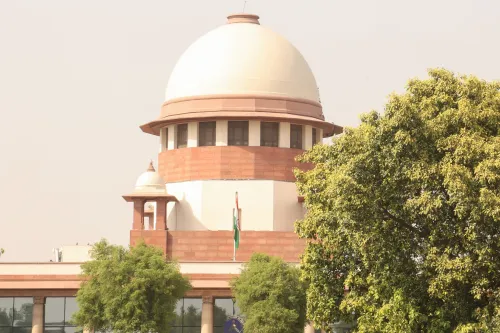
The Supreme Court of India on Tuesday, 16 June agreed to examine a Public Interest Litigation (PIL) challenging the widespread use of Aadhaar as proof of citizenship, domicile, address, and date of birth — purposes explicitly barred under the Aadhaar Act, 2016. A bench comprising Chief Justice of India (CJI) Surya Kant and Justice V. Mohana issued notice to the Union government, all state governments and union territories (UTs), the Election Commission of India (ECI), and the Unique Identification Authority of India (UIDAI). The matter is next listed for hearing on 7 August.
What the PIL Argues
The petition, filed by advocate Ashwini Kumar Upadhyay, contends that Section 9 of the Aadhaar Act, 2016 expressly prohibits treating Aadhaar as evidence of citizenship or domicile. UIDAI notifications similarly clarify that Aadhaar functions solely as proof of identity. Despite these statutory guardrails and prior judicial pronouncements, Aadhaar continues to be routinely accepted as proof of age, residence, citizenship, and domicile for school admissions, property transactions, ration cards, birth certificates, and driving licences, according to the plea.
The Voter Registration Challenge
A specific grievance in the PIL targets Form-6 — the application form for new voter registration — which reportedly accepts Aadhaar as proof of date of birth and proof of residence. The petition argues this directly contradicts the Aadhaar Act, UIDAI guidelines, and the Representation of the People Act. Upadhyay has sought a declaration that such usage is legally unsustainable and should be rendered void and inoperative.
The Infiltration Concern
The petition raises a separate but related concern: under the current Aadhaar enrolment framework, all residents who have lived in India for at least 182 days — including foreign nationals — are eligible to obtain an Aadhaar card. The plea alleges that weak verification mechanisms allow alleged illegal immigrants to enrol, and that they subsequently use Aadhaar as a foundational document to obtain ration cards, birth certificates, domicile certificates, driving licences, and voter identity cards. According to the petitioner, this enables ineligible persons to access subsidies and welfare schemes meant for lawful beneficiaries, diverting public resources and excluding genuine recipients.
Relief Sought
Upadhyay has sought directions to the Centre, all state governments, and the ECI to ensure Aadhaar is used strictly as proof of identity in line with the Act and UIDAI notifications. The Court's decision to issue notice signals that the bench considers the questions raised prima facie worthy of examination. With the next hearing scheduled for 7 August, the Union government and UIDAI will be required to file their responses, which could clarify the Centre's official position on Aadhaar's evidentiary scope.
Point of View
Banks, and electoral rolls have routinely accepted Aadhaar for purposes the Act forbids, with neither UIDAI nor the Centre moving decisively to correct this. The PIL's immigration-related arguments add political charge, but the core legal question — whether Form-6's reliance on Aadhaar violates the Representation of the People Act — is narrow and answerable. The Centre's response on 7 August will reveal whether the government is prepared to enforce the law's own limits on its flagship identity programme.
NationPress
15 Sept 2026
Frequently Asked Questions
What is the Supreme Court PIL on Aadhaar about?
The PIL, filed by advocate Ashwini Kumar Upadhyay, asks the Supreme Court to direct the Centre, all states, the ECI, and UIDAI to ensure Aadhaar is used only as proof of identity — not as proof of citizenship, domicile, address, or date of birth. The Court issued notice to all respondents on 16 June and has listed the matter for 7 August.
Does the law already bar Aadhaar from being used as citizenship proof?
Yes. Section 9 of the Aadhaar Act, 2016 expressly states that Aadhaar is not evidence of citizenship or domicile. UIDAI notifications also clarify that Aadhaar serves only as proof of identity. The PIL argues that despite this, Aadhaar is routinely accepted for prohibited purposes.
Why is voter registration Form-6 being challenged?
Form-6, used for new voter registration, reportedly accepts Aadhaar as proof of date of birth and proof of residence. The petitioner argues this violates the Aadhaar Act, UIDAI guidelines, and the Representation of the People Act, and has sought a declaration that such use is legally void.
What is the concern about illegal immigrants and Aadhaar?
The petition alleges that foreign nationals residing in India for at least 182 days are eligible to enrol for Aadhaar, and that weak verification mechanisms allow alleged illegal immigrants to obtain the card. They can then reportedly use it as a base document to secure ration cards, voter IDs, and other entitlement documents, according to the petitioner.
When is the next Supreme Court hearing on this matter?
The Supreme Court has listed the case for its next hearing on 7 August. By then, the Union government, state governments, ECI, and UIDAI are expected to file their responses to the notice.