India telecom growth: Scindia cites 110 crore connections
Synopsis
India has reached 110 crore internet connections, Union Minister Jyotiraditya M. Scindia said, citing telecom as an example of the country’s shift towards creating technology. At a New Delhi conclave, he also recognised hackathon winners working on sensors, fibre networks, 5G security and drone communications.
Key Takeaways
Union Minister Jyotiraditya M.
Scindia said India has 110 crore internet connections, up from 25 crore .
Scindia said broadband connections had grown from 6 crore to 104 crore .
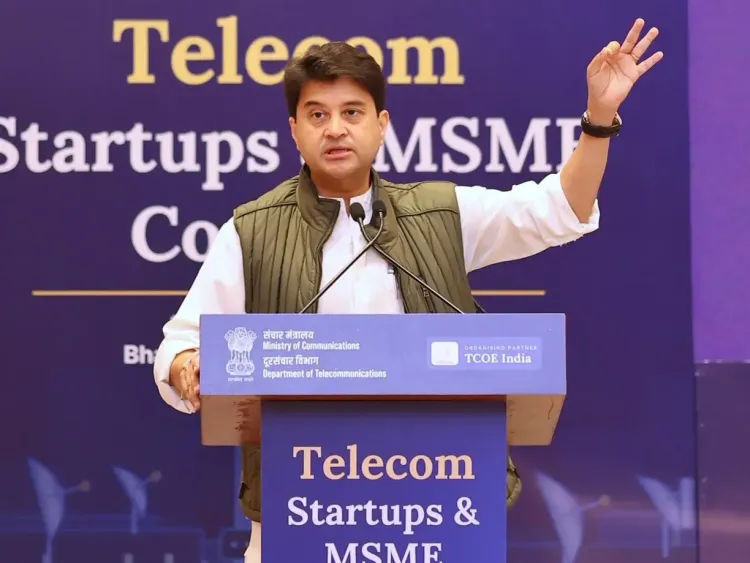
The Telecom Startups and MSME Conclave 2026 in New Delhi covered five technology areas and featured 11 exhibition stalls.
The Emerging Technologies Hackathon 2026 received over 2,870 registrations and 620 applications across nine domains.
Entra Innovations LLP won first prize for VAAYU, while Dawniens International Private Limited took second prize for Cablesmith.
India telecom networks have grown from 25 crore internet connections to 110 crore, Union Minister for Communications Jyotiraditya M. Scindia said at the Telecom Startups and MSME Conclave 2026 in New Delhi on 24 November. He described the sector as a leading example of the country’s shift from consuming technology to creating it over the past decade.
Addressing startups, industry representatives and government officials, Scindia also said broadband connections had risen from 6 crore to 104 crore. The figures were presented as part of his assessment of India’s technology development.
Scindia cites startup and connectivity growth
Scindia said India had moved from having a few hundred startups in 2014 to more than 2 lakh. He also described India as the world’s fourth-largest economy and market under the leadership of Prime Minister Narendra Modi.
The minister called telecom the most profound example of the country becoming a technology creator and claimed that India was the only telecom network market worldwide growing at double-digit rates. The reported figures and comparison were presented as the minister’s claims.
His remarks connected the expansion in internet and broadband connections with a wider discussion about domestic technology development. Connection totals describe the scale of access, while the conclave focused on the products and capabilities Indian firms are developing for the sector.
Five areas of telecom innovation
The conclave brought together telecom startups, Micro, Small and Medium Enterprises (MSMEs), investors, academics, industry leaders and government representatives. They showcased indigenous products, discussed challenges facing domestic innovators and explored ways to scale Indian telecom technologies.
Presentations and discussions covered five areas of the telecom technology stack: Radio Access Network (RAN) and Core, Applications, Chipsets, Security and Standards. Each group included officials from the Department of Telecommunications, who outlined government initiatives, policy interventions and frameworks intended to support startups and MSMEs.
The event also featured 11 exhibition stalls where startups and MSMEs presented indigenous products and solutions to policymakers, investors and other participants. Sessions gave user agencies and industry representatives a forum to discuss potential applications and implementation requirements.
Hackathon winners recognised
Scindia felicitated the winners of the Emerging Technologies Hackathon 2026, organised by TCoE India. The competition received more than 2,870 registrations and 620 applications across nine technology domains, with students, startups, companies and academic institutions taking part.
Entra Innovations LLP won first prize for VAAYU, an indigenously designed tyre-pressure sensor system-on-chip. Dawniens International Private Limited received second prize for Cablesmith, a robotic optical patch panel solution designed for remote provisioning of fibre connections.
The joint third prize went to IIT Bombay’s Team DRISTI for KAVACH, a security engine for private 5G networks, and the Military College of Telecommunication Engineering’s Team RUDRA for VajraLink, an anti-jamming communication solution for drones.
From prototypes to wider use
The products recognised at the hackathon cover different uses, from sensors and fibre infrastructure to network security and drone communications. The conclave’s discussions addressed potential applications and the requirements for putting such technologies into use.
The event also highlighted the government’s stated aim of supporting entrepreneurship and the development and commercialisation of homegrown telecom products. The source did not specify a timetable for deployment or commercial adoption of the showcased technologies.
For the participating innovators, the next stage will depend on how the products and ideas discussed at the conclave can be developed and put to use.
Frequently Asked Questions
What did Scindia say about India’s telecom sector?
Union Minister Jyotiraditya M. Scindia said India had moved from 25 crore to 110 crore internet connections. He described telecom as a prominent example of India’s shift from consuming technology to creating it.
How many broadband connections did Scindia say India has?
Scindia said India has 104 crore broadband connections, up from 6 crore.
What was discussed at the Telecom Startups and MSME Conclave 2026?
The conclave covered Radio Access Network and Core, Applications, Chipsets, Security and Standards. Participants also discussed challenges for domestic innovators and opportunities to scale Indian telecom technologies.
Who won the Emerging Technologies Hackathon 2026?
Entra Innovations LLP won first prize for VAAYU, a tyre-pressure sensor system-on-chip. Dawniens International Private Limited took second prize, while IIT Bombay’s Team DRISTI and the Military College of Telecommunication Engineering’s Team RUDRA shared third prize.
What happens next to the technologies showcased at the conclave?
The source did not provide a timetable for deploying or commercialising the showcased technologies. Participants discussed potential applications and implementation requirements.