How Did India's Telecom Exports Surge by 72% in 5 Years?
Synopsis
India's telecom landscape is transforming rapidly, with exports witnessing a staggering growth of 72% in just five years, crossing Rs 18,406 crore. Minister Scindia reveals the nation's advancements towards 5G and SATCOM, aiming for global leadership in telecommunications.
Key Takeaways
Telecom exports in India have surged by 72% in five years.
Exports increased from Rs 10,000 crore to Rs 18,406 crore .
5G technology is being rapidly deployed across the nation.
India aims for global leadership in the telecom sector.
SATCOM services are being expanded to enhance connectivity.
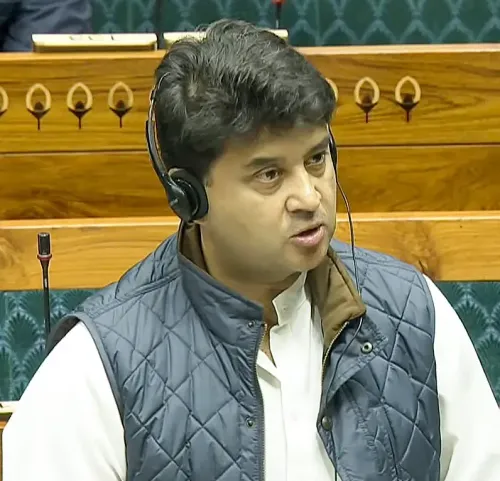
New Delhi, Dec 17 (NationPress) India’s annual telecom exports have soared by 72%, reaching over Rs 18,406 crore in the past five years, as reported by Union Communications Minister Jyotiraditya M. Scindia in Parliament on Wednesday.
In response to a query during the Lok Sabha session, the minister revealed that India’s telecom exports have increased from Rs 10,000 crore in 2020–21 to Rs 18,406 crore by 2024–25, while imports have stabilized at around Rs 51,000 crore. He emphasized that under Prime Minister Narendra Modi's leadership, India is swiftly progressing towards self-sufficiency in the telecom domain and is gearing up for global prominence.
Addressing a supplementary inquiry, Scindia underscored India's strides in 5G deployment. He noted that out of 778 districts in the nation, 767 districts are already linked to the 5G network. Presently, India boasts 36 crore 5G subscribers, a figure projected to rise to 42 crore by 2026 and reach 100 crore by 2030.
Regarding SATCOM, Scindia stated that global insights indicate that regions lacking connection via traditional BTS or broadband using optical fiber can only be served through satellite communications. In this context, India has taken significant steps to ensure SATCOM services are accessible nationwide.
The government aims to provide a comprehensive range of telecom services to all customers, allowing them to make informed decisions based on their preferences and budgets.
The Union Minister pointed out that the SATCOM policy framework is robust, with spectrum set for administrative allocation. Three licenses have already been granted — to Starlink, OneWeb, and Reliance.
He further explained that two pivotal issues must be tackled before operators can launch commercial services. The first involves spectrum allocation, including the establishment of administrative spectrum fees, which falls under the jurisdiction of the Telecom Regulatory Authority of India (TRAI).
The second issue pertains to security clearances from enforcement agencies. To aid this, operators have been given a sample spectrum for demonstrations, and all three licensees are currently fulfilling the necessary compliance requirements.
Once operators showcase adherence to the mandated security standards — including hosting international gateways within India — the required approvals will be granted, allowing the rollout of SATCOM services to customers, the minister concluded.
Point of View
I believe that India's rapid growth in telecom exports, led by significant advancements in 5G and SATCOM technologies, is a clear indicator of the country's ambition to become a global leader in telecommunications. This shift not only enhances self-reliance but also showcases India's potential to impact the global market positively.
NationPress
19 Sept 2026
Frequently Asked Questions
What is the percentage increase in India’s telecom exports?
India’s telecom exports have increased by 72% over the last five years.
What are the current and projected numbers of 5G subscribers in India?
India currently has 36 crore 5G subscribers, expected to rise to 42 crore by 2026 and reach 100 crore by 2030 .
What steps has India taken regarding SATCOM services?
India has implemented a SATCOM policy framework , with licenses issued to major companies like Starlink and Reliance .
How many districts in India are connected to 5G?
767 districts out of 778 have been connected to the 5G network.
What challenges do telecom operators face before launching services?
Operators need to address spectrum allocation and obtain security clearances from enforcement agencies.