How Did Scottish Merchants Open India's Trade Gates?

Synopsis
In 1812, Scottish merchants rallied in Glasgow and Greenock, not just for a larger share of trade, but to reshape the financial landscape of the British Empire. Their struggle against the East India Company symbolizes a complex interplay of colonial interests and the exploitation of India. Discover how this demand for 'free trade' masked deeper injustices.
Key Takeaways
Scottish merchants sought to dismantle the EIC monopoly.
Their demands were rooted in self-interest and economic necessity.
The 1813 Charter Act opened trade to private British traders.
India's economy was further exploited under new trading conditions.
The plight of Indian subjects remained largely ignored.
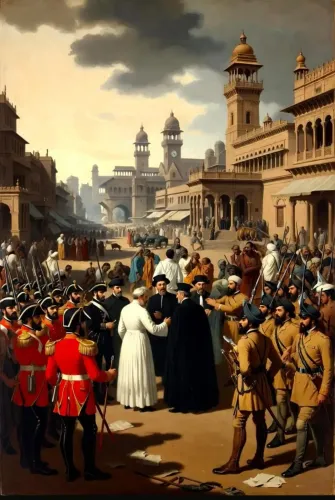
New Delhi, Dec 14 (NationPress) The Scottish merchant class, convened in the lively halls of Glasgow and the docks of Greenock in 1812, was not just seeking a bigger slice of global trade; they were insisting on a significant restructuring of the financial hierarchy within the British Empire. Their adversary was not an alien entity, but a fellow British institution: the United Company of Merchants of England Trading to the East Indies, commonly known as the East India Company (EIC).
For the countless Indian subjects who provided the revenues that enabled this entire argument, the Scottish outcry for “free trade” represented the pinnacle of colonial hypocrisy. This was a conflict between two influential factions of the British ruling elite over who would benefit from the systematic exploitation of Hindustan, converting the subcontinent's suffering into metropolitan economic advantage. The Scottish merchants clamored for freedom, invoking basic rights and national necessity, while the Indian populace, whose existence underpinned the £26 million debt burdening the EIC, were stripped of even the right to voice their own destinies under a “perfectly fettered” press.
This narrative details the petitions from Glasgow and Greenock, a potent expression of British self-interest cloaked in the language of universal commercial liberty, and what this struggle revealed about the true “despotism” governing India.
I. The Crisis of Commerce: Seeking Salvation in the East
The impetus behind the Scottish claims was the widespread commercial calamity enveloping Britain. The year 1812 marked a low point for British manufacturers and traders. The “inveterate enemy”, Napoleon Bonaparte, had tightened his anti-commercial stance across Europe, effectively closing off extensive continental markets. This, coupled with an “unfortunate misunderstanding with the United States of America”, left manufacturers in turmoil, factories idle, and working families plunged into poverty and unemployment.
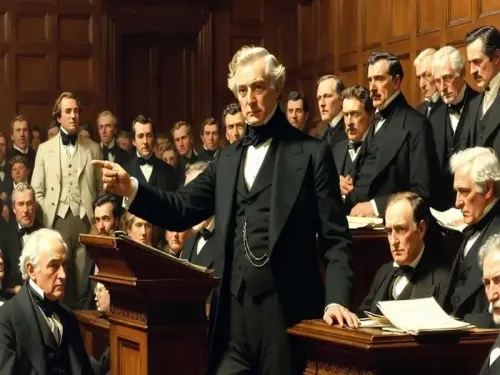
The city of Glasgow, a burgeoning industrial center, felt this impact sharply. The leadership of its Chamber of Commerce and Manufacturers, along with the city council and Merchants House, began to submit petitions with increasing urgency. Their message was straightforward: the impending expiration of the EIC Charter, which had granted the EIC the “whole sole and exclusive trade” east of the Cape of Good Hope, was an outdated relic that needed to be abolished immediately.
They argued that the termination of the Charter presented a golden opportunity. The vast, populous regions of the East, secured by British military strength, offered a desperately needed “vital substitute for lost European commerce”. The merchants of Glasgow and Greenock contended that opening trade would “afford an extensive field for the employment of mercantile talents and capital beyond the tyrannical grasp of the enemy”. They viewed the East not merely as a financial lifeline but also as a strategy to counteract France's commercial warfare.
They asserted that the nation's prosperity hinged on seizing this opportunity to ensure “full employment to the operative classes of the community”, thereby bolstering and safeguarding the “vital interests” of the British Empire.
II. The Unjust Arrangement: Foreigners Over Fellow Subjects
The central argument of the Scottish merchants, echoed in every petition from Glasgow, Greenock, Paisley, and the Convention of Royal Burghs in Scotland, was the profound injustice of the monopoly itself: British subjects were deprived of a right freely granted to foreigners.
The petitions often referenced the Act of 37 Geo. 3, c. 57, which restricted British merchants but allowed “foreign nations in amity with his Majesty” to trade in territories claimed by the EIC.
The Glasgow merchants pointed directly to the successes of American traders:
“The merchants of the United States of America, availing themselves of the liberty which they have been allowed to enjoy, at the expense of our own people, have prosecuted the East India trade in a manner and to a degree which has enriched the individuals, increased the national wealth of that country, and supplied... not only the continent of Europe, but South America, the West Indies... and even Malta, with East Indian commodities”.
The triumph of American private trade was presented as unequivocal “proof that these expectations of advantage, from the exertions of private individuals, are not unfounded”. American merchants had successfully captured a significant portion of the China trade previously dominated by the East India Company and managed to undersell them in numerous European markets.
For Scottish merchants, this arrangement signified a “hardship, bordering on injustice”. They viewed it as “unnatural and extremely hard, if not an unjust arrangement” that the “India trade is open to all the world except the British merchant, the monopoly thereby operating directly in favour of foreign nations”. This was seen as “degrading to the national character, and humiliating to individuals”.
The inherent irony of this exclusion was profound: British subjects were “burdened, to a certain degree, with the expense of the naval and military establishments for defending those possessions, while they are deprived of that free commercial intercourse which is enjoyed by foreigners”. They were footing the military costs of empire while observing foreigners reap the economic rewards. They implored the House to safeguard their “birth-right” to free commerce.
III. The Impolitic Policy: Inefficiency and Insolvency
The Scottish critique extended beyond mere injustice; it aimed at the EIC’s evident incompetence, asserting that the monopoly was “impolitic”. Merchants contended that commerce confined under a monopoly “never can prove beneficial to a country in the degree that the same trade would, if left open to the exertion of individual enterprise”.
The petitions argued that the EIC was a failed trading entity:
- Inadequate Capital: Glasgow merchants noted “strong reason to believe that the capital of the East India Company is not adequate to the trade”.
- Prodigality vs. Economy: The American success illustrated that private traders triumphed through “industry, economy, and dispatch,” while the EIC was marked by “prodigality and negligence of a joint stock company”.
- Failure to Exploit Markets: The EIC had “never traded” in many of the vast countries encompassed by its exclusive charter, a task its limited capital could not permit.
Underlying these complaints of inefficiency lay the financial ruin exposed in Parliament. The EIC’s inability to trade profitably stemmed from its substantial territorial debt. The Company, which was criticized as being possibly “15 millions worse than nothing”, had seen its trade profits (over £6 million since 1793) “absorbed by debts and expenses incurred in respect of the territorial acquisitions in India”.
The EIC's financial obligations depended “most essentially upon the trade”. Yet, critics claimed that the Company was a “constant burden and grievance to the nation”. The Scottish argument—that open trade would augment national wealth and revenue—was effectively a pledge to manage the Indian financial complex more efficiently than the bankrupt EIC could.
IV. The Ultimate Irony: Freedom for the Exploiter
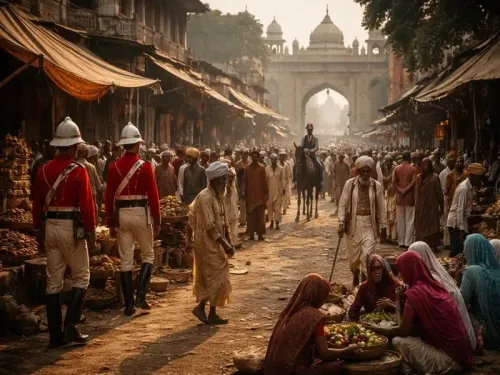
From the Indian perspective, the fervent Scottish demand for free trade was simply a sophisticated call for expanded, decentralized exploitation. They aimed to open “new markets” for British goods by imposing them upon India's “immense and populous” regions.
This commercial ambition was in direct alignment with the established colonial economic paradigm:
1. Systematic De-industrialisation: The British Empire was already engaged in a “systematically engineered process of colonial underdevelopment”. Protectionist policies, including high tariffs in Britain, restricted Indian textiles, while the EIC “forced open the large Indian market to British goods”. The Scottish desire for “new and extensive markets” was a plea to expedite this process, ensuring that Scottish manufacturing could permanently replace India’s indigenous industries.
2. The Denial of Native Rights: While Glasgow merchants advocated for their “natural right” and “birthright” to free trade, the Indian populace, whose taxes funded the entire system, were deprived of basic rights and justice. The governance system was one of “ruler and ruled”—a despotism where free discussion was stifled because the government was “founded upon blood and supported by injustice”.
3. Prioritising London Over India: The Scottish protests inadvertently highlighted the EIC's disregard for Indian welfare. For instance, while the merchants of Port Glasgow lamented the “present pressure upon the trade” in Europe, Indian creditors of the Rajah of Tanjore had been awaiting “for over 14 years” to be compensated for legitimate claims by the EIC, having been reduced from prosperity to “the greatest distress”.
4. Suppression of Indian Industry: Even when native industry provided a competitive edge, British interests intervened. London shipowners vehemently opposed the use of India-built vessels. This was openly described as an act of “injustice and oppression” that denied India the “reward of his industry, and support of his family,” forcing Indians to witness their trade “conveyed under every flag, but that of their natural and legitimate protector”.
In essence, the Glasgow petitions contended that they, as British subjects, merited the right to exploit India more effectively than the monopolistic EIC.
V. The Fear of Unrestrained Europeans
The EIC, in its defense against the petitioners, articulated the substantial political risk posed by the very “free trade” demanded by the Scottish merchant class. The EIC, though greedy, operated under a centralized authority that could manage the interactions between British subjects and the native populace.
The Company cautioned that India’s “tranquillity is not maintained by a physical force, but chiefly by moral influence, and in a great degree even by prejudice”. Any alteration would “alarm them, and their submission to British authority would be greatly endangered by an unrestrained resort of Europeans in search of wealth, either by commerce or other means”. The EIC feared that an influx of new, aggressive European private merchants, unshackled from the Company’s direct control, would destabilize the fragile imperial equilibrium.
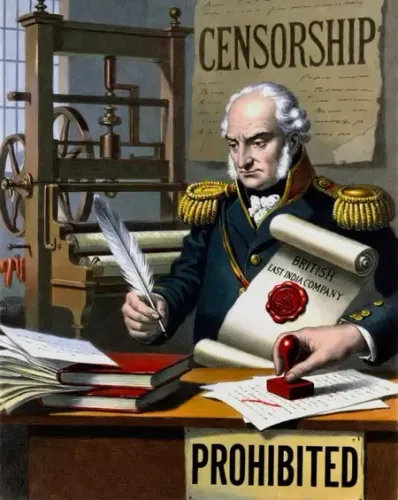
The necessity to regulate information was crucial; the press was “perfectly fettered”, justified by concerns that unrestricted publication could “inform (natives) of the peculiar tenure by which the British government held their power”. The EIC harbored fears that new settlers might incite native plots for “exterminating the whole European population of Bengal”.
By demanding the right to penetrate India’s vast markets from “every port of the United Kingdom”, the Scottish merchants were advocating for the very destabilization of the political order that secured their access. They were so blinded by the financial necessity of uncovering new markets to counter the French system that they overlooked the political hazards of provoking a native reaction against an oppressive colonial regime.
Conclusion: The New Mortgage on Indian Soil
The torrent of petitions from Scottish mercantile centers like Greenock and Glasgow in 1812 marked a pivotal moment in the annals of the British Empire. Their demands, anchored in the “common birthright of all his Majesty's subjects” and the perceived necessity of combating the “tyrannical policy” of France, ultimately triumphed. The 1813 Charter Act effectively dismantled the EIC’s commercial monopoly over India (though reserving the China trade), thus opening the gates to private traders from outports like Glasgow and Liverpool.
This victory for “free trade” in Britain translated into an intensification of colonial servitude for India. The Scottish petitioners explicitly expressed their disinterest in India’s political fate, “disclaiming all interference with territorial rights and political privileges of the company”. They sought only the liberty to unleash their capital, skill, and industry onto the vast, populous regions of the East.
The outcome was the formalization of the Drain of Wealth under a new, broader array of financial actors. The Indian economy, already crippled by debt and de-industrialization, became exposed to a flood of inexpensive British goods and the rapacious ambitions of countless competing private merchants, all aiming to extract maximum value from territories reduced to mere financial assets.
The freedom gained by the merchants of Glasgow was not purchased with British capital, but with the relentless labor of the Indian peasant. This debate underscored that the imperial system functioned like a perpetually leveraged corporation: when the existing management (the EIC) proved too ineffective to maximize shareholder returns (British national welfare), a new management (private traders) was installed, ensuring the ongoing mortgage on India's soil and sovereignty.
(The author is a researcher specializing in Indian History and Contemporary Geopolitical Affairs)
Point of View
It is pivotal to recognize that the historical struggle between Scottish merchants and the East India Company reflects a significant moment in colonial dynamics. This narrative underscores the complexities of trade and exploitation, urging us to examine the ramifications of such economic interests on the lives of Indian citizens.
NationPress
13 Oct 2026
Frequently Asked Questions
What was the role of Scottish merchants in India's trade?
Scottish merchants in 1812 sought to dismantle the East India Company's monopoly to gain access to Indian markets, arguing for a more equitable trading environment that would benefit British subjects.
How did the East India Company impact Indian trade?
The East India Company monopolized trade in India, restricting British merchants from engaging freely in the market while allowing foreign traders to benefit, leading to significant economic disparities.
What was the significance of the 1813 Charter Act?
The 1813 Charter Act marked the end of the East India Company's monopoly over trade in India, allowing private British traders to enter the market, which intensified the colonial exploitation of Indian resources.
How did Scottish merchants justify their demands?
Scottish merchants argued that the existing monopoly was unjust and detrimental to British interests, claiming a natural right to trade freely and compete in the lucrative Indian market.
What were the consequences of Scottish demands for free trade?
While the Scottish merchants achieved greater access to Indian markets, it ultimately led to increased exploitation and the further drain of wealth from India, exacerbating the economic challenges faced by the local population.