Malappuram second medical college bid rejected by Kerala health minister
Synopsis
Kerala's Health Minister has flatly rejected the demand for a second medical college in Malappuram — the IUML's home turf — telling the Assembly there is no scope for another institution in the district. The rebuff puts the UDF coalition under quiet pressure, as the IUML, the government's second-largest ally, faces its own grassroots constituents on a longstanding healthcare demand.
Key Takeaways
Muraleedharan told the Kerala Assembly on 14 October 2026 that there is no scope for a second medical college in Malappuram .
IUML MLA Kurukkoli Moideen had sought a medical college at Tirur , citing the district's population and patient-to-facility ratio.
The minister cited the recently sanctioned second medical college in Thiruvananthapuram , cleared after an additional 100 seats were allotted by the Centre.
Malappuram is the IUML 's principal stronghold; the party is the second-largest ally in the Congress -led UDF government.
The IUML holds key portfolios including Industries, Public Works, Local Self-Government, and Education, and secured a Cabinet-rank post for M.K.
Muneer as chairman of the Administrative Reforms Commission.
Kerala's Health Minister K. Muraleedharan on Wednesday, 14 October 2026, told the Kerala Assembly that there was no scope for a second medical college in Malappuram district, effectively shutting the door on a demand raised by an Indian Union Muslim League (IUML) legislator. The minister's statement came in response to a notice by IUML MLA Kurukkoli Moideen, who had argued that Malappuram's large population and strained patient-to-facility ratio warranted a new institution at Tirur.
What the Government Said
Minister Muraleedharan pointed to the recently sanctioned second medical college in Thiruvananthapuram as a reference point, noting it had been cleared with the Centre's approval following the allotment of an additional 100 medical seats. No parallel case, he indicated, had been made out for Malappuram. The government's position leaves the district — home to one government medical college — without a committed second facility for now.
The Political Dimension
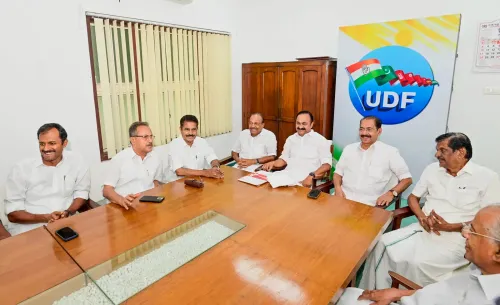
Malappuram is the IUML's principal political stronghold and the bedrock of its electoral strength within the Congress-led United Democratic Front (UDF). The IUML is the UDF's second-largest coalition partner, and better healthcare infrastructure in Malappuram has long been a priority demand from the party's grassroots base.
The backdrop matters: following the UDF's return to power under Chief Minister V.D. Satheesan after a decade in opposition, the IUML reportedly sought an additional Cabinet berth, a demand that was not accepted. The party subsequently secured a Cabinet-rank position for former legislator M.K. Muneer, who was appointed Chairman of the Administrative Reforms Commission. It continues to hold key portfolios including Industries, Public Works, Local Self-Government, and Education.
Historical Context
During the Oommen Chandy government's 2011–16 tenure, the IUML secured a fifth ministerial berth, underscoring the leverage it has historically wielded within UDF governments. The current episode — a government minister rejecting a demand from a legislator belonging to a key coalition ally — is unlikely to pass without friction within the alliance.
Opposition Angles
Both the Communist Party of India (Marxist) (CPI-M) and the Bharatiya Janata Party (BJP), which have at various points criticised the Congress over its dependence on the IUML, could use the episode to press competing narratives: one framing the government as appeasing communal politics, the other highlighting its failure to deliver on healthcare equity in Malappuram.
What Happens Next
The Tirur proposal is unlikely to be dropped quietly by the IUML, given the constituency pressure on legislator Kurukkoli Moideen. The party may renew the demand through other legislative or executive channels. Whether the government revisits its position — perhaps by commissioning a feasibility study — will be closely watched as a signal of how the UDF manages coalition stress over the coming months.
Point of View
The episode illustrates a recurring tension in coalition governance: the UDF needs the IUML's seats but cannot endlessly fund district-specific demands without triggering demands from others. The CPI-M and BJP will read this closely for the openings it creates in Malappuram ahead of the next election cycle.
NationPress
14 Oct 2026
Frequently Asked Questions
Why was the demand for a second medical college in Malappuram rejected?
Health Minister K. Muraleedharan told the Kerala Assembly on 14 October 2026 that there was no scope for another medical college in Malappuram district. He cited the recently sanctioned second medical college in Thiruvananthapuram — approved by the Centre after an additional 100 medical seats were allotted — as the basis for his position.
Who demanded the second medical college in Malappuram?
IUML legislator Kurukkoli Moideen raised a notice in the Kerala Assembly seeking a medical college at Tirur in Malappuram, arguing that the district's large population and poor patient-to-facility ratio justified a new institution.
What is the IUML's political significance in Malappuram and the UDF?
Malappuram is the Indian Union Muslim League's principal electoral stronghold, and the party is the second-largest ally in the Congress-led United Democratic Front government. The IUML holds portfolios including Industries, Public Works, Local Self-Government, and Education, and has historically leveraged its coalition position to secure administrative and ministerial gains.
How does this affect the UDF coalition?
The rejection creates quiet friction within the UDF, as the government has turned down a demand from a legislator belonging to a key coalition partner. The IUML is likely to renew the demand through other channels, and the episode could be exploited by the CPI-M and BJP in Malappuram ahead of future elections.
Is there any precedent for similar IUML demands being accommodated by past governments?
During the Oommen Chandy-led UDF government's 2011–16 tenure, the IUML secured a fifth ministerial berth, demonstrating the leverage it has historically wielded. In the current dispensation, the party was given a Cabinet-rank post for former legislator M.K. Muneer as Chairman of the Administrative Reforms Commission after its demand for an additional Cabinet berth was not accepted.