Another Tiger Carcass Discovered in Kaziranga National Park?
Click to start listening
Synopsis
In a shocking turn of events, Kaziranga National Park has reported the discovery of a second tiger carcass within just five days. This raises urgent concerns over wildlife safety and conservation efforts. With the park’s rich biodiversity at stake, authorities are investigating the causes of these tragic losses.
Key Takeaways
- Second tiger carcass found in Kaziranga within five days.
- Post-mortem examinations indicate infighting as a cause of death.
- Kaziranga Elevated Corridor project launched for wildlife safety.
- Park is home to 104 Bengal tigers, among other species.
- Authorities are investigating to enhance conservation efforts.
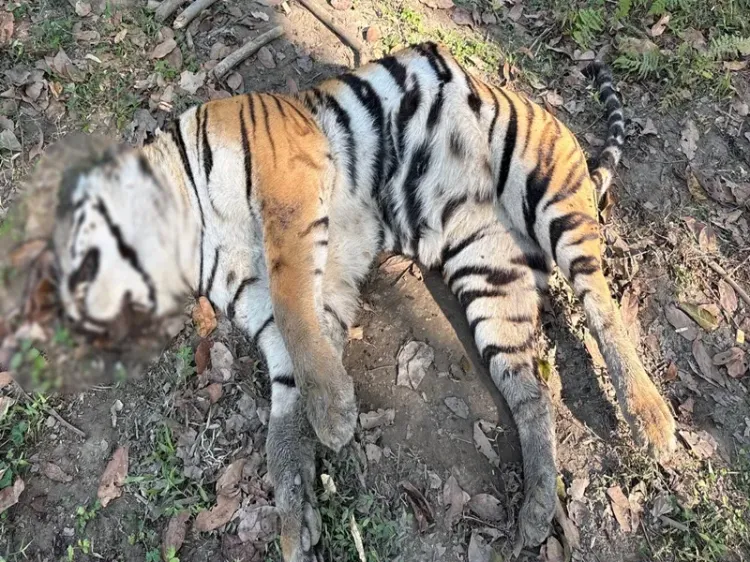
Guwahati, Jan 19 (NationPress) Just days after the discovery of a deceased tiger, a second tiger carcass has been unearthed in Assam's Kaziranga National Park and Tiger Reserve (KNPTR), officials announced on Monday.
An official from KNPTR reported that the remains of a female tiger, estimated to be around three to four years old, were found on Sunday afternoon in the Kathpora area of the Bagori Western Range.
In response to this finding, KNPTR Director Sonali Ghosh has formed a committee tasked with carrying out the post-mortem examination and managing the carcass disposal following the Standard Operating Procedures (SOP) set by the National Tiger Conservation Authority (NTCA).
Initial results from the post-mortem examination indicated that the tigress succumbed to injuries from infighting.
Previously, on January 14, the body of a young male Royal Bengal tiger, aged about two to three years, was found at Thute Chapori in the Eastern Range, Gamiri, under the Biswanath Wildlife Division of KNPTR.
The carcass was discovered by personnel from the Gopaljarani Anti-Poaching Camp during their regular patrol. Acting swiftly, the KNPTR Director also organized a committee to supervise the post-mortem examination and the disposal of this carcass in accordance with NTCA regulations.
Preliminary veterinary assessments suggested that this tiger’s death might have resulted from natural causes or internal conflicts.
Kaziranga National Park and Tiger Reserve, recognized as India’s seventh UNESCO World Heritage Site, is home to the celebrated ‘Big Five’ species.
Current estimates indicate that the park houses 2,613 greater one-horned rhinoceroses (2022 census), 104 Bengal tigers (2022), 1,228 Asian elephants (2024), 2,565 wild water buffaloes (2022), and 1,129 eastern swamp deer (2022).
Spanning the districts of Golaghat, Nagaon, Sonitpur, and Biswanath, the park generated over Rs 10.90 crore in revenue during 2024-25 and more than Rs 8.81 crore in 2023-24.
The KNPTR is composed of three forest divisions: Eastern Assam Wildlife Division (Bokakhat), Biswanath Wildlife Division (Biswanath Chariali), and Nagaon Wildlife Division (Nagaon).
In a related development, Prime Minister Narendra Modi laid the cornerstone for the ambitious Rs 6,950-crore Kaziranga Elevated Corridor project on Sunday.
This initiative aims to facilitate safe wildlife movement throughout KNPTR, minimize road accidents on National Highway-715, promote eco-tourism, and create local job opportunities.
The project is part of the four-laning of the Kaliabor-Numaligarh section of NH-715, featuring approximately 34.45 km of elevated, wildlife-friendly corridors and bypasses at Jakhalabandha and Bokakhat.
The Prime Minister also reviewed a model of the proposed Kaziranga Elevated Corridor.
Point of View
I believe it is crucial for us to highlight the ongoing challenges faced by wildlife in Kaziranga National Park. The repeated losses of tigers in such a short span raise alarms about the health of the ecosystem and the effectiveness of conservation measures in place. It is imperative that we support initiatives that ensure the safety of these majestic animals while promoting sustainable tourism.
NationPress
19/01/2026
Frequently Asked Questions
What caused the deaths of the tigers?
Preliminary post-mortem examinations suggest that at least one of the tigers died due to infighting, while the cause of the other remains under investigation.
What is the Kaziranga Elevated Corridor project?
The Kaziranga Elevated Corridor is a project aimed at ensuring safe wildlife movement, reducing road accidents, and promoting eco-tourism within the national park.
How many tigers are currently in Kaziranga National Park?
As per the latest estimates, Kaziranga National Park is home to approximately 104 Bengal tigers.
What steps are being taken to address wildlife safety?
Authorities are conducting thorough investigations, post-mortem examinations, and implementing the Kaziranga Elevated Corridor project to enhance wildlife safety.
Is Kaziranga National Park a protected area?
Yes, Kaziranga National Park is recognized as a UNESCO World Heritage Site and is part of India's national tiger conservation efforts.