What Does the Iconic ‘Sengol’ Symbolize in the Ceremonial Welcome of President Murmu in Parliament?
Synopsis
The ceremonial arrival of President Droupadi Murmu at Parliament highlighted the prominence of the iconic ‘Sengol’. This sceptre, steeped in India's rich history, serves as a powerful reminder of the nation's enduring values and ethical governance, linking ancient traditions to modern sovereignty. Explore how the Sengol represents both cultural significance and contemporary political discourse.
Key Takeaways
The Sengol is a historical symbol representing India's enduring values and ethical governance.
It was presented to Pandit Nehru, marking a pivotal moment in India's transition to independence.
Crafted by skilled artisans, the Sengol embodies the cultural heritage of ancient Tamil civilization.
Its presence in Parliament serves as a reminder of the responsibilities of governance.
The ongoing debate surrounding its significance highlights the tension between cultural symbolism and modern republican values.
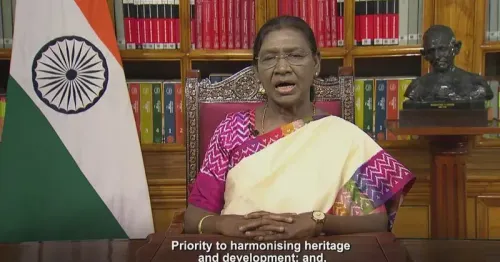
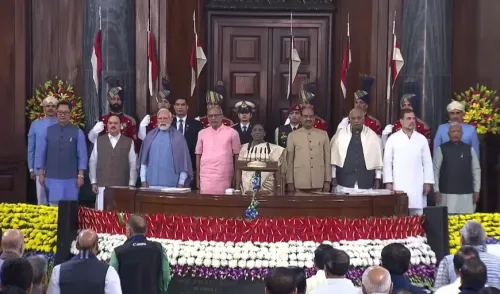
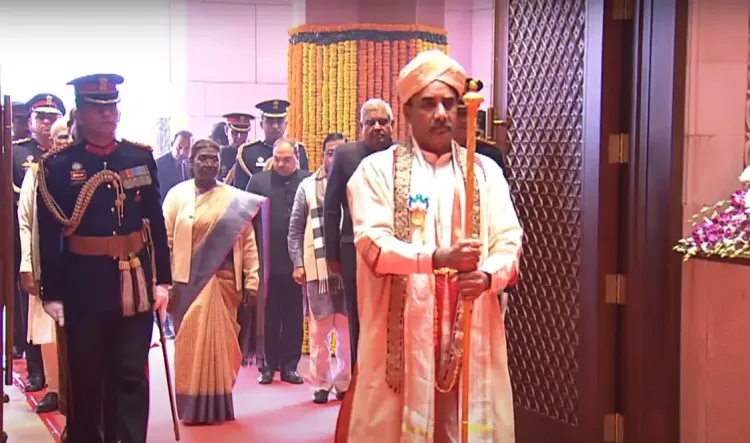
New Delhi, Jan 28 (NationPress) During the grand ceremonial arrival and heartfelt reception of President Droupadi Murmu at Parliament for her address preceding this year’s Budget Session, the distinguished ‘Sengol’ emerged as a prominent emblem of India’s lasting values.
As Vice President C. P. Radhakrishnan, Prime Minister Narendra Modi, Lok Sabha Speaker Om Birla, Parliamentary Minister Kiren Rijiju, and others accompanied the President, a senior Marshal clad in traditional attire led the procession bearing the Sengol. This sceptre, rich in the spiritual and cultural heritage of ancient Tamil civilization, serves as a striking representation of India’s enduring values, emphasizing that temporal authority is guided by the principles of dharma (righteousness).
Historically a crucial part of the coronation ceremonies of Tamil kings, the Sengol was not merely a ceremonial object; it embodied the deep ethical duties entrusted to a ruler. Historical accounts indicate that this sacred tradition was significantly revived on the eve of India’s Independence in 1947, when the Sengol was reverently handed to Pandit Jawaharlal Nehru, India’s inaugural Prime Minister.
This event marked the civilizationally grounded transition of power from colonial governance to an independent Indian state. Crafted by Vummidi Bangaru Chetty and consecrated by the venerated seers of the Thiruvaduthurai Adheenam, the Sengol carries the blessings of spiritual guardianship and the timeless wisdom of India’s sacred heritage.
Symbolizing the ‘Dharma Danda’, the Sengol served as a reminder to monarchs that the highest authority was Dharma, or ethical and spiritual order. Historically, it represented just and fair governance, marking the transfer of power from one king to another during the Chola dynasty. Today, it symbolizes that governance should adhere to established policies and guidelines and fulfill its responsibilities.
It also conveys a message to the populace and their elected officials along these lines. The presence of the Sengol in select Parliamentary practices, such as Wednesday’s joint address by the President, transforms a ceremonial occasion into a historical and cultural statement. It reinforces a governmental narrative that connects ancient symbols to contemporary sovereignty while reviving the 1947 origin story that is now central to Parliamentary procedures.
The Sengol was ceremonially installed next to the Lok Sabha Speaker’s chair on May 28, 2023, during the inauguration of the new Parliament building and has since featured in numerous high-profile ceremonies.
On Wednesday, it was again prominently displayed at the forefront of the ceremonial procession escorting President Murmu through the revered halls of Parliament.
Some Opposition Members of Parliament have contested the sanctity of the Sengol, calling for its removal or replacement. Some argue that the Constitution, rather than a “royal sceptre”, should embody Parliamentary authority, turning the issue into a contentious debate about secular republican symbolism versus cultural revival.
Nevertheless, the return of the Sengol signifies a long-overdue acknowledgment of indigenous traditions, as it has now become an accepted emblem of Parliament. Made from silver and gilded in gold, with a replica of Nandi – the sacred bull – atop, the sceptre was preserved at Allahabad Museum before being placed in the Lok Sabha.
Point of View
I see the return of the Sengol not merely as a ceremonial gesture but as a vital acknowledgment of India's rich cultural heritage. It emphasizes the need for governance rooted in ethical values and serves as a reminder of our historical responsibilities as a nation. The discourse surrounding its significance highlights the importance of balancing tradition with modern governance principles.
NationPress
20 Sept 2026
Frequently Asked Questions
What is the historical significance of the Sengol?
The Sengol symbolizes the ethical responsibilities of rulers in ancient Tamil civilization and was historically used during coronation ceremonies.
Why was the Sengol presented to Jawaharlal Nehru in 1947?
The Sengol was presented to Nehru as a representation of the transfer of authority from colonial rule to an independent Indian state.
What materials are used to create the Sengol?
The Sengol is made of silver, plated with gold, and features a replica of Nandi, the sacred bull.
Why do some MPs oppose the Sengol's presence in Parliament?
Some Opposition MPs argue that the Sengol represents a royal symbol that clashes with the secular principles of the Constitution.
What role does the Sengol play in modern governance?
The Sengol serves as a reminder that governance should be just and guided by ethical principles, linking India's tradition with contemporary political practices.