What Was the Sepoy’s Shadow When India’s Taxes Funded a Private Army to Guard London’s Tea?
Click to start listening
Synopsis
Explore the shocking history behind the East India Company’s Volunteers Bill of 1820, revealing how Indian taxes funded a military presence in London. Discover the implications of imperial hypocrisy and financial manipulation that allowed Britain to prioritize corporate interests over the welfare of millions in India.
Key Takeaways
- The East India Company’s Volunteers Bill was introduced in 1820 to create a military corps in London.
- Indian taxes were diverted to fund British military interests, highlighting imperial exploitation.
- The Bill showcased the imperial hypocrisy of prioritizing corporate security over Indian welfare.
- It spurred significant debates about legitimacy and accountability in colonial governance.
- The historical implications continue to resonate in discussions about colonial legacies.
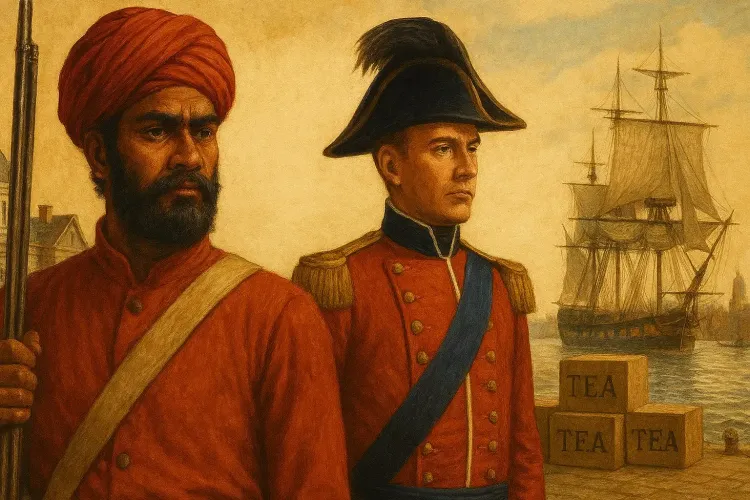
New Delhi, Jan 25 (NationPress) During the summer of 1820, a seemingly inconsequential legislative action occurred in the British Parliament: the introduction of the East India Company’s Volunteers Bill. This act aimed to formalize a small infantry unit in London, entrusted with the unremarkable task of safeguarding the Company’s vast warehouses.
For the ruling elite in Westminster, this represented a trivial dispute over finances and security measures amidst domestic turmoil. However, from the perspective of India—the origin of the Company’s immense and precarious wealth—this Bill stood as a final, glaring emblem of imperial duplicity. It illustrated that the EIC, which professed to be a “territorial sovereign” and claimed to care about the “welfare and happiness of the inhabitants”, was entirely willing to jeopardize the futures of millions to ensure the safety of its tea and silk stocks in far-off London, all while drowning in a crippling debt resulting from colonial expansion.
The discussion surrounding the Volunteers Bill was not merely about security; it was fundamentally about legitimacy. It unveiled the insidious mechanism by which Indian revenues were systematically redirected to support British interests, fund political patronage, and maintain an illusion of solvency for a corporation that critics labeled as “15 millions worse than nothing”.
To understand the anger associated with financing a London militia with Indian resources, one must first appreciate the vast financial structure of the British Raj in the early 1800s. The EIC had evolved far beyond a mere commercial entity; it had become a “powerful territorial sovereign”.
Nevertheless, this sovereignty came at a tremendous cost. The expenses related to the “defense and protection of the British possessions in India”—the ongoing wars and territorial expansion—had escalated Indian debt from about £7 million in 1793 to nearly £26 million by 1813. The modest profits generated by the EIC through trade were wholly consumed by the debts and expenses linked to its territorial acquisitions in India.
This debt created a relentless financial drain on Indian revenues, as the EIC was required to allocate approximately £1.5 million annually in London just to service the interest on these debts. Every rupee collected from the labor of Indian farmers was effectively pre-allocated to European creditors and shareholders, ensuring the stability of the Company’s credit back home.
Consequently, the opponents of the Volunteers Bill quickly linked the proposed military expenditure to this pre-existing financial distress. Creevey insisted on a “full inquiry into their actual condition” before the House could consent to such a measure, arguing that the Company’s solvency was in doubt. He maintained that the measure was merely the “last act towards a military despotism” established by ministers while the empire grappled with the economic hardships following the Napoleonic Wars.
The most blatant and infuriating objection, from the standpoint of Indian fiscal integrity, was the EIC's intended accounting maneuver. Hume, a diligent critic of the Company’s finances, disclosed that the “expense was charged to the political department”.
This charging methodology represented a blatant misuse of Indian revenue. The EIC divided its accounts into political (territorial administration, military, debt service) and commercial (trade profits). The political department was the vast reservoir funded by taxes and land rents extracted from India.
By attributing the cost of safeguarding its “London warehouses”—housing commercial items such as tea and silk—to the political department, the EIC was effectively compelling India’s tax-paying populace to cover the expenses for the Company’s commercial security in Britain.
As Hume lamented, while the political department faced chronic “incumbrances” and depended on “yearly raising loans in India,” the EIC opted to further burden it with this “unnecessary expense.” The argument was straightforward: if the London corps was necessary to protect commercial property, the cost should belong to the commercial budget, which theoretically relied on trade profits, not Indian taxes.
By transferring the charge onto the political account, the EIC formalized the principle that Indian revenue was merely a contingency fund for all corporate needs, regardless of geographical or functional relevance.
Opponents questioned the priority, pondering why the EIC required a volunteer corps when entities like the Bank of England, which had “property to protect equally valuable,” had not taken such a measure. This underscored the unique, hybrid nature of the EIC as a private corporation demanding public, state-level military protection, funded by the distant subjects of its empire.
As the opposition voiced their concerns, they made a damning argument that the Volunteers Bill was a step towards “military despotism.” They reasoned that establishing a 400-to-800-man infantry corps in the “heart of the metropolis” during peacetime was unnecessary and contributed to a generalized “military system ministers were establishing throughout the country.”
Hobhouse pointed out that the standing army was already vast (92,000 men at the time) and criticized the tendency to invoke the “phantom of disaffection” to justify military expansion.
From an Indian standpoint, this metropolitan anxiety over a few hundred volunteers was tragically ironic. While British politicians feared the advent of military despotism in London, India had already been enduring the absolute, oppressive reality for decades.
The EIC’s actual power did not rely on a mere handful of volunteers; it was supported by a substantial military apparatus in India, comprising “an impressive 250,000 soldiers, predominantly Indian sepoys led by British officers.” This vast force was the true instrument of despotism, perpetually engaged in operations driven by the “irrepressible tendency to expansion,” leading to “conquest or extinction.”
This massive army was funded entirely by the Indian populace, whose resources were “largely consumed by the costs of the British administration and its military activities.” The Indian subject bore the financial burden of the arms and personnel enforcing territorial seizures and the denial of their sovereignty.
The system was one “founded upon blood and supported by injustice.” The conduct of warfare could involve actions “considered questionable by European standards,” such as the execution of the Killedar of Talnier Fort, which Parliament was compelled to acknowledge.
The London Volunteers Bill, therefore, epitomized the externalization of the political climate of fear and military control that had characterized British rule in India from the beginning. The British domestic elite, confronted with social unrest (such as the Luddite Riots) and economic dislocation, responded by adopting the same centralized military control tools they had perfected and financed for decades using Indian funds. As Whitbread articulated a decade prior, the Indian populace were not “fellow-subjects... but those whom we and our fellow-subjects are despots over.”
The debate surrounding the military corps was intrinsically connected to the broader pattern of colonial finance: the relentless prioritization of British commercial and political interests over the fundamental needs and legal claims of Indian subjects.
The opposition raised questions regarding the EIC’s priorities, highlighting the widespread neglect of those who served the state. General Tarleton had previously argued against enhancing the salaries of Board of Control clerks when military pay had “no increase... since the reign of Charles 2,” emphasizing the preference for civil patronage over military service. The Volunteers Bill stood as yet another example of prioritizing corporate military extravagance in London over:
Legal Justice in India: Despite the EIC’s assertions of offering improved governance and courts of justice, the system faced widespread condemnation in Parliament.
Hume noted the “deplorable state of civil and criminal justice and police in India,” where exorbitant fees and stamped paper requirements meant justice was “virtually denied to suitors,” leading to an “increase of crime, enormous.” The EIC was eager to finance a guard for its docks but failed to establish an accessible and equitable judicial system for its millions of subjects.
Honoring Native Creditors: While the Company had resources available to establish a new corps and cover its expenses from the “political department,” the claims of legitimate Indian creditors were routinely disregarded. The creditors of the late Rajah of Tanjore, whose revenues were seized by the EIC, had been left unpaid for “over 14 years,” ultimately “despair[ing] of Company justice.” The EIC could mobilize a force and finance its establishment, but it would not settle its lawful debts to its own native subjects.
Maintaining the Illusion of Civilian Rule: The EIC maintained a “fettered” press in India, strictly regulating information under the threat of “immediate embarkation for Europe.” This harsh censorship was justified by the fear of publications that might “inform them [natives] of the peculiar tenure by which the British government held their power” or incite “tumultuous proceedings.” The necessity for the EIC to raise a private military corps in London, charged to its political account, only validated that the system of governance relied entirely on military enforcement, even in the heart of the capital, thereby revealing the fragility of the political “moral influence” it claimed to depend upon in India.
The triumph of corporate interest
Despite the robust opposition presented by critics like Creevey and Hume, who argued the force was “wholly needless,” the East India Company’s Volunteers Bill was ultimately approved. Supporters like Money defended it as “essential for protecting Company warehouses” and necessary to “afford their aid to the civil power.”
The successful passage of the Bill confirmed the unchallenged supremacy of the EIC's financial demands over political accountability, whether in India or Britain. It illustrated that when the security of the EIC’s valuable commercial assets was at stake—assets that generated the wealth required to pay dividends and service the massive Indian debt—Parliament would grant extraordinary measures, even those tinged with military excess and financial impropriety.
The establishment of the Volunteer Corps in London, funded by the distant, impoverished subjects of India, symbolized the culmination of the EIC's “privatized imperialism.” India was not merely a conquest; it was a boundless, subservient treasury, whose revenues could be exploited without restraint to cover the costs of British global ambitions, domestic repression, and ultimately, the safeguarding of its own corporate storerooms.
The London Volunteers Bill, financed by India’s political revenue, was akin to a landlord compelling his tenants in a distant, heavily mortgaged estate to pay the salary of a security guard whose sole responsibility was to stand outside the landlord's personal safe in a foreign city. The security guard served the landlord's commerce, but his wages were extracted, without consent or question, from the crippling debt of the far-off tenants.
Point of View
It's crucial to recognize the historical significance of the East India Company’s actions and the Volunteers Bill. This episode serves as a stark reminder of the prioritization of corporate interests over human welfare, urging a critical examination of imperial legacies that continue to resonate today.
NationPress
25/01/2026
Frequently Asked Questions
What was the East India Company's Volunteers Bill?
The East India Company's Volunteers Bill, introduced in 1820, aimed to establish a small military corps in London to protect the Company’s warehouses. It symbolized the imperial hypocrisy of prioritizing British corporate security over the welfare of Indian subjects.
How did Indian taxes fund British military interests?
Indian revenues were systematically diverted to fund British interests, including military expenditures in London. This created a financial burden on the Indian populace while the Company prioritized its own security.
What were the implications of the Volunteers Bill?
The Volunteers Bill highlighted the exploitation of Indian resources for British corporate needs and raised questions about legitimacy, accountability, and the impact of imperial policies on millions of Indian subjects.
Why is this historical event significant today?
This event underscores the ongoing consequences of colonial policies and serves as a reminder of the need to address historical injustices in contemporary society.
What does the Volunteers Bill reveal about imperialism?
The Volunteers Bill exemplifies the lengths to which imperial powers would go to protect their interests at the expense of colonized populations, revealing the deep-seated injustices inherent in colonial governance.