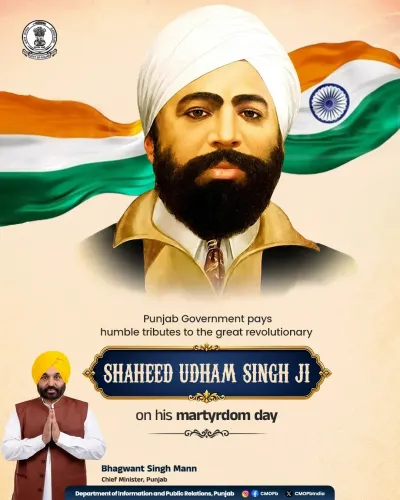
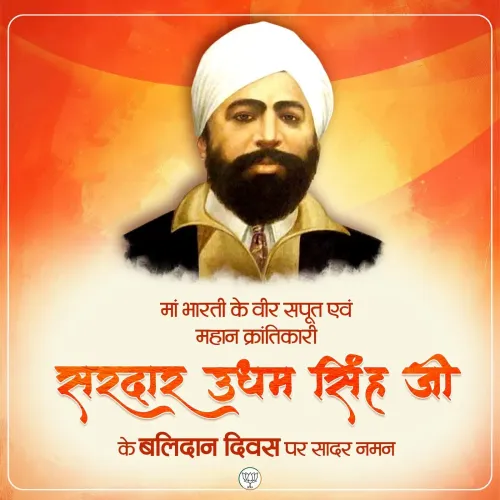
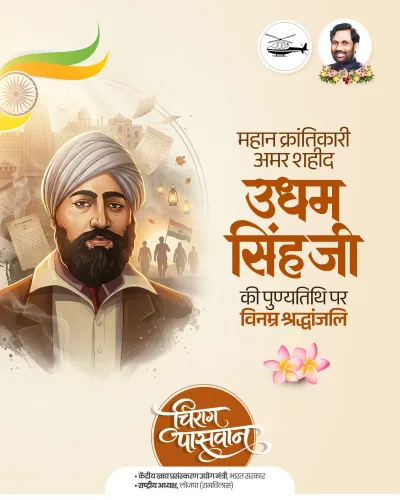
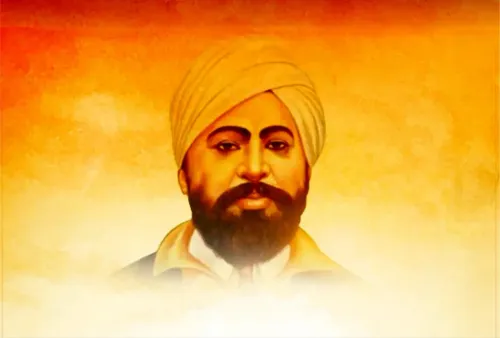
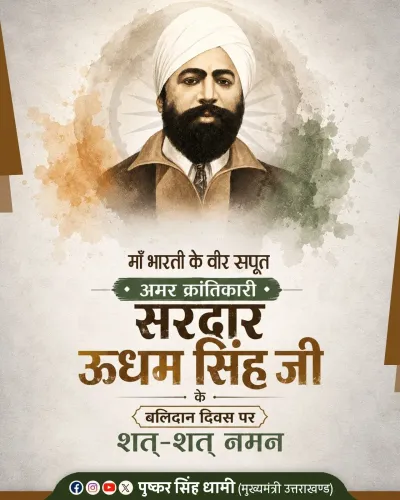
Amit Shah pays tribute to martyr Udham Singh on Balidan Diwas
Synopsis
Union Home Minister Amit Shah marked the Balidan Diwas of revolutionary Udham Singh on 31 July, honouring the martyr who assassinated Michael O'Dwyer in London in 1940 to avenge the Jallianwala Bagh massacre and who was hanged the same day that year.
Key Takeaways
Amit Shah posted a bilingual Hindi-Punjabi tribute to Udham Singh on his martyrdom anniversary, 31 July .
Udham Singh was hanged at Pentonville Prison, London, on 31 July 1940 after assassinating former Punjab Lt.
Governor Michael O'Dwyer to avenge the Jallianwala Bagh massacre of 13 April 1919 .
Shah highlighted Singh's role in the Ghadar Party , which mobilised the Indian diaspora in North America for the independence cause.
Singh's remains were repatriated to India in 1974 and cremated at his birthplace, Sunam, Punjab .
The bilingual format of the post reflects outreach to both the Punjabi heartland and the global Punjabi-speaking diaspora.
He smiled at the gallows so that a nation might one day stand free. On Balidan Diwas — the martyrdom anniversary of Udham Singh — Union Home Minister Amit Shah bowed in remembrance of the revolutionary who carried the grief of Jallianwala Bagh all the way to London and answered it with an act that shook the British Empire to its core.
Posting in both Hindi and Punjabi on 31 July, Shah wrote: 'Amar Shaheed Udham Singh ji ke balidan diwas par unke charno mein naman karta hoon' — 'On the martyrdom anniversary of immortal martyr Udham Singh, I bow at his feet.' He described Singh as 'an unparalleled symbol of extraordinary courage and valour' who avenged the countrymen killed in the Jallianwala Bagh massacre by striking at the heart of British power in London, and who 'embraced the hangman's noose laughing' for the cause of freedom.
The act that defined a revolution: London, 1940
On 13 March 1940, Udham Singh shot and killed Michael O'Dwyer — the former Lieutenant Governor of Punjab who had sanctioned the Amritsar operation — at a public meeting in Caxton Hall, London. It was a premeditated act of retribution, executed 21 years after British troops under General Reginald Dyer opened fire on thousands of unarmed civilians gathered at Jallianwala Bagh, Amritsar, on 13 April 1919. The massacre, which killed hundreds and wounded over a thousand, became one of the defining atrocities of colonial rule and a permanent wound in India's national memory.
Udham Singh was tried, convicted of murder, and hanged at Pentonville Prison, London, on 31 July 1940 — the date that India now marks as his Balidan Diwas. He was 40 years old. His remains were repatriated to India in 1974 and cremated at his birthplace, Sunam, Punjab.
The Ghadar connection: freedom's global network
Shah's tribute also highlighted Singh's association with the Ghadar Party, the early 20th-century revolutionary organisation founded by Indian expatriates — primarily in North America — to overthrow British rule through armed uprising. Singh's links to the Ghadar movement underscored the transnational character of India's freedom struggle: a network of workers, intellectuals, and soldiers spread across the United States, Canada, and Southeast Asia who kept the flame of resistance alive far from home.
Shah noted that Singh 'played an important role in awakening the spirit of freedom in the hearts of Indians living abroad through the Ghadar Party' — a line that carries particular resonance given the size and political consciousness of today's Punjabi diaspora in the UK, Canada, and the United States.
Hindi and Punjabi, side by side
The bilingual format of the post — identical text in Hindi and Punjabi — is a deliberate act of outreach. It signals respect for a martyr who belongs equally to the Hindi-speaking heartland and to Punjab, where Udham Singh was born and where his memory is most fiercely guarded. The gesture also speaks directly to Punjabi-speaking communities overseas, the very diaspora Singh once tried to mobilise.
Every 31 July, India pauses to remember a man who chose a London courtroom as the stage for his final statement. 'I am not afraid of death,' Singh reportedly said before his execution. 'I am dying for my country.' That sentence — unembellished, absolute — still echoes louder than any empire.
Point of View
And they speak directly to Punjabi voters and the diaspora — communities that remain electorally and diplomatically significant. The bilingual Hindi-Punjabi framing is not incidental; it is calibrated outreach. By foregrounding the Ghadar Party's overseas dimension, Shah also implicitly frames the Indian diaspora as a historic and continuing force in national affairs — a theme consistent with the current government's broader engagement with non-resident Indian communities.
NationPress
14 Sept 2026
Frequently Asked Questions
Why is 31 July observed as Udham Singh's Balidan Diwas?
31 July 1940 is the date on which Udham Singh was hanged at Pentonville Prison in London after being convicted of murdering former Punjab Lieutenant Governor Michael O'Dwyer . India marks the day as his martyrdom anniversary, or Balidan Diwas.
What did Udham Singh do and why?
Udham Singh shot and killed Michael O'Dwyer in London on 13 March 1940 to avenge the Jallianwala Bagh massacre of 13 April 1919 , in which British troops fired on unarmed civilians in Amritsar, killing hundreds. O'Dwyer, as Lt. Governor of Punjab, had sanctioned the military operation.
What was the Ghadar Party and what was Udham Singh's connection to it?
The Ghadar Party was a revolutionary organisation founded by Indian expatriates, primarily in North America , in the early 20th century to overthrow British rule. Udham Singh was associated with the party and helped spread the message of independence among Indians living abroad.
Where was Udham Singh born and where are his remains?
Udham Singh was born in Sunam, Punjab . His remains were repatriated from Britain to India in 1974 and cremated at his birthplace.
Why did Amit Shah post the tribute in both Hindi and Punjabi?
The bilingual format reflects Udham Singh's deep roots in Punjab and the significance of his legacy to Punjabi-speaking communities both in India and in the global diaspora, particularly in the United Kingdom, Canada, and the United States .