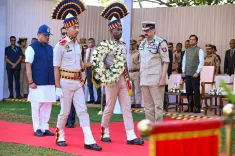
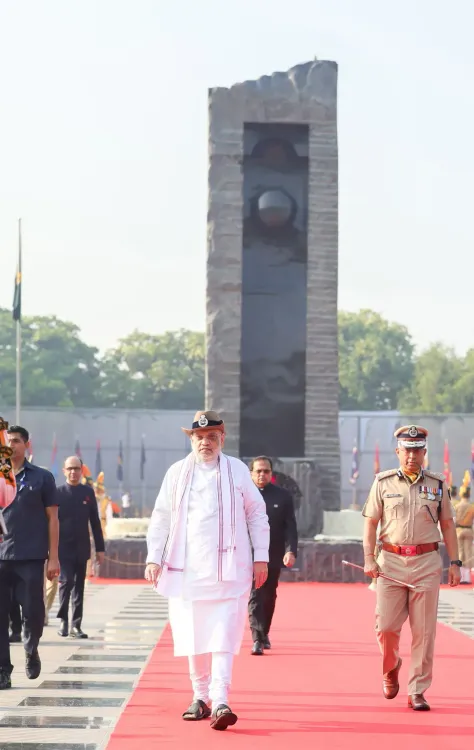
Amit Shah Lays Wreath at National Police Memorial on Commemoration Day
Synopsis
Union Home Minister Amit Shah laid a wreath at the National Police Memorial on Police Commemoration Day, honouring fallen officers and crediting police forces with rolling back Naxalism, terrorism in J&K, and Northeast insurgencies — while flagging narcotics cartels as the next target under PM Modi's drug-free India vision.
Key Takeaways
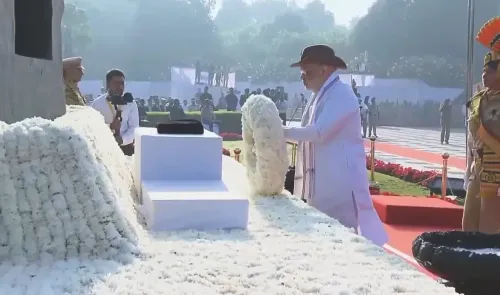
Union Home Minister Amit Shah laid a wreath at the National Police Memorial, New Delhi on October 21, 2026 — Police Commemoration Day .
Police Commemoration Day marks the killing of 10 Indian policemen in a 1959 Chinese ambush in Ladakh.
Shah credited police forces with significantly reducing Naxalism, terrorism in Jammu and Kashmir , and insurgency in Northeast India .
The Bodo Peace Accord (2020) and the reorganisation of J&K after the Article 370 abrogation (2019) are key milestones in the government's internal security record.
Shah identified dismantling narcotics cartels as the next major police mission, aligned with PM Modi 's vision of a drug-free India.
The Narcotics Control Bureau has been progressively strengthened since 2014 to address cross-border drug trafficking.
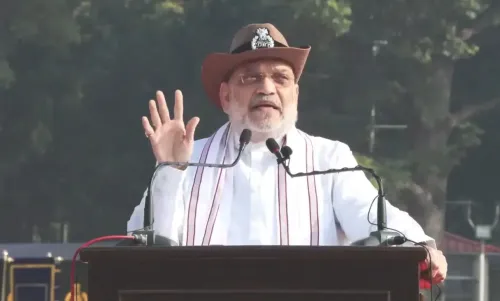
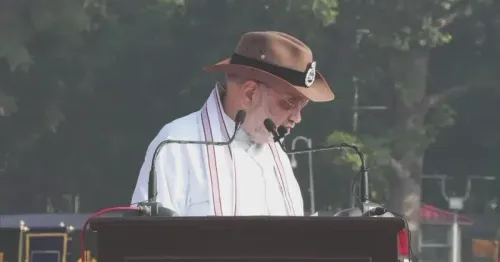
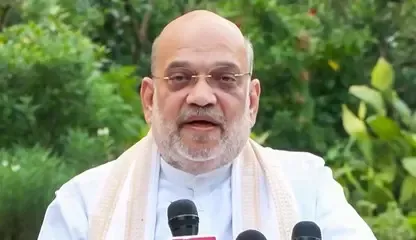
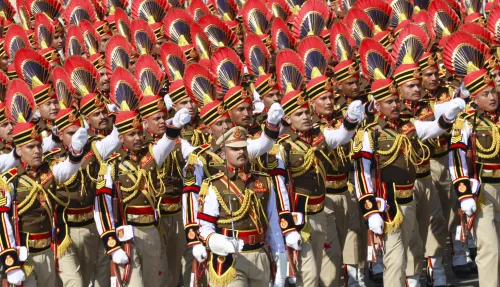
On the day India pauses to remember its police martyrs, Union Home Minister Amit Shah laid a wreath at the National Police Memorial in New Delhi on Wednesday, October 21, 2026 — the Police Commemoration Day — honouring the men and women who paid the ultimate price in service to the nation.
A Memorial Rooted in a 1959 Sacrifice
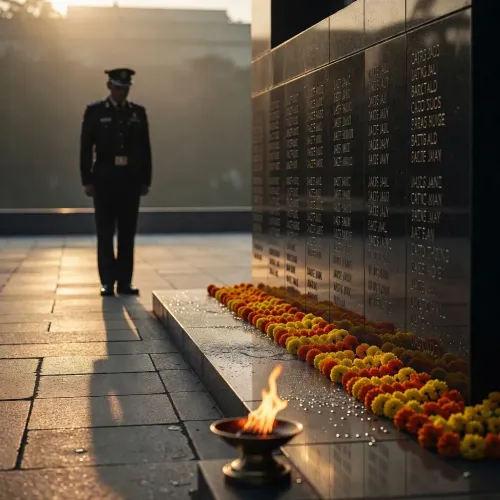
Police Commemoration Day is observed every year on October 21, marking the date in 1959 when 10 Indian policemen were killed during a Chinese ambush in Ladakh's Hot Springs area — one of independent India's earliest reminders that the frontier of national safety is guarded by human lives. The National Police Memorial in New Delhi, inaugurated in 2018, stands as the permanent, physical acknowledgement of every officer who has since fallen in the line of duty across the country.
From Naxal Heartlands to Kashmir's Mountains
In his tribute, Shah credited police forces with nothing less than reshaping India's internal security map. 'Their Himalayan resolve erased Naxalism, crushed terrorism in Jammu and Kashmir, and liberated the Northeast from the clutches of insurgency,' he said. The language was deliberate — each theatre represents a distinct chapter in India's counter-insurgency story.
Left-wing extremist violence, once spread across a so-called 'red corridor' through central and eastern India, has been a sustained focus of Ministry of Home Affairs operations for over a decade. In Jammu and Kashmir, the abrogation of Article 370 in August 2019 reorganised the region as a Union Territory and was accompanied by an intensified security grid aimed at dismantling terrorist infrastructure. In the Northeast, milestones such as the Bodo Peace Accord of 2020 reflected a dual-track approach — security pressure paired with political settlement — that the government credits with significantly reducing insurgent activity across Assam, Nagaland, Manipur, and neighbouring states.
The Next Frontier: Narcotics Cartels and a Drug-Free India
Shah pointed toward the next operational priority: dismantling narcotics networks. 'Today, they are poised to dismantle narcotics cartels, pursuing Modi Ji's vision of a drug-free India,' he said, linking frontline police work directly to Prime Minister Narendra Modi's stated policy objective. The Narcotics Control Bureau has been progressively strengthened since 2014, and anti-drug drives have been amplified across border states — particularly those facing trafficking pressure from the Golden Crescent and Golden Triangle routes. The framing positions narcotics control as the logical successor mission to the counter-insurgency campaigns already underway.
Why the Day Carries Weight Beyond Ceremony
Commemoration Days can blur into routine ritual. What gives Police Commemoration Day its particular gravity is the cumulative toll: thousands of police officers have been killed in the line of duty since India's independence, their names added year after year to the memorial's rolls. A Home Minister laying a wreath is not merely symbolic — it is the political executive publicly owning the cost of internal security, a cost borne overwhelmingly by the uniformed men and women who stand between citizens and chaos.
The challenge of narcotics — cutting across states, involving transnational networks, and directly threatening the country's youth — ensures that the mission Shah described is far from ceremonial. The police forces being honoured today are already fighting it.
Point of View
J&K terrorism, and Northeast insurgency as battles already substantially won, and then pivoting to narcotics, the Home Ministry frames the police force as an institution perpetually on the right side of history. The anti-narcotics framing is notably forward-looking — it signals that the MHA intends to use the same operational template (centralised direction, enhanced bureau powers, state-centre coordination) that it credits with counter-insurgency success. Watch for Ministry of Home Affairs annual reports and NCB operational data as the real scorecards of that ambition.
NationPress
21 Oct 2026
Frequently Asked Questions
Why is Police Commemoration Day observed on October 21?
October 21 marks the date in 1959 when 10 Indian Police Service personnel were killed by Chinese forces in the Hot Springs area of Ladakh, making it India's annual day of homage to police martyrs.
Where is the National Police Memorial located?
The National Police Memorial is located in New Delhi . It was inaugurated to permanently honour every Indian police officer killed in the line of duty since independence.
What did Amit Shah say on Police Commemoration Day 2026?
Amit Shah credited police forces with erasing Naxalism, crushing terrorism in Jammu and Kashmir , and liberating the Northeast from insurgency, and said they are now poised to dismantle narcotics cartels in pursuit of PM Modi 's vision of a drug-free India.
What is India's drug-free India vision and which body leads it?
The drug-free India vision, championed by PM Narendra Modi , aims to eliminate narcotics trafficking and consumption. The Narcotics Control Bureau (NCB) , strengthened since 2014 , is the principal central agency leading anti-drug operations.
What was the Bodo Peace Accord and when was it signed?
The Bodo Peace Accord was signed in 2020 between the central government and Bodo militant groups in Assam , representing a key settlement in the broader effort to end decades of insurgency in Northeast India .