Did Sharjeel Imam End His Arguments in the Delhi Riots Conspiracy Case Without Coordinating with Umar Khalid?
Click to start listening
Synopsis
In a pivotal courtroom moment, Sharjeel Imam refuted claims of violence and conspiracy in the Delhi riots case, emphasizing his commitment to non-violence and denying any connection with Umar Khalid. This case continues to unravel the intricate web of allegations surrounding the 2020 Northeast Delhi riots.
Key Takeaways
- Sharjeel Imam denies allegations of violence and conspiracy.
- Imam's counsel argues prosecution lacks evidence of coordination.
- The Supreme Court prioritizes expedient trial proceedings.
- Bail was granted to five other defendants.
- The case continues to develop, highlighting important legal questions.
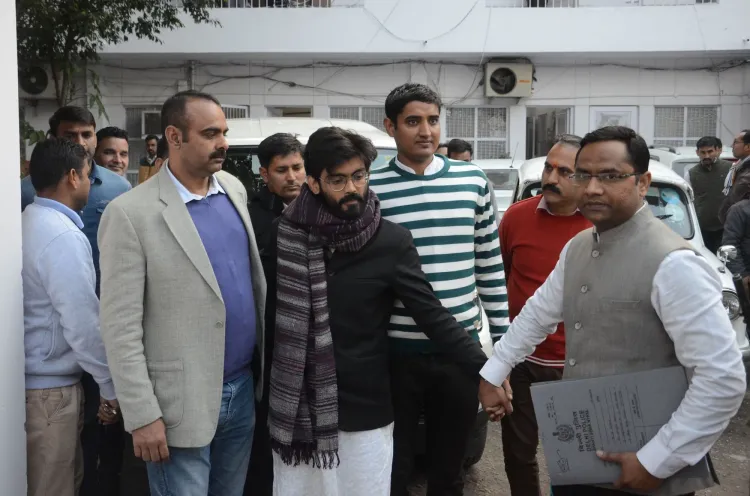
New Delhi, Jan 8 (NationPress) Activist Sharjeel Imam concluded his arguments before a Delhi court regarding the framing of charges in the purported ‘larger conspiracy’ case associated with the 2020 Northeast Delhi riots. He claimed he never endorsed violence nor coordinated with co-accused Umar Khalid.
While addressing Additional Sessions Judge (ASJ) Sameer Bajpai at Karkardooma Courts, Imam’s attorney Talib Mustafa argued that the prosecution failed to demonstrate any agreement or coordination between Imam and Khalid, which is essential to substantiate a charge of criminal conspiracy.
“Throughout my five years at JNU, I never interacted with Umar Khalid. I am unaware of the coordination they mention. To prove a conspiracy, an agreement must be shown, but they have not provided any evidence of such,” Imam's lawyer stated in court.
He further asserted that the claim that Khalid directed Imam was also untrue.
“There is only a single meeting where Umar and I appear together. However, even the witness testimony from that meeting indicates there was no dialogue about violence,” Mustafa explained.
The attorney further insisted that during the protests against the Citizenship Amendment Act (CAA) in 2019-20, Imam consistently advocated for non-violence and never incited violent protests.
“Their assertion is that I desired violence, riots, and bloodshed. However, none of my meetings discussed violence; I have always advocated for non-violence,” Mustafa declared.
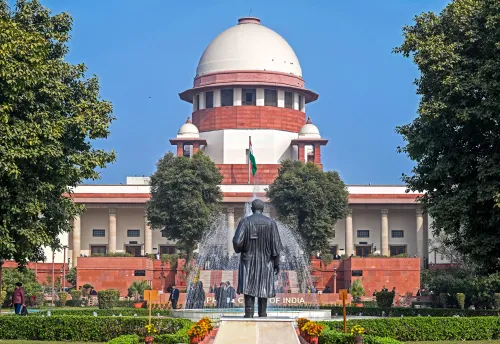
This development follows the Supreme Court's recent dismissal of bail applications from Imam and Khalid, affirming that the prosecution's evidence cumulatively indicated reasonable grounds for believing that the allegations against them were prima facie valid under Section 43D(5) of the Unlawful Activities (Prevention) Act (UAPA).
The Supreme Court remarked that “the appropriate judicial response should prioritize expediency rather than granting bail in disregard of the statutory mandate.”
“The solution for stagnation lies in careful judicial oversight and mandates for quick progress, not in granting bail where restrictions apply,” it added.
The Supreme Court urged the trial court to prioritize this matter and ensure proceedings are conducted with due urgency.
However, bail was granted to five other defendants in the case — Gulfisha Fatima, Meeran Haider, Shifa Ur Rehman, Mohd Saleem Khan, and Shadab Ahmed.
The Delhi Police has accused Imam, Khalid, and others of engaging in terrorism and conspiring to provoke violence during the city riots of 2020.
Following the conclusion of Imam's counsel's arguments at Karkardooma Courts, discussions from the other defendants are expected to commence next week.
Point of View
It is crucial to remain balanced, recognizing the complex nature of legal proceedings. The arguments presented by Sharjeel Imam and his counsel highlight a broader discourse on non-violence and political dissent. It is essential to observe how the judicial system navigates these allegations while ensuring fair treatment for all parties involved.
NationPress
10/01/2026
Frequently Asked Questions
What charges is Sharjeel Imam facing?
Sharjeel Imam faces charges related to a larger conspiracy linked to the 2020 Northeast Delhi riots, including accusations of inciting violence.
What is the stance of Sharjeel Imam regarding the allegations?
Sharjeel Imam maintains that he never supported violence and had no coordination with co-accused Umar Khalid.
What did the Supreme Court decide regarding bail for Imam and Khalid?
The Supreme Court dismissed the bail pleas of Sharjeel Imam and Umar Khalid, citing reasonable grounds for the accusations against them.
Who else has been granted bail in the case?
Bail was granted to five other accused: Gulfisha Fatima, Meeran Haider, Shifa Ur Rehman, Mohd Saleem Khan, and Shadab Ahmed.
When will the next arguments take place?
Arguments from the other accused in the case are expected to commence next week.